
OFFSET
0,3
COMMENTS
These were formerly sometimes called Segner numbers.
A very large number of combinatorial interpretations are known - see references, esp. R. P. Stanley, "Catalan Numbers", Cambridge University Press, 2015. This is probably the longest entry in the OEIS, and rightly so.
The solution to Schröder's first problem: number of ways to insert n pairs of parentheses in a word of n+1 letters. E.g., for n=2 there are 2 ways: ((ab)c) or (a(bc)); for n=3 there are 5 ways: ((ab)(cd)), (((ab)c)d), ((a(bc))d), (a((bc)d)), (a(b(cd))).
Consider all the binomial(2n,n) paths on squared paper that (i) start at (0, 0), (ii) end at (2n, 0) and (iii) at each step, either make a (+1,+1) step or a (+1,-1) step. Then the number of such paths that never go below the x-axis (Dyck paths) is C(n). [Chung-Feller]
Number of noncrossing partitions of the n-set. For example, of the 15 set partitions of the 4-set, only [{13},{24}] is crossing, so there are a(4)=14 noncrossing partitions of 4 elements. - Joerg Arndt, Jul 11 2011
a(n-1) is the number of ways of expressing an n-cycle (123...n) in the symmetric group S_n as a product of n-1 transpositions (u_1,v_1)*(u_2,v_2)*...*(u_{n-1},v_{n-1}) where u_i<v_i and u_k <= u_j for k < j; see example. If the condition is dropped, one obtains A000272. - Joerg Arndt and Greg Stevenson, Jul 11 2011
Noncrossing partitions are partitions of genus 0. - Robert Coquereaux, Feb 13 2024
a(n) is the number of ordered rooted trees with n nodes, not including the root. See the Conway-Guy reference where these rooted ordered trees are called plane bushes. See also the Bergeron et al. reference, Example 4, p. 167. - Wolfdieter Lang, Aug 07 2007
As shown in the paper from Beineke and Pippert (1971), a(n-2)=D(n) is the number of labeled dissections of a disk, related to the number R(n)=A001761(n-2) of labeled planar 2-trees having n vertices and rooted at a given exterior edge, by the formula D(n)=R(n)/(n-2)!. - M. F. Hasler, Feb 22 2012
Shifts one place left when convolved with itself.
For n >= 1, a(n) is also the number of rooted bicolored unicellular maps of genus 0 on n edges. - Ahmed Fares (ahmedfares(AT)my-deja.com), Aug 15 2001
Number of ways of joining 2n points on a circle to form n nonintersecting chords. (If no such restriction imposed, then the number of ways of forming n chords is given by (2n-1)!! = (2n)!/(n!*2^n) = A001147(n).)
Arises in Schubert calculus - see Sottile reference.
Inverse Euler transform of sequence is A022553.
With interpolated zeros, the inverse binomial transform of the Motzkin numbers A001006. - Paul Barry, Jul 18 2003
The Hankel transforms of this sequence or of this sequence with the first term omitted give A000012 = 1, 1, 1, 1, 1, 1, ...; example: Det([1, 1, 2, 5; 1, 2, 5, 14; 2, 5, 14, 42; 5, 14, 42, 132]) = 1 and Det([1, 2, 5, 14; 2, 5, 14, 42; 5, 14, 42, 132; 14, 42, 132, 429]) = 1. - Philippe Deléham, Mar 04 2004
a(n) equals the sum of squares of terms in row n of triangle A053121, which is formed from successive self-convolutions of the Catalan sequence. - Paul D. Hanna, Apr 23 2005
Also coefficients of the Mandelbrot polynomial M iterated an infinite number of times. Examples: M(0) = 0 = 0*c^0 = [0], M(1) = c = c^1 + 0*c^0 = [1 0], M(2) = c^2 + c = c^2 + c^1 + 0*c^0 = [1 1 0], M(3) = (c^2 + c)^2 + c = [0 1 1 2 1], ... ... M(5) = [0 1 1 2 5 14 26 44 69 94 114 116 94 60 28 8 1], ... - Donald D. Cross (cosinekitty(AT)hotmail.com), Feb 04 2005
The multiplicity with which a prime p divides C_n can be determined by first expressing n+1 in base p. For p=2, the multiplicity is the number of 1 digits minus 1. For p an odd prime, count all digits greater than (p+1)/2; also count digits equal to (p+1)/2 unless final; and count digits equal to (p-1)/2 if not final and the next digit is counted. For example, n=62, n+1 = 223_5, so C_62 is not divisible by 5. n=63, n+1 = 224_5, so 5^3 | C_63. - Franklin T. Adams-Watters, Feb 08 2006
Koshy and Salmassi give an elementary proof that the only prime Catalan numbers are a(2) = 2 and a(3) = 5. Is the only semiprime Catalan number a(4) = 14? - Jonathan Vos Post, Mar 06 2006
The answer is yes. Using the formula C_n = binomial(2n,n)/(n+1), it is immediately clear that C_n can have no prime factor greater than 2n. For n >= 7, C_n > (2n)^2, so it cannot be a semiprime. Given that the Catalan numbers grow exponentially, the above consideration implies that the number of prime divisors of C_n, counted with multiplicity, must grow without limit. The number of distinct prime divisors must also grow without limit, but this is more difficult. Any prime between n+1 and 2n (exclusive) must divide C_n. That the number of such primes grows without limit follows from the prime number theorem. - Franklin T. Adams-Watters, Apr 14 2006
The number of ways to place n indistinguishable balls in n numbered boxes B1,...,Bn such that at most a total of k balls are placed in boxes B1,...,Bk for k=1,...,n. For example, a(3)=5 since there are 5 ways to distribute 3 balls among 3 boxes such that (i) box 1 gets at most 1 ball and (ii) box 1 and box 2 together get at most 2 balls:(O)(O)(O), (O)()(OO), ()(OO)(O), ()(O)(OO), ()()(OOO). - Dennis P. Walsh, Dec 04 2006
a(n) is also the order of the semigroup of order-decreasing and order-preserving full transformations (of an n-element chain) - now known as the Catalan monoid. - Abdullahi Umar, Aug 25 2008
a(n) is the number of trivial representations in the direct product of 2n spinor (the smallest) representations of the group SU(2) (A(1)). - Rutger Boels (boels(AT)nbi.dk), Aug 26 2008
The invert transform appears to converge to the Catalan numbers when applied infinitely many times to any starting sequence. - Mats Granvik, Gary W. Adamson and Roger L. Bagula, Sep 09 2008, Sep 12 2008
Limit_{n->oo} a(n)/a(n-1) = 4. - Francesco Antoni (francesco_antoni(AT)yahoo.com), Nov 24 2008
Starting with offset 1 = row sums of triangle A154559. - Gary W. Adamson, Jan 11 2009
C(n) is the degree of the Grassmannian G(1,n+1): the set of lines in (n+1)-dimensional projective space, or the set of planes through the origin in (n+2)-dimensional affine space. The Grassmannian is considered a subset of N-dimensional projective space, N = binomial(n+2,2) - 1. If we choose 2n general (n-1)-planes in projective (n+1)-space, then there are C(n) lines that meet all of them. - Benji Fisher (benji(AT)FisherFam.org), Mar 05 2009
Starting with offset 1 = A068875: (1, 2, 4, 10, 18, 84, ...) convolved with Fine numbers, A000957: (1, 0, 1, 2, 6, 18, ...). a(6) = 132 = (1, 2, 4, 10, 28, 84) dot (18, 6, 2, 1, 0, 1) = (18 + 12 + 8 + 10 + 0 + 84) = 132. - Gary W. Adamson, May 01 2009
Convolved with A032443: (1, 3, 11, 42, 163, ...) = powers of 4, A000302: (1, 4, 16, ...). - Gary W. Adamson, May 15 2009
Sum_{k>=1} C(k-1)/2^(2k-1) = 1. The k-th term in the summation is the probability that a random walk on the integers (beginning at the origin) will arrive at positive one (for the first time) in exactly (2k-1) steps. - Geoffrey Critzer, Sep 12 2009
C(p+q)-C(p)*C(q) = Sum_{i=0..p-1, j=0..q-1} C(i)*C(j)*C(p+q-i-j-1). - Groux Roland, Nov 13 2009
Leonhard Euler used the formula C(n) = Product_{i=3..n} (4*i-10)/(i-1) in his 'Betrachtungen, auf wie vielerley Arten ein gegebenes polygonum durch Diagonallinien in triangula zerschnitten werden könne' and computes by recursion C(n+2) for n = 1..8. (Berlin, 4th September 1751, in a letter to Goldbach.) - Peter Luschny, Mar 13 2010
Let A179277 = A(x). Then C(x) is satisfied by A(x)/A(x^2). - Gary W. Adamson, Jul 07 2010
a(n) is also the number of quivers in the mutation class of type B_n or of type C_n. - Christian Stump, Nov 02 2010
From Matthew Vandermast, Nov 22 2010: (Start)
Consider a set of A000217(n) balls of n colors in which, for each integer k = 1 to n, exactly one color appears in the set a total of k times. (Each ball has exactly one color and is indistinguishable from other balls of the same color.) a(n+1) equals the number of ways to choose 0 or more balls of each color while satisfying the following conditions: 1. No two colors are chosen the same positive number of times. 2. For any two colors (c, d) that are chosen at least once, color c is chosen more times than color d iff color c appears more times in the original set than color d.
If the second requirement is lifted, the number of acceptable ways equals A000110(n+1). See related comments for A016098, A085082. (End)
Deutsch and Sagan prove the Catalan number C_n is odd if and only if n = 2^a - 1 for some nonnegative integer a. Lin proves for every odd Catalan number C_n, we have C_n == 1 (mod 4). - Jonathan Vos Post, Dec 09 2010
a(n) is the number of functions f:{1,2,...,n}->{1,2,...,n} such that f(1)=1 and for all n >= 1 f(n+1) <= f(n)+1. For a nice bijection between this set of functions and the set of length 2n Dyck words, see page 333 of the Fxtbook (see link below). - Geoffrey Critzer, Dec 16 2010
Postnikov (2005) defines "generalized Catalan numbers" associated with buildings (e.g., Catalan numbers of Type B, see A000984). - N. J. A. Sloane, Dec 10 2011
Number of permutations in S(n) for which length equals depth. - Bridget Tenner, Feb 22 2012
a(n) is also the number of standard Young tableau of shape (n,n). - Thotsaporn Thanatipanonda, Feb 25 2012
a(n) is the number of binary sequences of length 2n+1 in which the number of ones first exceed the number of zeros at entry 2n+1. See the example below in the example section. - Dennis P. Walsh, Apr 11 2012
Number of binary necklaces of length 2*n+1 containing n 1's (or, by symmetry, 0's). All these are Lyndon words and their representatives (as cyclic maxima) are the binary Dyck words. - Joerg Arndt, Nov 12 2012
Number of sequences consisting of n 'x' letters and n 'y' letters such that (counting from the left) the 'x' count >= 'y' count. For example, for n=3 we have xxxyyy, xxyxyy, xxyyxy, xyxxyy and xyxyxy. - Jon Perry, Nov 16 2012
a(n) is the number of Motzkin paths of length n-1 in which the (1,0)-steps come in 2 colors. Example: a(4)=14 because, denoting U=(1,1), H=(1,0), and D=(1,-1), we have 8 paths of shape HHH, 2 paths of shape UHD, 2 paths of shape UDH, and 2 paths of shape HUD. - José Luis Ramírez Ramírez, Jan 16 2013
If p is an odd prime, then (-1)^((p-1)/2)*a((p-1)/2) mod p = 2. - Gary Detlefs, Feb 20 2013
Conjecture: For any positive integer n, the polynomial Sum_{k=0..n} a(k)*x^k is irreducible over the field of rational numbers. - Zhi-Wei Sun, Mar 23 2013
a(n) is the size of the Jones monoid on 2n points (cf. A225798). - James Mitchell, Jul 28 2013
For 0 < p < 1, define f(p) = Sum_{n>=0} a(n)*(p*(1-p))^n, then f(p) = min{1/p, 1/(1-p)}, so f(p) reaches its maximum value 2 at p = 0.5, and p*f(p) is constant 1 for 0.5 <= p < 1. - Bob Selcoe, Nov 16 2013 [Corrected by Jianing Song, May 21 2021]
No a(n) has the form x^m with m > 1 and x > 1. - Zhi-Wei Sun, Dec 02 2013
From Alexander Adamchuk, Dec 27 2013: (Start)
Prime p divides a((p+1)/2) for p > 3. See A120303(n) = Largest prime factor of Catalan number.
Reciprocal Catalan Constant C = 1 + 4*sqrt(3)*Pi/27 = 1.80613.. = A121839.
Log(Phi) = (125*C - 55) / (24*sqrt(5)), where C = Sum_{k>=1} (-1)^(k+1)*1/a(k). See A002390 = Decimal expansion of natural logarithm of golden ratio.
3-d analog of the Catalan numbers: (3n)!/(n!(n+1)!(n+2)!) = A161581(n) = A006480(n) / ((n+1)^2*(n+2)), where A006480(n) = (3n)!/(n!)^3 De Bruijn's S(3,n). (End)
For a relation to the inviscid Burgers's, or Hopf, equation, see A001764. - Tom Copeland, Feb 15 2014
From Fung Lam, May 01 2014: (Start)
One class of generalized Catalan numbers can be defined by g.f. A(x) = (1-sqrt(1-q*4*x*(1-(q-1)*x)))/(2*q*x) with nonzero parameter q. Recurrence: (n+3)*a(n+2) -2*q*(2*n+3)*a(n+1) +4*q*(q-1)*n*a(n) = 0 with a(0)=1, a(1)=1.
Asymptotic approximation for q >= 1: a(n) ~ (2*q+2*sqrt(q))^n*sqrt(2*q*(1+sqrt(q))) /sqrt(4*q^2*Pi*n^3).
For q <= -1, the g.f. defines signed sequences with asymptotic approximation: a(n) ~ Re(sqrt(2*q*(1+sqrt(q)))*(2*q+2*sqrt(q))^n) / sqrt(q^2*Pi*n^3), where Re denotes the real part. Due to Stokes' phenomena, accuracy of the asymptotic approximation deteriorates at/near certain values of n.
(End)
Number of sequences [s(0), s(1), ..., s(n)] with s(n)=0, Sum_{j=0..n} s(j) = n, and Sum_{j=0..k} s(j)-1 >= 0 for k < n-1 (and necessarily Sum_{j=0..n-1} s(j)-1 = 0). These are the branching sequences of the (ordered) trees with n non-root nodes, see example. - Joerg Arndt, Jun 30 2014
Number of stack-sortable permutations of [n], these are the 231-avoiding permutations; see the Bousquet-Mélou reference. - Joerg Arndt, Jul 01 2014
a(n) is the number of increasing strict binary trees with 2n-1 nodes that avoid 132. For more information about increasing strict binary trees with an associated permutation, see A245894. - Manda Riehl, Aug 07 2014
In a one-dimensional medium with elastic scattering (zig-zag walk), first recurrence after 2n+1 scattering events has the probability C(n)/2^(2n+1). - Joachim Wuttke, Sep 11 2014
The o.g.f. C(x) = (1 - sqrt(1-4x))/2, for the Catalan numbers, with comp. inverse Cinv(x) = x*(1-x) and the functions P(x) = x / (1 + t*x) and its inverse Pinv(x,t) = -P(-x,t) = x / (1 - t*x) form a group under composition that generates or interpolates among many classic arrays, such as the Motzkin (Riordan, A005043), Fibonacci (A000045), and Fine (A000957) numbers and polynomials (A030528), and enumerating arrays for Motzkin, Dyck, and Łukasiewicz lattice paths and different types of trees and non-crossing partitions (A091867, connected to sums of the refined Narayana numbers A134264). - Tom Copeland, Nov 04 2014
Conjecture: All the rational numbers Sum_{i=j..k} 1/a(i) with 0 < min{2,k} <= j <= k have pairwise distinct fractional parts. - Zhi-Wei Sun, Sep 24 2015
The Catalan number series A000108(n+3), offset n=0, gives Hankel transform revealing the square pyramidal numbers starting at 5, A000330(n+2), offset n=0 (empirical observation). - Tony Foster III, Sep 05 2016
Hankel transforms of the Catalan numbers with the first 2, 4, and 5 terms omitted give A001477, A006858, and A091962, respectively, without the first 2 terms in all cases. More generally, the Hankel transform of the Catalan numbers with the first k terms omitted is H_k(n) = Product_{j=1..k-1} Product_{i=1..j} (2*n+j+i)/(j+i) [see Cigler (2011), Eq. (1.14) and references therein]; together they form the array A078920/A123352/A368025. - Andrey Zabolotskiy, Oct 13 2016
Presumably this satisfies Benford's law, although the results in Hürlimann (2009) do not make this clear. See S. J. Miller, ed., 2015, p. 5. - N. J. A. Sloane, Feb 09 2017
Coefficients of the generating series associated to the Magmatic and Dendriform operadic algebras. Cf. p. 422 and 435 of the Loday et al. paper. - Tom Copeland, Jul 08 2018
Let M_n be the n X n matrix with M_n(i,j) = binomial(i+j-1,2j-2); then det(M_n) = a(n). - Tony Foster III, Aug 30 2018
Also the number of Catalan trees, or planted plane trees (Bona, 2015, p. 299, Theorem 4.6.3). - N. J. A. Sloane, Dec 25 2018
Number of coalescent histories for a caterpillar species tree and a matching caterpillar gene tree with n+1 leaves (Rosenberg 2007, Corollary 3.5). - Noah A Rosenberg, Jan 28 2019
Finding solutions of eps*x^2+x-1 = 0 for eps small, that is, writing x = Sum_{n>=0} x_{n}*eps^n and expanding, one finds x = 1 - eps + 2*eps^2 - 5*eps^3 + 14*eps^3 - 42*eps^4 + ... with x_{n} = (-1)^n*C(n). Further, letting x = 1/y and expanding y about 0 to find large roots, that is, y = Sum_{n>=1} y_{n}*eps^n, one finds y = 0 - eps + eps^2 - 2*eps^3 + 5*eps^3 - ... with y_{n} = (-1)^n*C(n-1). - Derek Orr, Mar 15 2019
Permutations of length n that produce a bipartite permutation graph of order n [see Knuth (1973), Busch (2006), Golumbic and Trenk (2004)]. - Elise Anderson, R. M. Argus, Caitlin Owens, Tessa Stevens, Jun 27 2019
For n > 0, a random selection of n + 1 objects (the minimum number ensuring one pair by the pigeonhole principle) from n distinct pairs of indistinguishable objects contains only one pair with probability 2^(n-1)/a(n) = b(n-1)/A098597(n), where b is the 0-offset sequence with the terms of A120777 repeated (1,1,4,4,8,8,64,64,128,128,...). E.g., randomly selecting 6 socks from 5 pairs that are black, blue, brown, green, and white, results in only one pair of the same color with probability 2^(5-1)/a(5) = 16/42 = 8/21 = b(4)/A098597(5). - Rick L. Shepherd, Sep 02 2019
See Haran & Tabachnikov link for a video discussing Conway-Coxeter friezes. The Conway-Coxeter friezes with n nontrivial rows are generated by the counts of triangles at each vertex in the triangulations of regular n-gons, of which there are a(n). - Charles R Greathouse IV, Sep 28 2019
For connections to knot theory and scattering amplitudes from Feynman diagrams, see Broadhurst and Kreimer, and Todorov. Eqn. 6.12 on p. 130 of Bessis et al. becomes, after scaling, -12g * r_0(-y/(12g)) = (1-sqrt(1-4y))/2, the o.g.f. (expressed as a Taylor series in Eqn. 7.22 in 12gx) given for the Catalan numbers in Copeland's (Sep 30 2011) formula below. (See also Mizera p. 34, Balduf pp. 79-80, Keitel and Bartosch.) - Tom Copeland, Nov 17 2019
Number of permutations in S_n whose principal order ideals in the weak order are modular lattices. - Bridget Tenner, Jan 16 2020
Number of permutations in S_n whose principal order ideals in the weak order are distributive lattices. - Bridget Tenner, Jan 16 2020
Legendre gives the following formula for computing the square root modulo 2^m:
sqrt(1 + 8*a) mod 2^m = (1 + 4*a*Sum_{i=0..m-4} C(i)*(-2*a)^i) mod 2^m
as cited by L. D. Dickson, History of the Theory of Numbers, Vol. 1, 207-208. - Peter Schorn, Feb 11 2020
a(n) is the number of length n permutations sorted to the identity by a consecutive-132-avoiding stack followed by a classical-21-avoiding stack. - Kai Zheng, Aug 28 2020
Number of non-crossing partitions of a 2*n-set with n blocks of size 2. Also number of non-crossing partitions of a 2*n-set with n+1 blocks of size at most 3, and without cyclical adjacencies. The two partitions can be mapped by rotated Kreweras bijection. - Yuchun Ji, Jan 18 2021
Named by Riordan (1968, and earlier in Mathematical Reviews, 1948 and 1964) after the French and Belgian mathematician Eugène Charles Catalan (1814-1894) (see Pak, 2014). - Amiram Eldar, Apr 15 2021
For n >= 1, a(n-1) is the number of interpretations of x^n is an algebra where power-associativity is not assumed. For example, for n = 4 there are a(3) = 5 interpretations: x(x(xx)), x((xx)x), (xx)(xx), (x(xx))x, ((xx)x)x. See the link "Non-associate powers and a functional equation" from I. M. H. Etherington and the page "Nonassociative Product" from Eric Weisstein's World of Mathematics for detailed information. See also A001190 for the case where multiplication is commutative. - Jianing Song, Apr 29 2022
Number of states in the transition diagram associated with the Laplacian system over the complete graph K_N, corresponding to ordered initial conditions x_1 < x_2 < ... < x_N. - Andrea Arlette España, Nov 06 2022
a(n) is the number of 132-avoiding stabilized-interval-free permutations of size n+1. - Juan B. Gil, Jun 22 2023
Number of rooted polyominoes composed of n triangular cells of the hyperbolic regular tiling with Schläfli symbol {3,oo}. A rooted polyomino has one external edge identified, and chiral pairs are counted as two. A stereographic projection of the {3,oo} tiling on the Poincaré disk can be obtained via the Christensson link. - Robert A. Russell, Jan 27 2024
a(n) is the number of extremely lucky Stirling permutations of order n; i.e., the number of Stirling permutations of order n that have exactly n lucky cars. (see Colmenarejo et al. reference) - Bridget Tenner, Apr 16 2024
REFERENCES
The large number of references and links demonstrates the ubiquity of the Catalan numbers.
R. Alter, Some remarks and results on Catalan numbers, pp. 109-132 in Proceedings of the Louisiana Conference on Combinatorics, Graph Theory and Computer Science. Vol. 2, edited R. C. Mullin et al., 1971.
Miklos Bona, editor, Handbook of Enumerative Combinatorics, CRC Press, 2015, many references.
L. Comtet, Advanced Combinatorics, Reidel, 1974, p. 53.
J. H. Conway and R. K. Guy, The Book of Numbers, New York: Springer-Verlag, 1995, ch. 4, pp. 96-106.
S. J. Cyvin and I. Gutman, Kekulé structures in benzenoid hydrocarbons, Lecture Notes in Chemistry, No. 46, Springer, New York, 1988 (see pp. 183, 196, etc.).
Michael Dairyko, Samantha Tyner, Lara Pudwell, and Casey Wynn, Non-contiguous pattern avoidance in binary trees. Electron. J. Combin. 19 (2012), no. 3, Paper 22, 21 pp. MR2967227.
E. Deutsch, Dyck path enumeration, Discrete Math., 204, 167-202, 1999.
E. Deutsch and L. Shapiro, Seventeen Catalan identities, Bulletin of the Institute of Combinatorics and its Applications, 31, 31-38, 2001.
L. E. Dickson, History of the Theory of Numbers. Carnegie Institute Public. 256, Washington, DC, Vol. 1, 1919; Vol. 2, 1920; Vol. 3, 1923, see vol. 1, 207-208.
Tomislav Doslic and Darko Veljan, Logarithmic behavior of some combinatorial sequences. Discrete Math. 308 (2008), no. 11, 2182-2212. MR2404544 (2009j:05019)
S. Dulucq and J.-G. Penaud, Cordes, arbres et permutations. Discrete Math. 117 (1993), no. 1-3, 89-105.
A. Errera, Analysis situs - Un problème d'énumération, Mémoires Acad. Bruxelles, Classe des sciences, Série 2, Vol. XI, Fasc. 6, No. 1421 (1931), 26 pp.
Ehrenfeucht, Andrzej; Haemer, Jeffrey; Haussler, David. Quasimonotonic sequences: theory, algorithms and applications. SIAM J. Algebraic Discrete Methods 8 (1987), no. 3, 410-429. MR0897739 (88h:06026)
I. M. H. Etherington, Non-associate powers and a functional equation. The Mathematical Gazette, 21 (1937): 36-39; addendum 21 (1937), 153.
I. M. H. Etherington, On non-associative combinations, Proc. Royal Soc. Edinburgh, 59 (Part 2, 1938-39), 153-162.
I. M. H. Etherington, Some problems of non-associative combinations (I), Edinburgh Math. Notes, 32 (1940), pp. i-vi. Part II is by A. Erdelyi and I. M. H. Etherington, and is on pages vii-xiv of the same issue.
K. Fan, Structure of a Hecke algebra quotient, J. Amer. Math. Soc., 10 (1997), 139-167.
Susanna Fishel, Myrto Kallipoliti and Eleni Tzanaki, Facets of the Generalized Cluster Complex and Regions in the Extended Catalan Arrangement of Type A, The electronic Journal of Combinatorics 20(4) (2013), #P7.
D. Foata and D. Zeilberger, A classic proof of a recurrence for a very classical sequence, J. Comb Thy A 80 380-384 1997.
H. G. Forder, Some problems in combinatorics, Math. Gazette, vol. 45, 1961, 199-201.
Fürlinger, J.; Hofbauer, J., q-Catalan numbers. J. Combin. Theory Ser. A 40 (1985), no. 2, 248-264. MR0814413 (87e:05017)
M. Gardner, Time Travel and Other Mathematical Bewilderments, Chap. 20 pp. 253-266, W. H. Freeman NY 1988.
James Gleick, Faster, Vintage Books, NY, 2000 (see pp. 259-261).
M. C. Golumbic and A. N. Trenk, Tolerance graphs, Vol. 89, Cambridge University Press, 2004, pp. 32.
S Goodenough, C Lavault, Overview on Heisenberg—Weyl Algebra and Subsets of Riordan Subgroups, The Electronic Journal of Combinatorics, 22(4) (2015), #P4.16,
H. W. Gould, Research bibliography of two special number sequences, Mathematica Monongaliae, Vol. 12, 1971.
D. Gouyou-Beauchamps, Chemins sous-diagonaux et tableau de Young, pp. 112-125 of "Combinatoire Enumerative (Montreal 1985)", Lect. Notes Math. 1234, 1986.
M. Griffiths, The Backbone of Pascal's Triangle, United Kingdom Mathematics Trust (2008), 53-63 and 85-93.
J. L. Gross and J. Yellen, eds., Handbook of Graph Theory, CRC Press, 2004; p. 530.
N. S. S. Gu, N. Y. Li and T. Mansour, 2-Binary trees: bijections and related issues, Discr. Math., 308 (2008), 1209-1221.
R. K. Guy, Dissecting a polygon into triangles, Research Paper #9, Math. Dept., Univ. Calgary, 1967.
R. K. Guy and J. L. Selfridge, The nesting and roosting habits of the laddered parenthesis. Amer. Math. Monthly 80 (1973), 868-876.
Peter Hajnal and Gabor V. Nagy, A bijective proof of Shapiro's Catalan convolution, Elect. J. Combin., 21 (2014), #P2.42.
F. Harary and E. M. Palmer, Graphical Enumeration, Academic Press, NY, 1973, p. 67, (3.3.23).
F. Harary, G. Prins, and W. T. Tutte, The number of plane trees. Indag. Math. 26, 319-327, 1964.
J. Harris, Algebraic Geometry: A First Course (GTM 133), Springer-Verlag, 1992, pages 245-247.
S. Heubach, N. Y. Li and T. Mansour, Staircase tilings and k-Catalan structures, Discrete Math., 308 (2008), 5954-5964.
Silvia Heubach and Toufik Mansour, Combinatorics of Compositions and Words, CRC Press, 2010.
Higgins, Peter M. Combinatorial results for semigroups of order-preserving mappings. Math. Proc. Camb. Phil. Soc. (1993), 113: 281-296.
B. D. Hughes, Random Walks and Random Environments, Oxford 1995, vol. 1, p. 513, Eq. (7.282).
F. Hurtado, M. Noy, Ears of triangulations and Catalan numbers, Discrete Mathematics, Volume 149, Issues 1-3, Feb 22 1996, Pages 319-324.
M. Janjic, Determinants and Recurrence Sequences, Journal of Integer Sequences, 2012, Article 12.3.5.
R. H. Jeurissen, Raney and Catalan, Discrete Math., 308 (2008), 6298-6307.
M. Kauers and P. Paule, The Concrete Tetrahedron, Springer 2011, p. 36.
Kim, Ki Hang; Rogers, Douglas G.; Roush, Fred W. Similarity relations and semiorders. Proceedings of the Tenth Southeastern Conference on Combinatorics, Graph Theory and Computing (Florida Atlantic Univ., Boca Raton, Fla., 1979), pp. 577-594, Congress. Numer., XXIII-XXIV, Utilitas Math., Winnipeg, Man., 1979. MR0561081 (81i:05013)
Klarner, D. A. A Correspondence Between Sets of Trees. Indag. Math. 31, 292-296, 1969.
M. Klazar, On numbers of Davenport-Schinzel sequences, Discr. Math., 185 (1998), 77-87.
D. E. Knuth, The Art of Computer Programming, 2nd Edition, Vol. 1, Addison-Wesley, 1973, pp. 238.
D. E. Knuth, The Art of Computer Programming, vol. 4A, Combinatorial Algorithms, Section 7.2.1.6 (p. 450).
Thomas Koshy and Mohammad Salmassi, "Parity and Primality of Catalan Numbers", College Mathematics Journal, Vol. 37, No. 1 (Jan 2006), pp. 52-53.
M. Kosters, A theory of hexaflexagons, Nieuw Archief Wisk., 17 (1999), 349-362.
E. Krasko, A. Omelchenko, Brown's Theorem and its Application for Enumeration of Dissections and Planar Trees, The Electronic Journal of Combinatorics, 22 (2015), #P1.17.
C. Krishnamachary and M. Bheemasena Rao, Determinants whose elements are Eulerian, prepared Bernoullian and other numbers, J. Indian Math. Soc., 14 (1922), 55-62, 122-138 and 143-146.
P. Lafar and C. T. Long, A combinatorial problem, Amer. Math. Mnthly, 69 (1962), 876-883.
Laradji, A. and Umar, A. On certain finite semigroups of order-decreasing transformations I, Semigroup Forum 69 (2004), 184-200.
P. J. Larcombe, On pre-Catalan Catalan numbers: Kotelnikow (1766), Mathematics Today, 35 (1999), p. 25.
P. J. Larcombe, On the history of the Catalan numbers: a first record in China, Mathematics Today, 35 (1999), p. 89.
P. J. Larcombe, The 18th century Chinese discovery of the Catalan numbers, Math. Spectrum, 32 (1999/2000), 5-7.
P. J. Larcombe and P. D. C. Wilson, On the trail of the Catalan sequence, Mathematics Today, 34 (1998), 114-117.
P. J. Larcombe and P. D. C. Wilson, On the generating function of the Catalan sequence: a historical perspective, Congress. Numer., 149 (2001), 97-108.
G. S. Lueker, Some techniques for solving recurrences, Computing Surveys, 12 (1980), 419-436.
J. J. Luo, Antu Ming, the first inventor of Catalan numbers in the world [in Chinese], Neimenggu Daxue Xuebao, 19 (1998), 239-245.
C. L. Mallows, R. J. Vanderbei, Which Young Tableaux Can Represent an Outer Sum?, Journal of Integer Sequences, Vol. 18, 2015, #15.9.1.
Toufik Mansour, Matthias Schork, and Mark Shattuck, Catalan numbers and pattern restricted set partitions. Discrete Math. 312(2012), no. 20, 2979-2991. MR2956089
Toufik Mansour and Simone Severini, Enumeration of (k,2)-noncrossing partitions, Discrete Math., 308 (2008), 4570-4577.
M. E. Mays and Jerzy Wojciechowski, A determinant property of Catalan numbers. Discrete Math. 211, No. 1-3, 125-133 (2000). Zbl 0945.05037
D. Merlini, R. Sprugnoli and M. C. Verri, The tennis ball problem, J. Combin. Theory, A 99 (2002), 307-344.
A. Milicevic and N. Trinajstic, "Combinatorial Enumeration in Chemistry", Chem. Modell., Vol. 4, (2006), pp. 405-469.
Miller, Steven J., ed. Benford's Law: Theory and Applications. Princeton University Press, 2015.
David Molnar, "Wiggly Games and Burnside's Lemma", Chapter 8, The Mathematics of Various Entertaining Subjects: Volume 3 (2019), Jennifer Beineke & Jason Rosenhouse, eds. Princeton University Press, Princeton and Oxford, p. 102.
C. O. Oakley and R. J. Wisner, Flexagons, Amer. Math. Monthly, 64 (1957), 143-154.
A. Panholzer and H. Prodinger, Bijections for ternary trees and non-crossing trees, Discrete Math., 250 (2002), 181-195 (see Eq. 4).
Papoulis, Athanasios. "A new method of inversion of the Laplace transform."Quart. Appl. Math 14.405-414 (1957): 124.
S. G. Penrice, Stacks, bracketings and CG-arrangements, Math. Mag., 72 (1999), 321-324.
C. A. Pickover, Wonders of Numbers, Chap. 71, Oxford Univ. Press NY 2000.
Clifford A. Pickover, A Passion for Mathematics, Wiley, 2005; see p. 71.
G. Pólya, On the number of certain lattice polygons. J. Combinatorial Theory 6 1969 102-105. MR0236031 (38 #4329)
C. Pomerance, Divisors of the middle binomial coefficient, Amer. Math. Monthly, 112 (2015), 636-644.
Jocelyn Quaintance and Harris Kwong, A combinatorial interpretation of the Catalan and Bell number difference tables, Integers, 13 (2013), #A29.
Ronald C. Read, "The Graph Theorists who Count -- and What They Count", in 'The Mathematical Gardner', in D. A. Klarner, Ed., pp. 331-334, Wadsworth CA 1989.
J. Riordan, Combinatorial Identities, Wiley, 1968, p. 101.
J. Riordan, The distribution of crossings of chords joining pairs of 2n points on a circle, Math. Comp., 29 (1975), 215-222.
T. Santiago Costa Oliveira, "Catalan traffic" and integrals on the Grassmannian of lines, Discr. Math., 308 (2007), 148-152.
A. Sapounakis, I. Tasoulas and P. Tsikouras, Counting strings in Dyck paths, Discrete Math., 307 (2007), 2909-2924.
E. Schröder, Vier combinatorische Probleme, Z. f. Math. Phys., 15 (1870), 361-376.
Shapiro, Louis W. Catalan numbers and "total information" numbers. Proceedings of the Sixth Southeastern Conference on Combinatorics, Graph Theory, and Computing (Florida Atlantic Univ., Boca Raton, Fla., 1975), pp. 531-539. Congressus Numerantium, No. XIV, Utilitas Math., Winnipeg, Man., 1975. MR0398853 (53 #2704).
L. W. Shapiro, A short proof of an identity of Touchard's concerning Catalan numbers, J. Combin. Theory, A 20 (1976), 375-376.
L. W. Shapiro and C. J. Wang, Generating identities via 2 X 2 matrices, Congressus Numerantium, 205 (2010), 33-46.
L. W. Shapiro, W.-J. Woan and S. Getu, The Catalan numbers via the World Series, Math. Mag., 66 (1993), 20-22.
D. M. Silberger, Occurrences of the integer (2n-2)!/n!(n-1)!, Roczniki Polskiego Towarzystwa Math. 13 (1969): 91-96.
N. J. A. Sloane, A Handbook of Integer Sequences, Academic Press, 1973 (includes this sequence).
N. J. A. Sloane and Simon Plouffe, The Encyclopedia of Integer Sequences, Academic Press, 1995 (includes this sequence).
S. Snover and S. Troyer, Multidimensional Catalan numbers, Abstracts 848-05-94 and 848-05-95, 848th Meeting, Amer. Math. Soc., Worcester Mass., March 15-16, 1989.
Solomon, A. Catalan monoids, monoids of local endomorphisms and their presentations. Semigroup Forum 53 (1996), 351-368.
R. P. Stanley, Enumerative Combinatorics, Wadsworth, Vol. 1, 1986, Vol. 2, 1999; see especially Chapter 6.
R. P. Stanley, Recent Progress in Algebraic Combinatorics, Bull. Amer. Math. Soc., 40 (2003), 55-68.
Richard P. Stanley, "Catalan Numbers", Cambridge University Press, 2015.
J. J. Sylvester, On reducible cyclodes, Coll. Math. Papers, Vol. 2, see especially page 670, where Catalan numbers appear.
Thiel, Marko. "A new cyclic sieving phenomenon for Catalan objects." Discrete Mathematics 340.3 (2017): 426-429.
I. Vun and P. Belcher, Catalan numbers, Mathematical Spectrum, 30 (1997/1998), 3-5.
D. Wells, Penguin Dictionary of Curious and Interesting Numbers, Entry 42 p 121, Penguin Books, 1987.
D. B. West, Combinatorial Mathematics, Cambridge, 2021, p. 41.
J. Wuttke, The zig-zag walk with scattering and absorption on the real half line and in a lattice model, J. Phys. A 47 (2014), 215203, 1-9.
LINKS
Robert G. Wilson v, Table of n, a(n) for n = 0..1000 (first 200 terms from N. J. A. Sloane, first 351 from K. D. Bajpai)
James Abello, The weak Bruhat order of S_Sigma, consistent sets, and Catalan numbers, SIAM J. Discrete Math. 4 (1991), 1-16.
Marco Abrate, Stefano Barbero, Umberto Cerruti and Nadir Murru, Colored compositions, Invert operator and elegant compositions with the "black tie", Discrete Mathematics, 335 (2014), 1-7.
M. Aigner, Enumeration via ballot numbers, Discrete Mathematics, Vol. 308, No. 12 (2008), 2544-2563.
R. Alter and K. K. Kubota, Prime and prime power divisibility of Catalan numbers, Journal of Combinatorial Theory, Series A, Vol. 15, No. 3 (1973), 243-256.
M. J. H. Al-Kaabi, D. Manchon and F. Patras, Chapter 2 of Monomial bases and pre-Lie structure for free Lie algebras, arXiv:1708.08312 [math.RA], 2017, See p. 3.
P. C. Allaart and K. Kawamura, The Takagi function: a survey, Real Analysis Exchange, 37 (2011/12), 1-54; arXiv:1110.1691 [math.CA]. See Section 3.2.
N. Alon, Y. Caro and I. Krasikov, Bisection of trees and sequences, Discrete Math., 114 (1993), 3-7. (See Lemma 2.1.)
G. Alvarez, J. E. Bergner and R. Lopez, Action graphs and Catalan numbers, arXiv preprint arXiv:1503.00044 [math.CO], 2015.
George E. Andrews, Catalan numbers, q-Catalan numbers and hypergeometric series, Journal of Combinatorial Theory, Series A, Vol. 44, No. 2 (1987), 267-273.
Federico Ardila, Catalan Numbers, 2016.
Drew Armstrong, Generalized Noncrossing Partitions and Combinatorics of Coxeter Groups, Mem. Amer. Math. Soc. 202 (2009), no. 949, x+159. MR 2561274 16; See Table 2.8. Also arXiv:math/0611106, 2006-2007.
Joerg Arndt, Matters Computational (The Fxtbook), p. 333 and p. 337.
Joerg Arndt, The a(5)=42 Young tableaux of shape [5,5].
Yu Hin (Gary) Au, Fatemeh Bagherzadeh, Murray R. Bremner, Enumeration and Asymptotic Formulas for Rectangular Partitions of the Hypercube, arXiv:1903.00813 [math.CO], 2019.
Yu Hin Au, Some Properties and Combinatorial Implications of Weighted Small Schröder Numbers, arXiv:1912.00555 [math.CO], 2019.
Jean-Christophe Aval, Multivariate Fuss-Catalan numbers, arXiv:0711.0906v1, Discrete Math., 308 (2008), 4660-4669.
M. Azaola and F. Santos, The number of triangulations of the cyclic polytope C(n,n-4), Discrete Comput. Geom., 27 (2002), 29-48. (C(n) = number of triangulations of cyclic polytope C(n,2).)
R. Bacher and C. Krattenthaler, Chromatic statistics for triangulations and Fuss-Catalan complexes, Electronic Journal of Combinatorics, Vol. 18, No. 1 (2011), #P152.
D. F. Bailey, Counting Arrangements of 1's and -1's, Mathematics Magazine 69(2) 128-131 1996.
I. Bajunaid et al., Function Series, Catalan Numbers, and Random Walks on Trees, The American Mathematical Monthly, Vol. 112, No. 9 (2005), 765-785.
P. Balduf, The propagator and diffeomorphisms of an interacting field theory, Master's thesis, submitted to the Institut für Physik, Mathematisch-Naturwissenschaftliche Fakultät, Humboldt-Universität, Berlin, 2018.
C. Banderier, M. Bousquet-Mélou, A. Denise, P. Flajolet, D. Gardy and D. Gouyou-Beauchamps, Generating Functions for Generating Trees, Discrete Mathematics 246(1-3), March 2002, pp. 29-55.
C. Banderier, M. Bousquet-Mélou, A. Denise, P. Flajolet, D. Gardy and D. Gouyou-Beauchamps, INRIA report 3661, preprint for FPSAC 99, Generating Functions for Generating Trees, Discrete Mathematics 246(1-3), March 2002, pp. 29-55.
C. Banderier, C. Krattenthaler, A. Krinik, D. Kruchinin, V. Kruchinin, D. Nguyen, and M. Wallner, Explicit formulas for enumeration of lattice paths: basketball and the kernel method, arXiv preprint arXiv:1609.06473 [math.CO], 2016.
Mohamed Barakat, Reimer Behrends, Christopher Jefferson, Lukas Kühne and Martin Leuner, On the generation of rank 3 simple matroids with an application to Terao's freeness conjecture, arXiv:1907.01073 [math.CO], 2019.
S. Barbero, U. Cerruti and N. Murru, A Generalization of the Binomial Interpolated Operator and its Action on Linear Recurrent Sequences, J. Int. Seq. 13 (2010) # 10.9.7, theorem 17.
E. Barcucci, A. Del Lungo, E. Pergola and R. Pinzani, Permutations avoiding an increasing number of length-increasing forbidden subsequences, Discrete Mathematics and Theoretical Computer Science 4, 2000, 31-44.
E. Barcucci, A. Del Lungo, E. Pergola and R. Pinzani, Some permutations with forbidden subsequences and their inversion number, Discrete Mathematics, Vol. 234, No. 1-3 (2001), 1-15.
E. Barcucci, A. Frosini and S. Rinaldi, On directed-convex polyominoes in a rectangle, Discrete Mathematics, Vol. 298, No. 1-3 (2005), 62-78.
Jean-Luc Baril, Classical sequences revisited with permutations avoiding dotted pattern, Electronic Journal of Combinatorics, 18 (2011), #P178.
Jean-Luc Baril, Avoiding patterns in irreducible permutations, Discrete Mathematics and Theoretical Computer Science, Vol 17, No 3 (2016).
Jean-Luc Baril, David Bevan and Sergey Kirgizov, Bijections between directed animals, multisets and Grand-Dyck paths, arXiv:1906.11870 [math.CO], 2019.
Jean-Luc Baril, C. Khalil and V. Vajnovszki, Catalan and Schröder permutations sortable by two restricted stacks, arXiv:2004.01812 [cs.DM], 2020.
Jean-Luc Baril, Sergey Kirgizov and Armen Petrossian, Motzkin paths with a restricted first return decomposition, Integers (2019) Vol. 19, A46.
Jean-Luc Baril, Sergey Kirgizov, José L. Ramírez, and Diego Villamizar, The Combinatorics of Motzkin Polyominoes, arXiv:2401.06228 [math.CO], 2024. See page 1.
Jean-Luc Baril, Sergey Kirgizov and Vincent Vajnovszki, Descent distribution on Catalan words avoiding a pattern of length at most three, arXiv:1803.06706 [math.CO], 2018.
Jean-Luc Baril, T. Mansour and A. Petrossian, Equivalence classes of permutations modulo excedances, 2014.
Jean-Luc Baril and J.-M. Pallo, Motzkin subposet and Motzkin geodesics in Tamari lattices, 2013.
Jean-Luc Baril and Armen Petrossian, Equivalence classes of Dyck paths modulo some statistics, Discrete Mathematics, Vol. 338, No. 4 (2015), 655-660.
Marilena Barnabei, Flavio Bonetti, and Niccolò Castronuovo, Motzkin and Catalan Tunnel Polynomials, J. Int. Seq., Vol. 21 (2018), Article 18.8.8.
Paul Barry, A Catalan Transform and Related Transformations on Integer Sequences, Journal of Integer Sequences, Vol. 8 (2005), Article 05.4.5.
Paul Barry, On Integer-Sequence-Based Constructions of Generalized Pascal Triangles, Journal of Integer Sequences, Vol. 9 (2006), Article 06.2.4.
Paul Barry, Generalized Catalan Numbers, Hankel Transforms and Somos-4 Sequences , J. Int. Seq. 13 (2010) #10.7.2.
Paul Barry, Three Études on a sequence transformation pipeline, arXiv:1803.06408 [math.CO], 2018.
Paul Barry, Generalized Eulerian Triangles and Some Special Production Matrices, arXiv:1803.10297 [math.CO], 2018.
Paul Barry, Riordan arrays, generalized Narayana triangles, and series reversion, Linear Algebra and its Applications, 491 (2016), 343-385.
Paul Barry, The Gamma-Vectors of Pascal-like Triangles Defined by Riordan Arrays, arXiv:1804.05027 [math.CO], 2018.
Paul Barry and A. Hennessy, The Euler-Seidel Matrix, Hankel Matrices and Moment Sequences, J. Int. Seq. 13 (2010) # 10.8.2
Paul Barry, Invariant number triangles, eigentriangles and Somos-4 sequences, arXiv:1107.5490 [math.CO], 2011.
Paul Barry, Riordan Pseudo-Involutions, Continued Fractions and Somos 4 Sequences, arXiv:1807.05794 [math.CO], 2018.
Paul Barry, The Central Coefficients of a Family of Pascal-like Triangles and Colored Lattice Paths, J. Int. Seq., Vol. 22 (2019), Article 19.1.3.
Paul Barry, Generalized Catalan Numbers Associated with a Family of Pascal-like Triangles, J. Int. Seq., Vol. 22 (2019), Article 19.5.8.
Paul Barry, Generalized Catalan recurrences, Riordan arrays, elliptic curves, and orthogonal polynomials, arXiv:1910.00875 [math.CO], 2019.
Paul Barry, A Note on Riordan Arrays with Catalan Halves, arXiv:1912.01124 [math.CO], 2019.
Paul Barry, Riordan arrays, the A-matrix, and Somos 4 sequences, arXiv:1912.01126 [math.CO], 2019.
Paul Barry, Chebyshev moments and Riordan involutions, arXiv:1912.11845 [math.CO], 2019.
Paul Barry, Characterizations of the Borel triangle and Borel polynomials, arXiv:2001.08799 [math.CO], 2020.
A. M. Baxter and L. K. Pudwell, Ascent sequences avoiding pairs of patterns, 2014.
Margaret Bayer and Keith Brandt, The Pill Problem, Lattice Paths and Catalan Numbers, preprint, Mathematics Magazine, Vol. 87, No. 5 (December 2014), pp. 388-394.
Christian Bean, A. Claesson and H. Ulfarsson, Simultaneous Avoidance of a Vincular and a Covincular Pattern of Length 3, arXiv preprint arXiv:1512.03226 [math.CO], 2015.
Nicholas R. Beaton, Mathilde Bouvel, Veronica Guerrini and Simone Rinaldi, Enumerating five families of pattern-avoiding inversion sequences; and introducing the powered Catalan numbers, arXiv:1808.04114 [math.CO], 2018.
L. W. Beineke and R. E. Pippert, Enumerating labeled k-dimensional trees and ball dissections, pp. 12-26 of Proceedings of Second Chapel Hill Conference on Combinatorial Mathematics and its Applications, University of North Carolina, Chapel Hill, 1970. Reprinted in Math. Annalen 191 (1971), 87-98.
E. T. Bell, The Iterated Exponential Integers, Annals of Mathematics, Vol. 39, No. 3 (1938), 539-557.
Maciej Bendkowski and Pierre Lescanne, Combinatorics of explicit substitutions, arXiv:1804.03862 [cs.LO], 2018.
Matthew Bennett, Vyjayanthi Chari, R. J. Dolbin and Nathan Manning, Square partitions and Catalan numbers, arXiv:0912.4983 [math.RT], 2009.
F. Bergeron, G. Labelle and P. Leroux, Combinatorial Species and Tree-like Structures, Encyclopedia of Mathematics and its Applications 67 (1997), see pp. 163, 167, 168, 252, 256, 291.
Julia E. Bergner, Cedric Harper, Ryan Keller and Mathilde Rosi-Marshall, Action graphs, planar rooted forests, and self-convolutions of the Catalan numbers, arXiv:1807.03005 [math.CO], 2018.
E. E. Bernard and P. D. A. Mole, Generating strategies for continuous separation processes, Computer J., 2 (1959), 87-89. [Annotated scanned copy]
E. E. Bernard and P. D. A. Mole, Generating Strategies for Continuous Separation Processes, The Computer Journal, Vol. 2, No. 2 (1959), 87-89.
F. R. Bernhart, Catalan, Motzkin and Riordan numbers, Discrete Mathematics, Vol. 204, No. 1-3 (1999), 73-112.
A. Bernini, F. Disanto, R. Pinzani and S. Rinaldi, Permutations Defining Convex Permutominoes, Journal of Integer Sequences 10 (2007), Article 07.9.7.
M. Bernstein and N. J. A. Sloane, Some canonical sequences of integers, Linear Alg. Applications, 226-228 (1995), 57-72; erratum 320 (2000), 210. [Link to arXiv version]
M. Bernstein and N. J. A. Sloane, Some canonical sequences of integers, Linear Alg. Applications, 226-228 (1995), 57-72; erratum 320 (2000), 210. [Link to Lin. Alg. Applic. version together with omitted figures].
D. Bessis, C. Itzykson, and J. B. Zuber, Quantum Field Theory Techniques in Graphical Enumeration, Adv. in Applied Math., Vol. I, Issue 3, Jun 1980, p. 109-157.
D. Birmajer, J. B. Gil, J. O. Tirrell, and M. D. Weiner, Pattern-avoiding stabilized-interval-free permutations, arXiv:2306.03155 [math.CO], 2023.
Aubrey Blecher, Charlotte Brennan and Arnold Knopfmacher, Water capacity of Dyck paths, Advances in Applied Mathematics (2019) Vol. 112, 101945.
Natasha Blitvić and Einar Steingrímsson, Permutations, moments, measures, arXiv:2001.00280 [math.CO], 2020.
Miklós Bóna, Surprising Symmetries in Objects Counted by Catalan Numbers, Electronic J. Combin., 19 (2012), P62.
M. Bona and B. E. Sagan, On Divisibility of Narayana Numbers by Primes, Journal of Integer Sequences 8 (2005), Article 05.2.4.
H. Bottomley, Catalan Space Invaders

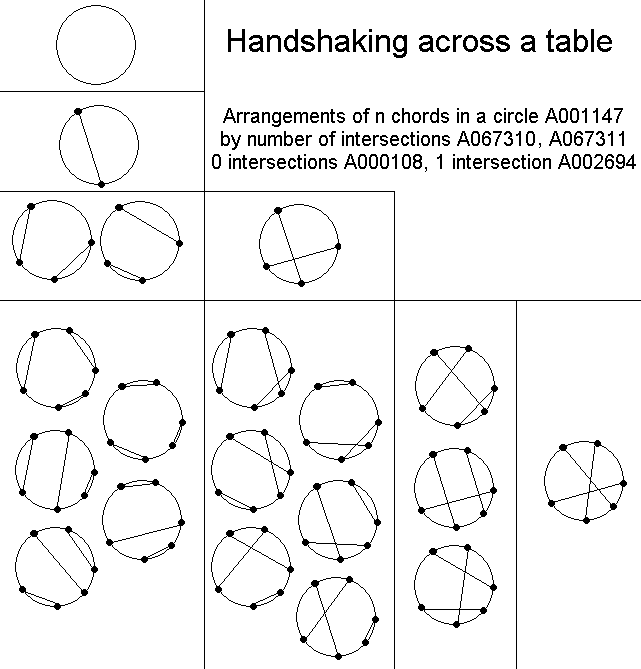
T. Bourgeron, Montagnards et polygones [dead link]
Michel Bousquet and Cedric Lamathe, On symmetric structures of order two, Discrete Mathematics and Theoretical Computer Science, Vol. 10, No. 2 (2008), 153-176.
Mireille Bousquet-Mélou, Sorted and/or sortable permutations, Discrete Mathematics, vol.225, no.1-3, pp.25-50, (2000).
M. Bousquet-Mélou and Gilles Schaeffer, Walks on the slit plane, Probability Theory and Related Fields, Vol. 124, no. 3 (2002), 305-344.
M. Bouvel, V. Guerrini and S. Rinaldi, Slicings of parallelogram polyominoes, or how Baxter and Schroeder can be reconciled, arXiv preprint arXiv:1511.04864 [math.CO], 2015.
G. Bowlin and M. G. Brin, Coloring Planar Graphs via Colored Paths in the Associahedra, arXiv preprint arXiv:1301.3984 [math.CO], 2013.
Douglas Bowman and Alon Regev, Counting symmetry classes of dissections of a convex regular polygon, arXiv preprint arXiv:1209.6270 [math.CO], 2012.
Richard Brak, A Universal Bijection for Catalan Structures, arXiv:1808.09078 [math.CO], 2018.
D. Broadhurst and D. Kreimer, Knots and Numbers in phi^4 Theory to 7 Loops and Beyond, arXiv:9504352 [hep-ph], 1995.
K. S. Brown's Mathpages at Math Forum, The Meanings of Catalan Numbers
W. G. Brown, Historical Note on a Recurrent Combinatorial Problem, The American Mathematical Monthly, Vol. 72, No. 9 (1965), 973-977.
W. G. Brown, Historical note on a recurrent combinatorial problem, Amer. Math. Monthly, 72 (1965), 973-977. [Annotated scanned copy]
Kevin Buchin, Man-Kwun Chiu, Stefan Felsner, Günter Rote and André Schulz, The Number of Convex Polyominoes with Given Height and Width, arXiv:1903.01095 [math.CO], 2019.
B. Bukh, PlanetMath.org, Catalan numbers
Alexander Burstein, Sergi Elizalde and Toufik Mansour, Restricted Dumont permutations, Dyck paths and noncrossing partitions, arXiv:math/0610234 [math.CO], 2006.
A. H. Busch, A characterization of triangle-free tolerance graphs, Discrete Applied Mathematics 154, no. 3, 2006 pp. 471.
W. Butler, A. Kalotay and N. J. A. Sloane, Correspondence, 1974
W. Butler and N. J. A. Sloane, Correspondence, 1974
Libor Caha and Daniel Nagaj, The pair-flip model: a very entangled translationally invariant spin chain, arXiv:1805.07168 [quant-ph], 2018.
Fangfang Cai, Qing-Hu Hou, Yidong Sun and Arthur L.B. Yang, Combinatorial identities related to 2X2 submatrices of recursive matrices, arXiv:1808.05736 [math.CO], 2018.
David Callan, A Combinatorial Interpretation for a Super-Catalan Recurrence, Journal of Integer Sequences, Vol. 8 (2005), Article 05.1.8.
D. Callan, A Combinatorial Interpretation of a Catalan Numbers Identity, Mathematics Magazine, Vol. 72, No. 4 (1999), 295-298.
David Callan, A Combinatorial Interpretation of the Eigensequence for Composition, Journal of Integer Sequences, Vol. 9 (2006), Article 06.1.4.
D. Callan, A variant of Touchard's Catalan number identity, arXiv preprint arXiv:1204.5704 [math.CO], 2012.
D. Callan, Pattern avoidance in "flattened" partitions, Discrete Mathematics, Vol. 309, No. 12 (2009), 4187-4191.
D. Callan, The Maximum Associativeness of Division: 11091, The American Mathematical Monthly, Vol. 113, No. 5 (2006), 462-463.
David Callan and Emeric Deutsch, The Run Transform, Discrete Math. 312 (2012), no. 19, 2927-2937, arXiv:1112.3639 [math.CO], 2011.
H. Cambazard and N. Catusse, Fixed-Parameter Algorithms for Rectilinear Steiner tree and Rectilinear Traveling Salesman Problem in the Plane, arXiv preprint arXiv:1512.06649, 2015
Naiomi T. Cameron and Asamoah Nkwanta, On Some (Pseudo) Involutions in the Riordan Group, Journal of Integer Sequences, Vol. 8 (2005), Article 05.3.7.
Peter J. Cameron, Some treelike objects, The Quarterly Journal of Mathematics, Vol. 38, No. 2 (1987), 155-183. See pp. 155, 162.
P. J. Cameron, Sequences realized by oligomorphic permutation groups, J. Integ. Seqs. Vol. 3 (2000), #00.1.5.
A. Cayley, On the partitions of a polygon, Proc. London Math. Soc., 22 (1891), 237-262 = Collected Mathematical Papers. Vols. 1-13, Cambridge Univ. Press, London, 1889-1897, Vol. 13, pp. 93ff.
F. Cazals, Combinatorics of Non-Crossing Configurations, Studies in Automatic Combinatorics, Volume II (1997).
Giulio Cerbai, Anders Claesson, Luca Ferrari and Einar Steingrímsson, Sorting with pattern-avoiding stacks: the 132-machine, arXiv:2006.05692 [math.CO], 2020.
José Luis Cereceda, An alternative recursive formula for the sums of powers of integers, arXiv:1510.00731 [math.CO], 2015.
G. Chatel and V. Pilaud, The Cambrian and Baxter-Cambrian Hopf Algebras, arXiv preprint arXiv:1411.3704 [math.CO], 2014.
Cedric Chauve, Yann Ponty and Michael Wallner, Counting and sampling gene family evolutionary histories in the duplication-loss and duplication-loss-transfer models, arXiv:1905.04971 [math.CO], 2019.
Young-Ming Chen, The Chung-Feller theorem revisited, Discrete Mathematics, Vol. 308, No. 7 (2008), 1328-1329.
Peter Cholak and Ludovic Patey, Thin set theorems and cone avoidance, arXiv:1812.00188 [math.LO], 2018.
Wun-Seng Chou, Tian-Xiao He and Peter J.-S. Shiue, On the Primality of the Generalized Fuss-Catalan Numbers, Journal of Integer Sequences, Vol. 21 (2018), Article 18.2.1.
Malin Christensson, Make hyperbolic tilings of images, web page, 2019.
Julie Christophe, Jean-Paul Doignon and Samuel Fiorini, Counting Biorders, J. Integer Seqs., Vol. 6, 2003.
Kai Lai Chung and W. Feller, On Fluctuations in Coin-Tossing, Proceedings of the National Academy of Sciences of the United States of America, Vol. 35, No. 10 (1949), 605-608.
J. Cigler, Some nice Hankel determinants, arXiv:1109.1449 [math.CO], 2011.
J. Cigler, Some remarks about q-Chebyshev polynomials and q-Catalan numbers and related results, 2013.
Johann Cigler and Christian Krattenthaler, Hankel determinants of linear combinations of moments of orthogonal polynomials, arXiv:2003.01676 [math.CO], 2020.
Laura Colmenarejo, Aleyah Dawkins, Jennifer Elder, Pamela E. Harris, Kimberly J. Harry, Selvi Kara, Dorian Smith, and Bridget Eileen Tenner, On the lucky and displacement statistics of Stirling permutations, arXiv:2403.03280 [math.CO], 2024.
CombOS - Combinatorial Object Server, Generate Dyck paths
Aldo Conca, Hans-Christian Herbig and Srikanth B. Iyengar, Koszul properties of the moment map of some classical representations, arXiv:1705.02688 [math.AC], 2017, also Collectanea Mathematica (2018) 69.3, 337-357.
Harry Crane, Left-right arrangements, set partitions, and pattern avoidance, Australasian Journal of Combinatorics, 61(1) (2015), 57-72.
Alissa S. Crans, A surreptitious sequence: the Catalan numbers video (2014).
Danielle Cressman, Jonathan Lin, An Nguyen and Luke Wiljanen, Generalized Action Graphs, poster, (2020).
S. J. Cyvin, J. Brunvoll, E. Brendsdal, B. N. Cyvin and E. K. Lloyd, Enumeration of polyene hydrocarbons: a complete mathematical solution, J. Chem. Inf. Comput. Sci., 35 (1995) 743-751. [Annotated scanned copy]
Dennis E. Davenport, Lara K. Pudwell, Louis W. Shapiro and Leon C. Woodson, The Boundary of Ordered Trees, Journal of Integer Sequences, Vol. 18 (2015), Article 15.5.8.
Dennis E. Davenport, Louis W. Shapiro and Leon C. Woodson, A bijection between the triangulations of convex polygons and ordered trees, Integers (2020) Vol. 20, Article #A8.
T. Davis, Catalan Numbers
Colin Defant, Catalan Intervals and Uniquely Sorted Permutations, arXiv:1904.02627 [math.CO], 2019.
C. Defant and K. Zheng, Stack-Sorting with Consecutive-Pattern-Avoiding Stacks, arXiv:2008.12297 [math.CO], 2020.
Italo J. Dejter, The role of restricted growth strings in the two middle levels of the Boolean lattice B_(2k+1), University of Puerto Rico, 2018.
Italo J. Dejter, Reinterpreting Mütze's Theorem via Natural Enumeration of Ordered Rooted Trees, arXiv:1911.02100 [math.CO], 2019.
E. Deutsch and B. E. Sagan, Congruences for Catalan and Motzkin numbers and related sequences, J. Num. Theory 117 (2006), 191-215.
E. Deutsch and L. Shapiro, A survey of the Fine numbers, Discrete Math., 241 (2001), 241-265.
Jimmy Devillet and Bruno Teheux, Associative, idempotent, symmetric, and order-preserving operations on chains, arXiv:1805.11936 [math.RA], 2018.
R. M. Dickau, Catalan numbers
T. Dokos and I. Pak, The expected shape of random doubly alternating Baxter permutations, arXiv:1401.0770 [math.CO], 2014.
C. Domb & A. J. Barrett, Enumeration of ladder graphs, Discrete Math. 9 (1974), 341-358. (Annotated scanned copy)
C. Domb & A. J. Barrett, Notes on Table 2 in "Enumeration of ladder graphs", Discrete Math. 9 (1974), 55. (Annotated scanned copy)
T. Doslic, Handshakes across a (round) table, JIS 13 (2010) #10.2.7.
Eric S. Egge, Kailee Rubin, Snow Leopard Permutations and Their Even and Odd Threads, arXiv:1508.05310 [math.CO], 2015.
Roger B. Eggleton and Richard K. Guy, Catalan strikes again! How likely is a function to be convex?, Mathematics Magazine, 61 (1988): 211-219.
Shalosh B. Ekhad, Nathaniel Shar, and Doron Zeilberger, The number of 1...d-avoiding permutations of length d+r for SYMBOLIC d but numeric r, arXiv:1504.02513 [math.CO], 2015.
Gennady Eremin, Factoring Catalan numbers, arXiv:1908.03752 [math.NT], 2019.
A. España, X. Leoncini, and E. Ugalde, Combinatorics of the paths towards synchronization, arXiv:2205.05948 [math.DS], 2022.
I. M. H. Etherington, Non-associate powers and a functional equation, Math. Gaz., 21 (1937), 36-39. [Annotated scanned copy]
I. M. H. Etherington, On non-associative combinations, Proc. Royal Soc. Edinburgh, 59 (Part 2, 1938-39), 153-162. [Annotated scanned copy]
I. M. H. Etherington, Some problems of non-associative combinations (I), Edinburgh Math. Notes, 32 (1940), pp. i-vi. [Annotated scanned copy]. Part II [not scanned] is by A. Erdelyi and I. M. H. Etherington, and is on pages vii-xiv of the same issue.
Jackson Evoniuk, Steven Klee and Van Magnan, Enumerating Minimal Length Lattice Paths, J. Int. Seq., Vol. 21 (2018), Article 18.3.6.
Luca Ferrari and Emanuele Munarini, Enumeration of edges in some lattices of paths, arXiv preprint arXiv:1203.6792 [math.CO], 2012.
FindStat - Combinatorial Statistic Finder, The number of stack-sorts needed to sort a permutation
D. C. Fielder & C. O. Alford, An investigation of sequences derived from Hoggatt Sums and Hoggatt Triangles, Application of Fibonacci Numbers, 3 (1990) 77-88. Proceedings of 'The Third Annual Conference on Fibonacci Numbers and Their Applications,' Pisa, Italy, July 25-29, 1988. (Annotated scanned copy)
Philippe Flajolet, Éric Fusy, Xavier Gourdon, Daniel Panario and Nicolas Pouyanne, A hybrid of Darboux's method and singularity analysis in combinatorial asymptotics, arXiv:math/0606370 [math.CO], 2006.
Philippe Flajolet, Xavier Gourdon, and Philippe Dumas, Mellin transforms and asymptotics: harmonic sums, Special volume on mathematical analysis of algorithms. Theoret. Comput. Sci. 144 (1995), no. 1-2, 3-58.
P. Flajolet and R. Sedgewick, Analytic Combinatorics, 2009; see page 18, 35
D. Foata and G.-N. Han, The doubloon polynomial triangle, Ram. J. 23 (2010), 107-126
Dominique Foata and Guo-Niu Han, Doubloons and new q-tangent numbers, Quart. J. Math. 62 (2) (2011) 417-432
D. Foata and D. Zeilberger, A classic proof of a recurrence for a very classical sequence
S. Forcey, M. Kafashan, M. Maleki and M. Strayer, Recursive bijections for Catalan objects, arXiv preprint arXiv:1212.1188 [math.CO], 2012 and J. Int. Seq. 16 (2013) #13.5.3.
H. G. Forder, Some problems in combinatorics, Math. Gazette, vol. 45, 1961, 199-201. [Annotated scanned copy]
Shishuo Fu and Yaling Wang, Bijective recurrences concerning two Schröder triangles, arXiv:1908.03912 [math.CO], 2019.
J. R. Gaggins, Constructing the Centroid of a Polygon, Math. Gaz., 61 (1988), 211-212.
Mohammad Ganjtabesh, Armin Morabbi and Jean-Marc Steyaert, Enumerating the number of RNA structures
Joël Gay and Vincent Pilaud, The weak order on Weyl posets, arXiv:1804.06572 [math.CO], 2018.
E.-K. Ghang and D. Zeilberger, Zeroless Arithmetic: Representing Integers ONLY using ONE, arXiv preprint arXiv:1303.0885 [math.CO], 2013.
A. Ghasemi, K. Sreenivas and L. K. Taylor, Numerical Stability and Catalan Numbers, arXiv preprint arXiv:1309.4820 [math.NA], 2013.
Étienne Ghys, A Singular Mathematical Promenade, arXiv:1612.06373, 2016.
Juan B. Gil and Michael D. Weiner, On pattern-avoiding Fishburn permutations, arXiv:1812.01682 [math.CO], 2018.
S. Gilliand, C. Johnson, S. Rush, D. Wood, The sock matching problem, Involve, a Journal of Mathematics, Vol. 7 (2014), No. 5, 691-697.
Samuele Giraudo, Pluriassociative algebras II: The polydendriform operad and related operads, arXiv:1603.01394 [math.CO], 2016.
Samuele Giraudo, Tree series and pattern avoidance in syntax trees, arXiv:1903.00677 [math.CO], 2019.
Lisa R. Goldberg, Catalan numbers and branched coverings by the Riemann sphere, Adv. Math. 85 (1991), No. 2, 129-144.
S. Goldstein, J. L. Lebowitz and E. R. Speer, The Discrete-Time Facilitated Totally Asymmetric Simple Exclusion Process, arXiv:2003.04995 [math-ph], 2020.
K. Gorska and K. A. Penson, Multidimensional Catalan and related numbers as Hausdorff moments, arXiv preprint arXiv:1304.6008 [math.CO], 2013.
H. W. Gould, Proof and generalization of a Catalan number formula of Larcombe, Congr. Numer. 165 (2003) p 33-38.
Alain Goupil and Gilles Schaeffer, Factoring N-Cycles and Counting Maps of Given Genus, Europ. J. Combinatorics (1998) 19 819-834.
B. Gourevitch, L'univers de Pi (click Mathematiciens, Gosper)
D. Gouyou-Beauchamps, Chemins sous-diagonaux et tableau de Young, pp. 112-125 of "Combinatoire Enumerative (Montreal 1985)", Lect. Notes Math. 1234, Springer, 1986. (Annotated scanned copy)
Taras Goy and Mark Shattuck, Determinant formulas of some Toeplitz-Hessenberg matrices with Catalan entries, Proceedings of the Indian Academy of Science - Mathematical Sciences, Vol. 129 (2019), Article 46.
Mats Granvik, Catalan numbers as convergents of power series
Curtis Greene and Brady Haran, Shapes and Hook Numbers (extra footage), Numberphile video (2016)
Catherine Greenhill, Bernard Mans, and Ali Pourmiri, Balanced Allocation on Dynamic Hypergraphs, arXiv:2006.07588 [cs.DS], 2020.
H. G. Grundman and E. A. Teeple, Sequences of Generalized Happy Numbers with Small Bases, Journal of Integer Sequences, Vol. 10 (2007), Article 07.1.8.
R. K. Guy, Dissecting a polygon into triangles, Research Paper #9, Math. Dept., Univ. Calgary, 1967. [Annotated scanned copy]
R. K. Guy, Catwalks, Sandsteps and Pascal Pyramids, J. Integer Seqs., Vol. 3 (2000), #00.1.6.
R. K. Guy and J. L. Selfridge, The nesting and roosting habits of the laddered parenthesis (annotated cached copy)
Mark Haiman, with an Appendix by Ezra Miller, Commutative algebra of n points in the plane, Trends Commut. Algebra, MSRI Publ 51 (2004): 153-180. [See Theorem 1.2]
Guo-Niu Han, Enumeration of Standard Puzzles [Cached copy]
Brady Haran and Sergei Tabachnikov, Frieze Patterns, Numberphile video (2019); more footage
F. Harary, E. M. Palmer, R. C. Read, On the cell-growth problem for arbitrary polygons, computer printout, circa 1974
F. Harary & R. W. Robinson, The number of achiral trees, Jnl. Reine Angewandte Mathematik 278 (1975), 322-335. (Annotated scanned copy)
Elizabeth Hartung, Hung Phuc Hoang, Torsten Mütze and Aaron Williams, Combinatorial generation via permutation languages. I. Fundamentals, arXiv:1906.06069 [cs.DM], 2019.
Aoife Hennessy, A Study of Riordan Arrays with Applications to Continued Fractions, Orthogonal Polynomials and Lattice Paths, Ph. D. Thesis, Waterford Institute of Technology, Oct. 2011
A. M. Hinz, S. Klavžar, U. Milutinović and C. Petr, The Tower of Hanoi - Myths and Maths, Birkhäuser 2013. See page 259. Book's website
V. E. Hoggatt, Jr., Letters to N. J. A. Sloane, 1974-1975
V. E. Hoggatt, Jr. and M. Bicknell, Catalan and related sequences arising from inverses of Pascal's triangle matrices, Fib. Quart., 14 (1976), 395-405.
V. E. Hoggatt, Jr. and Paul S. Bruckman, The H-convolution transform, Fibonacci Quart., Vol. 13(4), 1975, p. 357.
C. Homberger, Patterns in Permutations and Involutions: A Structural and Enumerative Approach, arXiv preprint arXiv:1410.2657 [math.CO], 2014.
W. Hürlimann (2009). Generalizing Benford's law using power laws: application to integer sequences. International Journal of Mathematics and Mathematical Sciences, Article ID 970284.
Hsien-Kuei Hwang, Mihyun Kang and Guan-Huei Duh, Asymptotic Expansions for Sub-Critical Lagrangean Forms, LIPIcs Proceedings of Analysis of Algorithms (2018), Vol. 110, Article 29.
Anders Hyllengren, Four integer sequences, Oct 04 1985. Observes essentially that A000984 and A002426 are inverse binomial transforms of each other, as are A000108 and A001006.
INRIA Algorithms Project, Encyclopedia of Combinatorial Structures 48, Encyclopedia of Combinatorial Structures 52, Encyclopedia of Combinatorial Structures 71, Encyclopedia of Combinatorial Structures 76, and Encyclopedia of Combinatorial Structures 284 [dead links]
Milan Janjić, On Restricted Ternary Words and Insets, arXiv:1905.04465 [math.CO], 2019.
I. Jensen, Series expansions for self-avoiding polygons
S. Johnson, The Catalan Numbers
A. Joseph and P. Lamprou, A new interpretation of Catalan numbers, arXiv preprint arXiv:1512.00406 [math.CO], 2015.
R. Kahkeshani, A Generalization of the Catalan Numbers, J. Int. Seq. 16 (2013) #13.6.8
A. Karttunen, Illustration of initial terms up to size n=7
Nicholas M. Katz, A note on random matrix integrals, moment identities, and Catalan numbers, 2015.
Manuel Kauers and Doron Zeilberger, Counting Standard Young Tableaux With Restricted Runs, arXiv:2006.10205 [math.CO], 2020.
J. Keitel and L. Bartosch, The zero-dimensional O(N) vector model as a benchmark for perturbation theory, the large-N expansion and the functional renormalisation group, arXiv preprint arXiv:1109.3013 [cond-mat.stat-mech], 2012.
Clark Kimberling, Matrix Transformations of Integer Sequences, J. Integer Seqs., Vol. 6, 2003.
Martin Klazar, What is an answer? — remarks, results and problems on PIO formulas in combinatorial enumeration, part I, arXiv:1808.08449, 2018.
Martin Klazar and Richard Horský, Are the Catalan Numbers a Linear Recurrence Sequence?, arXiv:2107.10717 [math.CO], 2021. Published in American Mathematical Monthly, 129:2, 166-171, DOI:10.1080/00029890.2022.2005392.
D. E. Knuth, Convolution polynomials, The Mathematica J., 2 (1992), 67-78.
M. Konvalinka and S. Wagner, The shape of random tanglegrams, arXiv preprint arXiv:1512.01168 [cond-mat.mes-hall], 2015.
G. Kreweras, Sur les éventails de segments, Cahiers du Bureau Universitaire de Recherche Opérationnelle, Institut de Statistique, Université de Paris, #15 (1970), 3-41. [Annotated scanned copy]
G. Kreweras, Sur les partitions non croisées d'un cycle, (in French) Discrete Math. 1 (1972), no. 4, 333-350. MR0309747 (46 #8852)
C. Krishnamachary and M. Bheemasena Rao, Determinants whose elements are Eulerian, prepared Bernoullian and other numbers, J. Indian Math. Soc., 14 (1922), 55-62, 122-138 and 143-146. [Annotated scanned copy]
Nate Kube and Frank Ruskey, Sequences That Satisfy a(n-a(n))=0, Journal of Integer Sequences, Vol. 8 (2005), Article 05.5.5.
Shrinu Kushagra, Shai Ben-David and Ihab Ilyas, Semi-supervised clustering for de-duplication, arXiv:1810.04361 [cs.LG], 2018.
Marie-Louise Lackner and M Wallner, An invitation to analytic combinatorics and lattice path counting; Preprint, Dec 2015.
Wolfdieter Lang, On generalizations of Stirling number triangles, J. Integer Seqs., Vol. 3 (2000), #00.2.4.
Peter J. Larcombe, Daniel R. French, On the "Other" Catalan Numbers: A Historical Formulation Re-Examined, Preprint 2000-2016.
P. J. Larcombe et al., On certain series expansions of the sine function: Catalan numbers and convergence, Fib. Q., 52 (2014), 236-242.
J. W. Layman, The Hankel Transform and Some of its Properties, J. Integer Sequences, 4 (2001), #01.1.5.
Pierre Lescanne, An exercise on streams: convergence acceleration, arXiv preprint arXiv:1312.4917 [cs.NA], 2013.
Hsueh-Yung Lin, The odd Catalan numbers modulo 2^k, arXiv:1012.1756 [math.NT], 2010-2011.
Elżbieta Liszewska and Wojciech Młotkowski, Some relatives of the Catalan sequence, arXiv:1907.10725 [math.CO], 2019.
J.-L. Loday and B. Vallette, Algebraic Operads, version 0.999, 2012.
R. P. Loh, A. G. Shannon, A. F. Horadam, Divisibility Criteria and Sequence Generators Associated with Fermat Coefficients, Preprint, 1980.
Peter Luschny, The Lost Catalan Numbers And The Schröder Tableaux
Sara Madariaga, Gröbner-Shirshov bases for the non-symmetric operads of dendriform algebras and quadri-algebras, arXiv:1304.5184 [math.RA], 2013.
Colin L. Mallows and Lou Shapiro, Balls on the Lawn, J. Integer Sequences, Vol. 2, 1999, #5.
C. Mallows and R. J. Vanderbei, Which Young Tableaux Can Represent an Outer Sum?, J. Int. Seq. 18 (2015) 15.9.1.
K Manes, A Sapounakis, I Tasoulas, P Tsikouras, Equivalence classes of ballot paths modulo strings of length 2 and 3, arXiv preprint arXiv:1510.01952 [math.CO], 2015.
Toufik Mansour, Counting Peaks at Height k in a Dyck Path, Journal of Integer Sequences, Vol. 5 (2002), Article 02.1.1
Toufik Mansour, Statistics on Dyck Paths, Journal of Integer Sequences, Vol. 9 (2006), Article 06.1.5.
Toufik Mansour and Mark Shattuck, Counting Dyck Paths According to the Maximum Distance Between Peaks and Valleys, Journal of Integer Sequences, Vol. 15 (2012), #12.1.1.
Toufik Mansour and Yidong Sun, Identities involving Narayana polynomials and Catalan numbers (2008), arXiv:0805.1274 [math.CO]; Discrete Mathematics, Volume 309, Issue 12, Jun 28 2009, Pages 4079-4088
R. J. Marsh and P. P. Martin, Pascal arrays: counting Catalan sets, arXiv:math/0612572 [math.CO], 2006.
MathOverflow, Geometric / physical / probabilistic interpretations of Riemann zeta(n>1)?, answer by Tom Copeland posted in Aug 2021.
Peter McCalla and Asamoah Nkwanta, Catalan and Motzkin Integral Representations, arXiv:1901.07092 [math.NT], 2019.
Jon McCammond, Noncrossing partitions in surprising locations, arXiv:math/0601687 [math.CO], 2006.
D. Merlini, R. Sprugnoli and M. C. Verri, Waiting patterns for a printerDiscrete Applied Mathematics, 144 (2004), 359-373; FUN with algorithm'01, Isola d'Elba, 2001.
Ângela Mestre and José Agapito, A Family of Riordan Group Automorphisms, J. Int. Seq., Vol. 22 (2019), Article 19.8.5.
Sam Miner and I. Pak, The shape of random pattern avoiding permutations, 2013.
Marni Mishna and Lily Yen, Set partitions with no k-nesting, arXiv:1106.5036 [math.CO], 2011.
S. Mizera, Combinatorics and Topology of Kawai-Lewellen-Tye Relations, arXiv:1706.08527 [hep-th], 2017.
T. Motzkin, The hypersurface cross ratio, Bull. Amer. Math. Soc., 51 (1945), 976-984.
T. S. Motzkin, Relations between hypersurface cross ratios and a combinatorial formula for partitions of a polygon, for permanent preponderance and for non-associative products, Bull. Amer. Math. Soc., 54 (1948), 352-360.
Torsten Mütze and Franziska Weber, Construction of 2-factors in the middle layer of the discrete cube, arXiv preprint arXiv:1111.2413 [math.CO], 2011.
Liviu I. Nicolaescu, Counting Morse functions on the 2-sphere, arXiv:math/0512496 [math.GT], 2005-2006.
J.-C. Novelli and J.-Y. Thibon, Free quasi-symmetric functions of arbitrary level, arXiv:math/0405597 [math.CO], 2004.
R. J. Nowakowski, G. Renault, E. Lamoureux, S. Mellon and T. Miller, The Game of timber!, 2013.
C. D. Olds (Proposer) and H. W. Becker (Discussion), Problem 4277, Amer. Math. Monthly 56 (1949), 697-699. [Annotated scanned copy]
Igor Pak, Catalan Numbers Page
Igor Pak, Who Named the Catalan Numbers?
Igor Pak, History of Catalan numbers, arXiv:1408.5711 [math.HO], 2014.
Hao Pan and Zhi-Wei Sun, A combinatorial identity with application to Catalan numbers, arXiv:math/0509648 [math.CO], 2005-2006.
A. Panayotopoulos and P. Tsikouras, Meanders and Motzkin Words, J. Integer Seqs., Vol. 7, 2004.
A. Panholzer and H. Prodinger, Bijections for ternary trees and non-crossing trees, Discrete Math., 250 (2002), 181-195 (see Eq. 4).
A. Papoulis, A new method of inversion of the Laplace transform, Quart. Appl. Math 14 (1957), 405-414. [Annotated scan of selected pages]
Robert Parviainen, Lattice Path Enumeration of Permutations with k Occurrences of the Pattern 2-13, Journal of Integer Sequences, Vol. 9 (2006), Article 06.3.2.
Ludovic Patey, Ramsey-like theorems and moduli of computation, arXiv:1901.04388 [math.LO], 2019.
P. Peart and W.-J. Woan, Generating Functions via Hankel and Stieltjes Matrices, J. Integer Seqs., Vol. 3 (2000), #00.2.1.
P. Peart and W.-J. Woan, Dyck Paths With No Peaks at Height k, J. Integer Sequences, 4 (2001), #01.1.3.
Robin Pemantle and Mark C. Wilson, Twenty Combinatorial Examples of Asymptotics Derived from Multivariate Generating Functions, SIAM Rev., 50 (2) (2008), 199-272.
K. A. Penson and J.-M. Sixdeniers, Integral Representations of Catalan and Related Numbers, J. Integer Sequences, 4 (2001), #01.2.5.
Karol A. Penson and Karol Zyczkowski, Product of Ginibre matrices : Fuss-Catalan and Raney distribution, arXiv version; Phys. Rev E. vol. 83, 061118 (2011).
T. K. Petersen and Bridget Eileen Tenner, The depth of a permutation, arXiv:1202.4765 [math.CO], 2012-2014.
Ville H. Pettersson, Enumerating Hamiltonian Cycles, The Electronic Journal of Combinatorics, Volume 21, Issue 4, 2014.
Vincent Pilaud, Brick polytopes, lattice quotients, and Hopf algebras, arXiv preprint arXiv:1505.07665 [math.CO], 2015.
Vincent Pilaud, Pebble trees, arXiv:2205.06686 [math.CO], 2022.
Maxim V. Polyakov, Kirill M. Semenov-Tian-Shansky, Alexander O. Smirnov and Alexey A. Vladimirov, Quasi-Renormalizable Quantum Field Theories, arXiv:1811.08449 [hep-th], 2018.
Alexander Postnikov, Permutohedra, associahedra, and beyond, 2005, arXiv:math/0507163 [math.CO], 2005.
J.-B. Priez and A. Virmaux, Non-commutative Frobenius characteristic of generalized parking functions: Application to enumeration, arXiv preprint arXiv:1411.4161 [math.CO], 2014-2015.
L. Pudwell and A. Baxter, Ascent sequences avoiding pairs of patterns, 2014.
Alon Regev, Enumerating Triangulations by Parallel Diagonals, Journal of Integer Sequences, Vol. 15 (2012), #12.8.5; arXiv preprint arXiv:1208.3915, 2012.
Alon Regev, Amitai Regev, and Doron Zeilberger, Identities in character tables of S_n, arXiv preprint arXiv:1507.03499 [math.CO], 2015.
Amitai Regev, Nathaniel Shar, and Doron Zeilberger, A Very Short (Bijective!) Proof of Touchard's Catalan Identity, 2015.
Amitai Regev, Nathaniel Shar, and Doron Zeilberger, A Very Short (Bijective!) Proof of Touchard's Catalan Identity, [Local copy, pdf file only, no active links]
J.-L. Rémy, Un procédé itératif de dénombrement d'arbres binaires et son application à leur génération aléatoire, RAIRO Inform. Theor. 19 (1985), 179-195.
C. M. Ringel, The Catalan combinatorics of the hereditary artin algebras, arXiv preprint arXiv:1502.06553 [math.RT], 2015.
J. Riordan, The distribution of crossings of chords joining pairs of 2n points on a circle, Math. Comp., 29 (1975), 215-222.
J. Riordan, The distribution of crossings of chords joining pairs of 2n points on a circle, Math. Comp., 29 (1975), 215-222. [Annotated scanned copy]
N. A. Rosenberg, Counting coalescent histories, J. Comput Biol., 14 (2007), 360-377.
E. Rowland and R. Yassawi, Automatic congruences for diagonals of rational functions, arXiv preprint arXiv:1310.8635 [math.NT], 2013-2014.
E. Rowland and D. Zeilberger, A Case Study in Meta-AUTOMATION: AUTOMATIC Generation of Congruence AUTOMATA For Combinatorial Sequences, arXiv preprint arXiv:1311.4776 [math.CO], 2013.
Albert Sade, Sur les Chevauchements des Permutations, published by the author, Marseille, 1949. [Annotated scanned copy]
A. Sapounakis, I. Tasoulas and P. Tsikouras, On the Dominance Partial Ordering of Dyck Paths, Journal of Integer Sequences, Vol. 9 (2006), Article 06.2.5.
A. Sapounakis and P. Tsikouras, On k-colored Motzkin words, Journal of Integer Sequences, Vol. 7 (2004), Article 04.2.5.
E. Schröder, Vier combinatorische Probleme, Z. f. Math. Phys., 15 (1870), 361-376. [Annotated scanned copy]
A. Schuetz and G. Whieldon, Polygonal Dissections and Reversions of Series, arXiv preprint arXiv:1401.7194 [math.CO], 2014.
J. A. von Segner, Enumeratio modorum, quibus figurae planae rectilineae per diagonales dividuntur in triangula, Novi Comm. Acad. Scient. Imper. Petropolitanae, 7 (1758/1759), 203-209.
Sarah Shader, Weighted Catalan Numbers and Their Divisibility Properties, Research Science Institute, MIT, 2014.
L. W. Shapiro, A Catalan triangle, Discrete Math., 14, 83-90, 1976.
L. W. Shapiro, A Catalan triangle, Discrete Math. 14 (1976), no. 1, 83-90. [Annotated scanned copy]
D. M. Silberger, Occurrences of the integer (2n-2)!/n!(n-1)!, Roczniki Polskiego Towarzystwa Math. 13 (1969): 91-96. [Annotated scanned copy]
N. J. A. Sloane, Illustration of initial terms
N. J. A. Sloane, Note on Sylvester's "On reducible cyclodes" paper [Scanned copy]
N. J. A. Sloane, "A Handbook of Integer Sequences" Fifty Years Later, arXiv:2301.03149 [math.NT], 2023, p. 7.
N. Solomon and S. Solomon, A natural extension of Catalan Numbers, JIS 11 (2008) 08.3.5
Frank Sottile, The Schubert Calculus of Lines (a section of Enumerative Real Algebraic Geometry)
Michael Z. Spivey and Laura L. Steil, The k-Binomial Transforms and the Hankel Transform, Journal of Integer Sequences, Vol. 9 (2006), Article 06.1.1.
R. P. Stanley, Hipparchus, Plutarch, Schröder and Hough, Am. Math. Monthly, Vol. 104, No. 4, p. 344, 1997.
R. P. Stanley, Exercises on Catalan and Related Numbers
R. P. Stanley, Catalan Addendum
R. P. Stanley, Interpretations of Catalan Numbers (Notes) [Annotated scanned copy]
P. J. Stockmeyer, The charm bracelet problem and its applications, pp. 339-349 of Graphs and Combinatorics (Washington, Jun 1973), Ed. by R. A. Bari and F. Harary. Lect. Notes Math., Vol. 406. Springer-Verlag, 1974. [Scanned annotated and corrected copy]
T. Stojadinovic, The Catalan numbers, Preprint 2015.
C. Stump, On a New Collection of Words in the Catalan Family, J. Int. Seq. 17 (2014) # 14.7.1
Zhi-Wei Sun and Roberto Tauraso, On some new congruences for binomial coefficients, arXiv:0709.1665 [math.NT], 2007-2011.
V. S. Sunder, Catalan numbers
P. Tarau, Computing with Catalan Families, 2013, doi:10.1007/978-3-319-28228-2_8.
P. Tarau, A Generic Numbering System based on Catalan Families of Combinatorial Objects, arXiv preprint arXiv:1406.1796 [cs.MS], 2014.
P. Tarau, A Logic Programming Playground for Lambda Terms, Combinators, Types and Tree-based Arithmetic Computations, arXiv preprint arXiv:1507.06944 [cs.LO], 2015.
I. Tasoulas, K. Manes, A. Sapounakis and P. Tsikouras, Chains with Small Intervals in the Lattice of Binary Paths, arXiv:1911.10883 [math.CO], 2019.
D. Taylor, Catalan Structures(up to C(7)).
B. E. Tenner, Interval structures in the Bruhat and weak orders, arXiv:2001.05011 [math.CO], 2020.
Thotsaporn "Aek" Thanatipanonda and Doron Zeilberger, A Multi-Computational Exploration of Some Games of Pure Chance, arXiv:1909.11546 [math.CO], 2019.
I. Todorov, Studying Quantum Field Theory, arXiv:1311.7258 [math-ph], 2013.
Michael Torpey, Semigroup congruences: computational techniques and theoretical applications, Ph.D. Thesis, University of St. Andrews (Scotland, 2019).
J.-D. Urbina, J. Kuipers, Q. Hummel and K. Richter, Multiparticle correlations in complex scattering and the mesoscopic Boson Sampling problem, arXiv preprint arXiv:1409.1558 [quant-ph], 2014.
A. Vieru, Agoh's conjecture: its proof, its generalizations, its analogues, arXiv:1107.2938 [math.NT], 2011.
Gérard Villemin, Nombres De Catalan (French)
D. W. Walkup, The number of plane trees, Mathematika, vol. 19, No. 2 (1972), 200-204.
Wenxi Wang, Muhammad Usman, Alyas Almaawi, Kaiyuan Wang, Kuldeep S. Meel and Sarfraz Khurshid, A Study of Symmetry Breaking Predicates and Model Counting, National University of Singapore (2020).
Eric Weisstein's World of Mathematics, Catalan Number, Binary Bracketing, Binary Tree, Nonassociative Product, Staircase Walk, and Dyck Path
Wikipedia, Catalan number
J. Winter, M. M. Bonsangue and J. J. M. M. Rutten, Context-free coalgebras, 2013.
Roman Witula, Damian Slota and Edyta Hetmaniok, Bridges between different known integer sequences, Annales Mathematicae et Informaticae, 41 (2013) pp. 255-263.
W.-J. Woan, Hankel Matrices and Lattice Paths, J. Integer Sequences, 4 (2001), #01.1.2.
Wen-jin Woan, A Recursive Relation for Weighted Motzkin Sequences Journal of Integer Sequences, Vol. 8 (2005), Article 05.1.6.
Wen-jin Woan, Animals and 2-Motzkin Paths, Journal of Integer Sequences, Vol. 8 (2005), Article 05.5.6.
Wen-jin Woan, A Relation Between Restricted and Unrestricted Weighted Motzkin Paths, Journal of Integer Sequences, Vol. 9 (2006), Article 06.1.7.
Chunyan Yan and Zhicong Lin, Inversion sequences avoiding pairs of patterns, arXiv:1912.03674 [math.CO], 2019.
F. Yano and H. Yoshida, Some set partition statistics in non-crossing partitions and generating functions, Discr. Math., 307 (2007), 3147-3160.
Yan X Zhang, Four Variations on Graded Posets, arXiv preprint arXiv:1508.00318 [math.CO], 2015.
FORMULA
a(n) = binomial(2*n, n)/(n+1) = (2*n)!/(n!*(n+1)!) = A000984(n)/(n+1).
Recurrence: a(n) = 2*(2*n-1)*a(n-1)/(n+1) with a(0) = 1.
Recurrence: a(n) = Sum_{k=0..n-1} a(k)a(n-1-k).
G.f.: A(x) = (1 - sqrt(1 - 4*x)) / (2*x), and satisfies A(x) = 1 + x*A(x)^2.
a(n) = Product_{k=2..n} (1 + n/k).
a(n+1) = Sum_{i} binomial(n, 2*i)*2^(n-2*i)*a(i). - Touchard
It is known that a(n) is odd if and only if n=2^k-1, k=0, 1, 2, 3, ... - Emeric Deutsch, Aug 04 2002, corrected by M. F. Hasler, Nov 08 2015
Using the Stirling approximation in A000142 we get the asymptotic expansion a(n) ~ 4^n / (sqrt(Pi * n) * (n + 1)). - Dan Fux (dan.fux(AT)OpenGaia.com or danfux(AT)OpenGaia.com), Apr 13 2001
Integral representation: a(n) = (1/(2*Pi))*Integral_{x=0..4} x^n*sqrt((4-x)/x). - Karol A. Penson, Apr 12 2001
E.g.f.: exp(2*x)*(I_0(2*x)-I_1(2*x)), where I_n is Bessel function. - Karol A. Penson, Oct 07 2001
a(n) = polygorial(n, 6)/polygorial(n, 3). - Daniel Dockery (peritus(AT)gmail.com), Jun 24 2003
G.f. A(x) satisfies ((A(x) + A(-x)) / 2)^2 = A(4*x^2). - Michael Somos, Jun 27, 2003
G.f. A(x) satisfies Sum_{k>=1} k(A(x)-1)^k = Sum_{n>=1} 4^{n-1}*x^n. - Shapiro, Woan, Getu
a(n+1) = (1/(n+1))*Sum_{k=0..n} a(n-k)*binomial(2k+1, k+1). - Philippe Deléham, Jan 24 2004
a(n) = Sum_{k>=0} A008313(n, k)^2. - Philippe Deléham, Feb 14 2004
a(n) = Sum_{k=0..n} (-1)^k*2^(n-k)*binomial(n, k)*binomial(k, floor(k/2)). - Paul Barry, Jan 27 2005
Sum_{n>=0} 1/a(n) = 2 + 4*Pi/3^(5/2) = F(1,2;1/2;1/4) = A268813 = 2.806133050770763... (see L'Univers de Pi link). - Gerald McGarvey and Benoit Cloitre, Feb 13 2005
a(n) = Sum_{k=0..floor(n/2)} ((n-2*k+1)*binomial(n, n-k)/(n-k+1))^2, which is equivalent to: a(n) = Sum_{k=0..n} A053121(n, k)^2, for n >= 0. - Paul D. Hanna, Apr 23 2005
E.g.f. Sum_{n>=0} a(n) * x^(2*n) / (2*n)! = BesselI(1, 2*x) / x. - Michael Somos, Jun 22 2005
Given g.f. A(x), then B(x) = x * A(x^3) satisfies 0 = f(x, B(X)) where f(u, v) = u - v + (u*v)^2 or B(x) = x + (x * B(x))^2 which implies B(-B(x)) = -x and also (1 + B^3) / B^2 = (1 - x^3) / x^2. - Michael Somos, Jun 27 2005
a(n) = a(n-1)*(4-6/(n+1)). a(n) = 2a(n-1)*(8a(n-2)+a(n-1))/(10a(n-2)-a(n-1)). - Franklin T. Adams-Watters, Feb 08 2006
Sum_{k>=1} a(k)/4^k = 1. - Franklin T. Adams-Watters, Jun 28 2006
a(n) = A047996(2*n+1, n). - Philippe Deléham, Jul 25 2006
Binomial transform of A005043. - Philippe Deléham, Oct 20 2006
a(n) = Sum_{k=0..n} (-1)^k*A116395(n,k). - Philippe Deléham, Nov 07 2006
a(n) = (1/(s-n))*Sum_{k=0..n} (-1)^k (k+s-n)*binomial(s-n,k) * binomial(s+n-k,s) with s a nonnegative free integer [H. W. Gould].
a(k) = Sum_{i=1..k} |A008276(i,k)| * (k-1)^(k-i) / k!. - André F. Labossière, May 29 2007
Row sums of triangle A124926. - Gary W. Adamson, Oct 22 2007
Limit_{n->oo} (1 + Sum_{k=0..n} a(k)/A004171(k)) = 4/Pi. - Reinhard Zumkeller, Aug 26 2008
a(n) = Sum_{k=0..n} A120730(n,k)^2 and a(k+1) = Sum_{n>=k} A120730(n,k). - Philippe Deléham, Oct 18 2008
Given an integer t >= 1 and initial values u = [a_0, a_1, ..., a_{t-1}], we may define an infinite sequence Phi(u) by setting a_n = a_{n-1} + a_0*a_{n-1} + a_1*a_{n-2} + ... + a_{n-2}*a_1 for n >= t. For example, the present sequence is Phi([1]) (also Phi([1,1])). - Gary W. Adamson, Oct 27 2008
a(n) = Sum_{l_1=0..n+1} Sum_{l_2=0..n}...Sum_{l_i=0..n-i}...Sum_{l_n=0..1} delta(l_1,l_2,...,l_i,...,l_n) where delta(l_1,l_2,...,l_i,...,l_n) = 0 if any l_i < l_(i+1) and l_(i+1) <> 0 for i=1..n-1 and delta(l_1,l_2,...,l_i,...,l_n) = 1 otherwise. - Thomas Wieder, Feb 25 2009
Let A(x) be the g.f., then B(x)=x*A(x) satisfies the differential equation B'(x)-2*B'(x)*B(x)-1=0. - Vladimir Kruchinin, Jan 18 2011
G.f.: 1/(1-x/(1-x/(1-x/(...)))) (continued fraction). - Joerg Arndt, Mar 18 2011
With F(x) = (1-2*x-sqrt(1-4*x))/(2*x) an o.g.f. in x for the Catalan series, G(x) = x/(1+x)^2 is the compositional inverse of F (nulling the n=0 term). - Tom Copeland, Sep 04 2011
With H(x) = 1/(dG(x)/dx) = (1+x)^3 / (1-x), the n-th Catalan number is given by (1/n!)*((H(x)*d/dx)^n)x evaluated at x=0, i.e., F(x) = exp(x*H(u)*d/du)u, evaluated at u = 0. Also, dF(x)/dx = H(F(x)), and H(x) is the o.g.f. for A115291. - Tom Copeland, Sep 04 2011
From Tom Copeland, Sep 30 2011: (Start)
With F(x) = (1-sqrt(1-4*x))/2 an o.g.f. in x for the Catalan series, G(x)= x*(1-x) is the compositional inverse and this relates the Catalan numbers to the row sums of A125181.
With H(x) = 1/(dG(x)/dx) = 1/(1-2x), the n-th Catalan number (offset 1) is given by (1/n!)*((H(x)*d/dx)^n)x evaluated at x=0, i.e., F(x) = exp(x*H(u)*d/du)u, evaluated at u = 0. Also, dF(x)/dx = H(F(x)). (End)
G.f.: (1-sqrt(1-4*x))/(2*x) = G(0) where G(k) = 1 + (4*k+1)*x/(k+1-2*x*(k+1)*(4*k+3)/(2*x*(4*k+3)+(2*k+3)/G(k+1))); (continued fraction). - Sergei N. Gladkovskii, Nov 30 2011
E.g.f.: exp(2*x)*(BesselI(0,2*x) - BesselI(1,2*x)) = G(0) where G(k) = 1 + (4*k+1)*x/((k+1)*(2*k+1)-x*(k+1)*(2*k+1)*(4*k+3)/(x*(4*k+3)+(k+1)*(2*k+3)/G(k+1))); (continued fraction). - Sergei N. Gladkovskii, Nov 30 2011
E.g.f.: Hypergeometric([1/2],[2],4*x) which coincides with the e.g.f. given just above, and also by Karol A. Penson further above. - Wolfdieter Lang, Jan 13 2012
A076050(a(n)) = n + 1 for n > 0. - Reinhard Zumkeller, Feb 17 2012
G.f.: 1 + 2*x/(U(0)-2*x) where U(k) = k*(4*x+1) + 2*x + 2 - x*(2*k+3)*(2*k+4)/U(k+1); (continued fraction, Euler's 1st kind, 1-step). - Sergei N. Gladkovskii, Sep 20 2012
G.f.: hypergeom([1/2,1],[2],4*x). - Joerg Arndt, Apr 06 2013
Special values of Jacobi polynomials, in Maple notation: a(n) = 4^n*JacobiP(n,1,-1/2-n,-1)/(n+1). - Karol A. Penson, Jul 28 2013
For n > 0: a(n) = sum of row n in triangle A001263. - Reinhard Zumkeller, Oct 10 2013
a(n) = binomial(2n,n-1)/n and a(n) mod n = binomial(2n,n) mod n = A059288(n). - Jonathan Sondow, Dec 14 2013
a(n-1) = Sum_{t1+2*t2+...+n*tn=n} (-1)^(1+t1+t2+...+tn)*multinomial(t1+t2 +...+tn,t1,t2,...,tn)*a(1)^t1*a(2)^t2*...*a(n)^tn. - Mircea Merca, Feb 27 2014
a(n) = Sum_{k=1..n} binomial(n+k-1,n)/n if n > 0. Alexander Adamchuk, Mar 25 2014
a(n) = -2^(2*n+1) * binomial(n-1/2, -3/2). - Peter Luschny, May 06 2014
a(n) = (2*n)!*[x^(2*n)]hypergeom([],[2],x^2). - Peter Luschny, Jan 31 2015
a(n) = 4^(n-1)*hypergeom([3/2, 1-n], [3], 1). - Peter Luschny, Feb 03 2015
a(n) = Sum_{t=1..n+1} n^(t-1)*abs(Stirling1(n+1, t)) / Sum_{t=1..n+1} abs(Stirling1(n+1, t)), for n > 0, see (10) in Cereceda link. - Michel Marcus, Oct 06 2015
a(n) ~ 4^(n-2)*(128 + 160/N^2 + 84/N^4 + 715/N^6 - 10180/N^8)/(N^(3/2)*Pi^(1/2)) where N = 4*n+3. - Peter Luschny, Oct 14 2015
a(n) = Sum_{k=1..floor((n+1)/2)} (-1)^(k-1)*binomial(n+1-k,k)*a(n-k) if n > 0; and a(0) = 1. - David Pasino, Jun 29 2016
Sum_{n>=0} (-1)^n/a(n) = 14/25 - 24*arccsch(2)/(25*sqrt(5)) = 14/25 - 24*A002390/(25*sqrt(5)) = 0.353403708337278061333... - Ilya Gutkovskiy, Jun 30 2016
C(n) = (1/n) * Sum_{i+j+k=n-1} C(i)*C(j)*C(k)*(k+1), n >= 1. - Yuchun Ji, Feb 21 2016
C(n) = 1 + Sum_{i+j+k<n-1} C(i)*C(j)*C(k). - Yuchun Ji, Sep 01 2016
a(n) = A001700(n) - A162551(n) = binomial(2*n+1,n+1). - 2*binomial(2*n,n-1). - Taras Goy, Aug 09 2018
G.f.: A(x) = (1 - sqrt(1 - 4*x)) / (2*x) = 2F1(1/2,1;2;4*x). G.f. A(x) satisfies A = 1 + x*A^2. - R. J. Mathar, Nov 17 2018
From A.H.M. Smeets, Apr 11 2020: (Start)
(1+sqrt(1+4*x))/2 = 1-Sum_{i >= 0} a(i)*(-x)^(i+1), for any complex x with |x| < 1/4; and sqrt(x+sqrt(x+sqrt(x+...))) = 1-Sum_{i >= 0} a(i)*(-x)^(i+1), for any complex x with |x| < 1/4 and x <> 0. (End)
a(3n+1)*a(5n+4)*a(15n+10) = a(3n+2)*a(5n+2)*a(15n+11). The first case of Catalan product equation of a triple partition of 23n+15. - Yuchun Ji, Sep 27 2020
a(n) = 4^n * (-1)^(n+1) * 3F2[{n + 1,n + 1/2,n}, {3/2,1}, -1], n >= 1. - Sergii Voloshyn, Oct 22 2020
a(n) = 2^(1 + 2 n) * (-1)^(n)/(1 + n) * 3F2[{n, 1/2 + n, 1 + n}, {1/2, 1}, -1], n >= 1. - Sergii Voloshyn, Nov 08 2020
a(n) = (1/Pi)*4^(n+1)*Integral_{x=0..Pi/2} cos(x)^(2*n)*sin(x)^2 dx. - Greg Dresden, May 30 2021
From Peter Bala, Aug 17 2021: (Start)
G.f. A(x) satisfies A(x) = 1/sqrt(1 - 4*x) * A( -x/(1 - 4*x) ) and (A(x) + A(-x))/2 = 1/sqrt(1 - 4*x) * A( -2*x/(1 - 4*x) ); these are the cases k = 0 and k = -1 of the general formula 1/sqrt(1 - 4*x) * A( (k-1)*x/(1 - 4*x) ) = Sum_{n >= 0} ((k^(n+1) - 1)/(k - 1))*Catalan(n)*x^n.
2 - sqrt(1 - 4*x)/A( k*x/(1 - 4*x) ) = 1 + Sum_{n >= 1} (1 + (k + 1)^n) * Catalan(n-1)*x^n. (End)
Sum_{n>=0} a(n)*(-1/4)^n = 2*(sqrt(2)-1) (A163960). - Amiram Eldar, Mar 22 2022
0 = a(n)*(16*a(n+1) - 10*a(n+2)) + a(n+1)*(2*a(n+1) + a(n+2)) for all n>=0. - Michael Somos, Dec 12 2022
G.f.: (offset 1) 1/G(x), with G(x) = 1 - 2*x - x^2/G(x) (Jacobi continued fraction). - Nikolaos Pantelidis, Feb 01 2023
a(n) = K^(2n+1, n, 1) for all n >= 0, where K^(n, s, x) is the Krawtchouk polynomial defined to be Sum_{k=0..s} (-1)^k * binomial(n-x, s-k) * binomial(x, k). - Vladislav Shubin, Aug 17 2023
From Peter Bala, Feb 03 2024: (Start)
The g.f. A(x) satisfies the following functional equations:
A(x) = 1 + x/(1 - 4*x) * A(-x/(1 - 4*x))^2,
A(x^2) = 1/(1 - 2*x) * A(- x/(1 - 2*x))^2 and, for arbitrary k,
1/(1 - k*x) * A(x/(1 - k*x))^2 = 1/(1 - (k+4)*x) * A(-x/(1 - (k+4)*x))^2. (End)
EXAMPLE
From Joerg Arndt and Greg Stevenson, Jul 11 2011: (Start)
The following products of 3 transpositions lead to a 4-cycle in S_4:
(1,2)*(1,3)*(1,4);
(1,2)*(1,4)*(3,4);
(1,3)*(1,4)*(2,3);
(1,4)*(2,3)*(2,4);
(1,4)*(2,4)*(3,4). (End)
G.f. = 1 + x + 2*x^2 + 5*x^3 + 14*x^4 + 42*x^5 + 132*x^6 + 429*x^7 + ...
For n=3, a(3)=5 since there are exactly 5 binary sequences of length 7 in which the number of ones first exceed the number of zeros at entry 7, namely, 0001111, 0010111, 0011011, 0100111, and 0101011. - Dennis P. Walsh, Apr 11 2012
From Joerg Arndt, Jun 30 2014: (Start)
The a(4) = 14 branching sequences of the (ordered) trees with 4 non-root nodes are (dots denote zeros):
01: [ 1 1 1 1 . ]
02: [ 1 1 2 . . ]
03: [ 1 2 . 1 . ]
04: [ 1 2 1 . . ]
05: [ 1 3 . . . ]
06: [ 2 . 1 1 . ]
07: [ 2 . 2 . . ]
08: [ 2 1 . 1 . ]
09: [ 2 1 1 . . ]
10: [ 2 2 . . . ]
11: [ 3 . . 1 . ]
12: [ 3 . 1 . . ]
13: [ 3 1 . . . ]
14: [ 4 . . . . ]
(End)
MAPLE
A000108 := n->binomial(2*n, n)/(n+1);
G000108 := (1 - sqrt(1 - 4*x)) / (2*x);
spec := [ A, {A=Prod(Z, Sequence(A))}, unlabeled ]: [ seq(combstruct[count](spec, size=n+1), n=0..42) ];
with(combstruct): bin := {B=Union(Z, Prod(B, B))}: seq(count([B, bin, unlabeled], size=n+1), n=0..25); # Zerinvary Lajos, Dec 05 2007
gser := series(G000108, x=0, 42): seq(coeff(gser, x, n), n=0..41); # Zerinvary Lajos, May 21 2008
seq((2*n)!*coeff(series(hypergeom([], [2], x^2), x, 2*n+2), x, 2*n), n=0..30); # Peter Luschny, Jan 31 2015
A000108List := proc(m) local A, P, n; A := [1, 1]; P := [1];
for n from 1 to m - 2 do P := ListTools:-PartialSums([op(P), A[-1]]);
A := [op(A), P[-1]] od; A end: A000108List(31); # Peter Luschny, Mar 24 2022
MATHEMATICA
(* TermFunction *)
CatalanNumber
(* TermFunctionDefinition *)
A000108[n_] := (2 n)!/n!/(n+1)!
(* TermFunctionDefinition *)
A000108[n_] := Hypergeometric2F1[1 - n, -n, 2, 1] (* Richard L. Ollerton, Sep 13 2006 *)
(* TermList *)
Table[ CatalanNumber@ n, {n, 0, 24}] (* Robert G. Wilson v, Feb 15 2011 *)
(* TermList *)
CoefficientList[InverseSeries[Series[x/Sum[x^n, {n, 0, 31}], {x, 0, 31}]]/x, x] (* Mats Granvik, Nov 24 2013 *)
(* TermListByIndexFunction *)
Function[n, CatalanNumber /@ Range[0, n]]
CoefficientList[Series[(1 - Sqrt[1 - 4*x]) / (2*x), {x, 0, 50}], x] (* Stefano Spezia, Aug 31 2018 *)
PROG
(PARI) a(n)=binomial(2*n, n)/(n+1) \\ M. F. Hasler, Aug 25 2012
(PARI) a(n) = (2*n)! / n! / (n+1)!
(PARI) a(n) = my(A, m); if( n<0, 0, m=1; A = 1 + x + O(x^2); while(m<=n, m*=2; A = sqrt(subst(A, x, 4*x^2)); A += (A - 1) / (2*x*A)); polcoeff(A, n));
(PARI) {a(n) = if( n<1, n==0, polcoeff( serreverse( x / (1 + x)^2 + x * O(x^n)), n))}; /* Michael Somos */
(PARI) (recur(a, b)=if(b<=2, (a==2)+(a==b)+(a!=b)*(1+a/2), (1+a/b)*recur(a, b-1))); a(n)=recur(n, n); \\ R. J. Cano, Nov 22 2012
(PARI) x='x+O('x^40); Vec((1-sqrt(1-4*x))/(2*x)) \\ Altug Alkan, Oct 13 2015
(MuPAD) combinat::dyckWords::count(n) $ n = 0..38 // Zerinvary Lajos, Apr 14 2007
(Magma) C:= func< n | Binomial(2*n, n)/(n+1) >; [ C(n) : n in [0..60]];
(Magma) [Catalan(n): n in [0..40]]; // Vincenzo Librandi, Apr 02 2011
(Haskell)
import Data.List (genericIndex)
a000108 n = genericIndex a000108_list n
a000108_list = 1 : catalan [1] where
catalan cs = c : catalan (c:cs) where
c = sum $ zipWith (*) cs $ reverse cs
-- Reinhard Zumkeller, Nov 12 2011
a000108 = map last $ iterate (scanl1 (+) . (++ [0])) [1]
-- David Spies, Aug 23 2015
(Sage) [catalan_number(i) for i in range(27)] # Zerinvary Lajos, Jun 26 2008
(Sage) # Generalized algorithm of L. Seidel
def A000108_list(n) :
D = [0]*(n+1); D[1] = 1
b = True; h = 1; R = []
for i in range(2*n-1) :
if b :
for k in range(h, 0, -1) : D[k] += D[k-1]
h += 1; R.append(D[1])
else :
for k in range(1, h, 1) : D[k] += D[k+1]
b = not b
return R
A000108_list(31) # Peter Luschny, Jun 02 2012
(Maxima) A000108(n):=binomial(2*n, n)/(n+1)$ makelist(A000108(n), n, 0, 30); /* Martin Ettl, Oct 24 2012 */
(Python)
from gmpy2 import divexact
A000108 = [1, 1]
for n in range(1, 10**3):
(Python)
# Works in Sage also.
A000108 = [1]
for n in range(1000):
(GAP) A000108:=List([0..30], n->Binomial(2*n, n)/(n+1)); # Muniru A Asiru, Feb 17 2018
CROSSREFS
Cf. A000142, A000245, A000344, A000588, A000957, A000984, A001392, A001453, A001791, A002057, A002420, A003046, A003517, A003518, A003519, A006480, A008276, A008549, A014137, A014138, A014140, A022553 (inv. Eul. trans.), A024492, A032357, A032443, A039599, A048990, A059288, A068875, A069640, A086117, A088327 (Eul. trans.), A094216, A094638, A094639, A098597, A099731, A119822, A120304, A124926, A129763, A137697, A154559, A161581, A167892, A167893, A179277, A211611, A275431 (multisets).
A row of A060854.
Enumerates objects encoded by A014486.
A diagonal of any of the essentially equivalent arrays A009766, A030237, A033184, A059365, A099039, A106566, A130020, A047072.
Cf. A051168 (diagonal of the square array described).
Cf. A120303 (largest prime factor of Catalan number).
Cf. A002390 (decimal expansion of natural logarithm of golden ratio).
For a(n) mod 6 see A259667.
For a(n) in base 2 see A264663.
Cf. A332602 (conjectured production matrix).
KEYWORD
core,nonn,easy,eigen,nice
AUTHOR
STATUS
approved