
OFFSET
0,3
COMMENTS
Also referred to as T(n) or C(n+1, 2) or binomial(n+1, 2) (preferred).
Also generalized hexagonal numbers: n*(2*n-1), n=0, +-1, +-2, +-3, ... Generalized k-gonal numbers are second k-gonal numbers and positive terms of k-gonal numbers interleaved, k >= 5. In this case k = 6. - Omar E. Pol, Sep 13 2011 and Aug 04 2012
Number of edges in complete graph of order n+1, K_{n+1}.
Number of legal ways to insert a pair of parentheses in a string of n letters. E.g., there are 6 ways for three letters: (a)bc, (ab)c, (abc), a(b)c, a(bc), ab(c). Proof: there are C(n+2,2) ways to choose where the parentheses might go, but n + 1 of them are illegal because the parentheses are adjacent. Cf. A002415.
For n >= 1, a(n) is also the genus of a nonsingular curve of degree n+2, such as the Fermat curve x^(n+2) + y^(n+2) = 1. - Ahmed Fares (ahmedfares(AT)my_deja.com), Feb 21 2001
From Harnack's theorem (1876), the number of branches of a nonsingular curve of order n is bounded by a(n-1)+1, and the bound can be achieved. See also A152947. - Benoit Cloitre, Aug 29 2002. Corrected by Robert McLachlan, Aug 19 2024
Number of tiles in the set of double-n dominoes. - Scott A. Brown, Sep 24 2002
Number of ways a chain of n non-identical links can be broken up. This is based on a similar problem in the field of proteomics: the number of ways a peptide of n amino acid residues can be broken up in a mass spectrometer. In general, each amino acid has a different mass, so AB and BC would have different masses. - James A. Raymond, Apr 08 2003
Triangular numbers - odd numbers = shifted triangular numbers; 1, 3, 6, 10, 15, 21, ... - 1, 3, 5, 7, 9, 11, ... = 0, 0, 1, 3, 6, 10, ... - Xavier Acloque, Oct 31 2003 [Corrected by Derek Orr, May 05 2015]
Centered polygonal numbers are the result of [number of sides * A000217 + 1]. E.g., centered pentagonal numbers (1,6,16,31,...) = 5 * (0,1,3,6,...) + 1. Centered heptagonal numbers (1,8,22,43,...) = 7 * (0,1,3,6,...) + 1. - Xavier Acloque, Oct 31 2003
Maximum number of lines formed by the intersection of n+1 planes. - Ron R. King, Mar 29 2004
Number of permutations of [n] which avoid the pattern 132 and have exactly 1 descent. - Mike Zabrocki, Aug 26 2004
Number of ternary words of length n-1 with subwords (0,1), (0,2) and (1,2) not allowed. - Olivier Gérard, Aug 28 2012
Number of ways two different numbers can be selected from the set {0,1,2,...,n} without repetition, or, number of ways two different numbers can be selected from the set {1,2,...,n} with repetition.
Conjecturally, 1, 6, 120 are the only numbers that are both triangular and factorial. - Christopher M. Tomaszewski (cmt1288(AT)comcast.net), Mar 30 2005
Binomial transform is {0, 1, 5, 18, 56, 160, 432, ...}, A001793 with one leading zero. - Philippe Deléham, Aug 02 2005
Each pair of neighboring terms adds to a perfect square. - Zak Seidov, Mar 21 2006
Number of transpositions in the symmetric group of n+1 letters, i.e., the number of permutations that leave all but two elements fixed. - Geoffrey Critzer, Jun 23 2006
With rho(n):=exp(i*2*Pi/n) (an n-th root of 1) one has, for n >= 1, rho(n)^a(n) = (-1)^(n+1). Just use the triviality a(2*k+1) == 0 (mod (2*k+1)) and a(2*k) == k (mod (2*k)).
a(n) is the number of terms in the expansion of (a_1 + a_2 + a_3)^(n-1). - Sergio Falcon, Feb 12 2007
a(n+1) is the number of terms in the complete homogeneous symmetric polynomial of degree n in 2 variables. - Richard Barnes, Sep 06 2017
The number of distinct handshakes in a room with n+1 people. - Mohammad K. Azarian, Apr 12 2007 [corrected, Joerg Arndt, Jan 18 2016]
Equal to the rank (minimal cardinality of a generating set) of the semigroup PT_n\S_n, where PT_n and S_n denote the partial transformation semigroup and symmetric group on [n]. - James East, May 03 2007
a(n) gives the total number of triangles found when cevians are drawn from a single vertex on a triangle to the side opposite that vertex, where n = the number of cevians drawn+1. For instance, with 1 cevian drawn, n = 1+1 = 2 and a(n)= 2*(2+1)/2 = 3 so there is a total of 3 triangles in the figure. If 2 cevians are drawn from one point to the opposite side, then n = 1+2 = 3 and a(n) = 3*(3+1)/2 = 6 so there is a total of 6 triangles in the figure. - Noah Priluck (npriluck(AT)gmail.com), Apr 30 2007
For n >= 1, a(n) is the number of ways in which n-1 can be written as a sum of three nonnegative integers if representations differing in the order of the terms are considered to be different. In other words, for n >= 1, a(n) is the number of nonnegative integral solutions of the equation x + y + z = n-1. - Amarnath Murthy, Apr 22 2001 (edited by Robert A. Beeler)
a(n) is the number of levels with energy n + 3/2 (in units of h*f0, with Planck's constant h and the oscillator frequency f0) of the three-dimensional isotropic harmonic quantum oscillator. See the comment by A. Murthy above: n = n1 + n2 + n3 with positive integers and ordered. Proof from the o.g.f. See the A. Messiah reference. - Wolfdieter Lang, Jun 29 2007
From Hieronymus Fischer, Aug 06 2007: (Start)
Numbers m >= 0 such that round(sqrt(2m+1)) - round(sqrt(2m)) = 1.
Numbers m >= 0 such that ceiling(2*sqrt(2m+1)) - 1 = 1 + floor(2*sqrt(2m)).
Numbers m >= 0 such that fract(sqrt(2m+1)) > 1/2 and fract(sqrt(2m)) < 1/2, where fract(x) is the fractional part of x (i.e., x - floor(x), x >= 0). (End)
If Y and Z are 3-blocks of an n-set X, then, for n >= 6, a(n-1) is the number of (n-2)-subsets of X intersecting both Y and Z. - Milan Janjic, Nov 09 2007
Equals row sums of triangle A143320, n > 0. - Gary W. Adamson, Aug 07 2008
a(n) is also a perfect number A000396 if n is a Mersenne prime A000668, assuming there are no odd perfect numbers. - Omar E. Pol, Sep 05 2008
Equals row sums of triangle A152204. - Gary W. Adamson, Nov 29 2008
The number of matches played in a round robin tournament: n*(n-1)/2 gives the number of matches needed for n players. Everyone plays against everyone else exactly once. - Georg Wrede (georg(AT)iki.fi), Dec 18 2008
-a(n+1) = E(2)*binomial(n+2,2) (n >= 0) where E(n) are the Euler numbers in the enumeration A122045. Viewed this way, a(n) is the special case k=2 in the sequence of diagonals in the triangle A153641. - Peter Luschny, Jan 06 2009
Equivalent to the first differences of successive tetrahedral numbers. See A000292. - Jeremy Cahill (jcahill(AT)inbox.com), Apr 15 2009
The general formula for alternating sums of powers is in terms of the Swiss-Knife polynomials P(n,x) A153641 2^(-n-1)(P(n,1)-(-1)^k P(n,2k+1)). Thus a(k) = |2^(-3)(P(2,1)-(-1)^k P(2,2k+1))|. - Peter Luschny, Jul 12 2009
a(n) is the smallest number > a(n-1) such that gcd(n,a(n)) = gcd(n,a(n-1)). If n is odd this gcd is n; if n is even it is n/2. - Franklin T. Adams-Watters, Aug 06 2009
Partial sums of A001477. - Juri-Stepan Gerasimov, Jan 25 2010. [A-number corrected by Omar E. Pol, Jun 05 2012]
The numbers along the right edge of Floyd's triangle are 1, 3, 6, 10, 15, .... - Paul Muljadi, Jan 25 2010
From Charlie Marion, Dec 03 2010: (Start)
More generally, a(2k+1) == j*(2j-1) (mod 2k+2j+1) and
a(2k) == [-k + 2j*(j-1)] (mod 2k+2j).
Column sums of:
1 3 5 7 9 ...
1 3 5 ...
1 ...
...............
---------------
1 3 6 10 15 ...
Sum_{n>=1} 1/a(n)^2 = 4*Pi^2/3-12 = 12 less than the volume of a sphere with radius Pi^(1/3).
(End)
1/a(n+1), n >= 0, has e.g.f. -2*(1+x-exp(x))/x^2, and o.g.f. 2*(x+(1-x)*log(1-x))/x^2 (see the Stephen Crowley formula line). -1/(2*a(n+1)) is the z-sequence for the Sheffer triangle of the coefficients of the Bernoulli polynomials A196838/A196839. - Wolfdieter Lang, Oct 26 2011
From Charlie Marion, Feb 23 2012: (Start)
a(n) + a(A002315(k)*n + A001108(k+1)) = (A001653(k+1)*n + A001109(k+1))^2. For k=0 we obtain a(n) + a(n+1) = (n+1)^2 (identity added by N. J. A. Sloane on Feb 19 2004).
(End)
Plot the three points (0,0), (a(n), a(n+1)), (a(n+1), a(n+2)) to form a triangle. The area will be a(n+1)/2. - J. M. Bergot, May 04 2012
The sum of four consecutive triangular numbers, beginning with a(n)=n*(n+1)/2, minus 2 is 2*(n+2)^2. a(n)*a(n+2)/2 = a(a(n+1)-1). - J. M. Bergot, May 17 2012
(a(n)*a(n+3) - a(n+1)*a(n+2))*(a(n+1)*a(n+4) - a(n+2)*a(n+3))/8 = a((n^2+5*n+4)/2). - J. M. Bergot, May 18 2012
a(n)*a(n+1) + a(n+2)*a(n+3) + 3 = a(n^2 + 4*n + 6). - J. M. Bergot, May 22 2012
In general, a(n)*a(n+1) + a(n+k)*a(n+k+1) + a(k-1)*a(k) = a(n^2 + (k+2)*n + k*(k+1)). - Charlie Marion, Sep 11 2012
a(n)*a(n+3) + a(n+1)*a(n+2) = a(n^2 + 4*n + 2). - J. M. Bergot, May 22 2012
In general, a(n)*a(n+k) + a(n+1)*a(n+k-1) = a(n^2 + (k+1)*n + k-1). - Charlie Marion, Sep 11 2012
a(n)*a(n+2) + a(n+1)*a(n+3) = a(n^2 + 4*n + 3). - J. M. Bergot, May 22 2012
Three points (a(n),a(n+1)), (a(n+1),a(n)) and (a(n+2),a(n+3)) form a triangle with area 4*a(n+1). - J. M. Bergot, May 23 2012
a(n) + a(n+k) = (n+k)^2 - (k^2 + (2n-1)*k -2n)/2. For k=1 we obtain a(n) + a(n+1) = (n+1)^2 (see below). - Charlie Marion, Oct 02 2012
In n-space we can define a(n-1) nontrivial orthogonal projections. For example, in 3-space there are a(2)=3 (namely point onto line, point onto plane, line onto plane). - Douglas Latimer, Dec 17 2012
From James East, Jan 08 2013: (Start)
For n >= 1, a(n) is equal to the rank (minimal cardinality of a generating set) and idempotent rank (minimal cardinality of an idempotent generating set) of the semigroup P_n\S_n, where P_n and S_n denote the partition monoid and symmetric group on [n].
For n >= 3, a(n-1) is equal to the rank and idempotent rank of the semigroup T_n\S_n, where T_n and S_n denote the full transformation semigroup and symmetric group on [n].
(End)
For n >= 3, a(n) is equal to the rank and idempotent rank of the semigroup PT_n\S_n, where PT_n and S_n denote the partial transformation semigroup and symmetric group on [n]. - James East, Jan 15 2013
Conjecture: For n > 0, there is always a prime between A000217(n) and A000217(n+1). Sequence A065383 has the first 1000 of these primes. - Ivan N. Ianakiev, Mar 11 2013
The formula, a(n)*a(n+4k+2)/2 + a(k) = a(a(n+2k+1) - (k^2+(k+1)^2)), is a generalization of the formula a(n)*a(n+2)/2 = a(a(n+1)-1) in Bergot's comment dated May 17 2012. - Charlie Marion, Mar 28 2013
The series Sum_{k>=1} 1/a(k) = 2, given in a formula below by Jon Perry, Jul 13 2003, has partial sums 2*n/(n+1) (telescopic sum) = A022998(n)/A026741(n+1). - Wolfdieter Lang, Apr 09 2013
For odd m = 2k+1, we have the recurrence a(m*n + k) = m^2*a(n) + a(k). Corollary: If number T is in the sequence then so is 9*T+1. - Lekraj Beedassy, May 29 2013
Euler, in Section 87 of the Opera Postuma, shows that whenever T is a triangular number then 9*T + 1, 25*T + 3, 49*T + 6 and 81*T + 10 are also triangular numbers. In general, if T is a triangular number then (2*k + 1)^2*T + k*(k + 1)/2 is also a triangular number. - Peter Bala, Jan 05 2015
Using 1/b and 1/(b+2) will give a Pythagorean triangle with sides 2*b + 2, b^2 + 2*b, and b^2 + 2*b + 2. Set b=n-1 to give a triangle with sides of lengths 2*n,n^2-1, and n^2 + 1. One-fourth the perimeter = a(n) for n > 1. - J. M. Bergot, Jul 24 2013
a(n) = A028896(n)/6, where A028896(n) = s(n) - s(n-1) are the first differences of s(n) = n^3 + 3*n^2 + 2*n - 8. s(n) can be interpreted as the sum of the 12 edge lengths plus the sum of the 6 face areas plus the volume of an n X (n-1) X (n-2) rectangular prism. - J. M. Bergot, Aug 13 2013
Dimension of orthogonal group O(n+1). - Eric M. Schmidt, Sep 08 2013
Number of positive roots in the root system of type A_n (for n > 0). - Tom Edgar, Nov 05 2013
A formula for the r-th successive summation of k, for k = 1 to n, is binomial(n+r,r+1) [H. W. Gould]. - Gary Detlefs, Jan 02 2014
Also the alternating row sums of A095831. Also the alternating row sums of A055461, for n >= 1. - Omar E. Pol, Jan 26 2014
For n >= 3, a(n-2) is the number of permutations of 1,2,...,n with the distribution of up (1) - down (0) elements 0...011 (n-3 zeros), or, the same, a(n-2) is up-down coefficient {n,3} (see comment in A060351). - Vladimir Shevelev, Feb 14 2014
a(n) is the dimension of the vector space of symmetric n X n matrices. - Derek Orr, Mar 29 2014
Non-vanishing subdiagonal of A132440^2/2, aside from the initial zero. First subdiagonal of unsigned A238363. Cf. A130534 for relations to colored forests, disposition of flags on flagpoles, and colorings of the vertices of complete graphs. - Tom Copeland, Apr 05 2014
The number of Sidon subsets of {1,...,n+1} of size 2. - Carl Najafi, Apr 27 2014
Number of factors in the definition of the Vandermonde determinant V(x_1,x_2,...,x_n) = Product_{1 <= i < k <= n} x_i - x_k. - Tom Copeland, Apr 27 2014
Number of weak compositions of n into three parts. - Robert A. Beeler, May 20 2014
Suppose a bag contains a(n) red marbles and a(n+1) blue marbles, where a(n), a(n+1) are consecutive triangular numbers. Then, for n > 0, the probability of choosing two marbles at random and getting two red or two blue is 1/2. In general, for k > 2, let b(0) = 0, b(1) = 1 and, for n > 1, b(n) = (k-1)*b(n-1) - b(n-2) + 1. Suppose, for n > 0, a bag contains b(n) red marbles and b(n+1) blue marbles. Then the probability of choosing two marbles at random and getting two red or two blue is (k-1)/(k+1). See also A027941, A061278, A089817, A053142, A092521. - Charlie Marion, Nov 03 2014
Let O(n) be the oblong number n(n+1) = A002378 and S(n) the square number n^2 = A000290(n). Then a(4n) = O(3n) - O(n), a(4n+1) = S(3n+1) - S(n), a(4n+2) = S(3n+2) - S(n+1) and a(4n+3) = O(3n+2) - O(n). - Charlie Marion, Feb 21 2015
Consider the partition of the natural numbers into parts from the set S=(1,2,3,...,n). The length (order) of the signature of the resulting sequence is given by the triangular numbers. E.g., for n=10, the signature length is 55. - David Neil McGrath, May 05 2015
a(n) counts the partitions of (n-1) unlabeled objects into three (3) parts (labeled a,b,c), e.g., a(5)=15 for (n-1)=4. These are (aaaa),(bbbb),(cccc),(aaab),(aaac),(aabb),(aacc),(aabc),(abbc),(abcc),(abbb),(accc),(bbcc),(bccc),(bbbc). - David Neil McGrath, May 21 2015
Conjecture: the sequence is the genus/deficiency of the sinusoidal spirals of index n which are algebraic curves. The value 0 corresponds to the case of the Bernoulli Lemniscate n=2. So the formula conjectured is (n-1)(n-2)/2. - Wolfgang Tintemann, Aug 02 2015
Conjecture: Let m be any positive integer. Then, for each n = 1,2,3,... the set {Sum_{k=s..t} 1/k^m: 1 <= s <= t <= n} has cardinality a(n) = n*(n+1)/2; in other words, all the sums Sum_{k=s..t} 1/k^m with 1 <= s <= t are pairwise distinct. (I have checked this conjecture via a computer and found no counterexample.) - Zhi-Wei Sun, Sep 09 2015
The Pisano period lengths of reading the sequence modulo m seem to be A022998(m). - R. J. Mathar, Nov 29 2015
For n >= 1, a(n) is the number of compositions of n+4 into n parts avoiding the part 2. - Milan Janjic, Jan 07 2016
In this sequence only 3 is prime. - Fabian Kopp, Jan 09 2016
Suppose you are playing Bulgarian Solitaire (see A242424 and Chamberland's and Gardner's books) and, for n > 0, you are starting with a single pile of a(n) cards. Then the number of operations needed to reach the fixed state {n, n-1,...,1} is a(n-1). For example, {6}->{5,1}->{4,2}->{3,2,1}. - Charlie Marion, Jan 14 2016
Numbers k such that 8k + 1 is a square. - Juri-Stepan Gerasimov, Apr 09 2016
Every perfect cube is the difference of the squares of two consecutive triangular numbers. 1^2-0^2 = 1^3, 3^2-1^2 = 2^3, 6^2-3^2 = 3^3. - Miquel Cerda, Jun 26 2016
For n > 1, a(n) = tau_n(k*) where tau_n(k) is the number of ordered n-factorizations of k and k* is the square of a prime. For example, tau_3(4) = tau_3(9) = tau_3(25) = tau_3(49) = 6 (see A007425) since the number of divisors of 4, 9, 25, and 49's divisors is 6, and a(3) = 6. - Melvin Peralta, Aug 29 2016
In an (n+1)-dimensional hypercube, number of two-dimensional faces congruent with a vertex (see also A001788). - Stanislav Sykora, Oct 23 2016
Generalizations of the familiar formulas, a(n) + a(n+1) = (n+1)^2 (Feb 19 2004) and a(n)^2 + a(n+1)^2 = a((n+1)^2) (Nov 22 2006), follow: a(n) + a(n+2k-1) + 4a(k-1) = (n+k)^2 + 6a(k-1) and a(n)^2 + a(n+2k-1)^2 + (4a(k-1))^2 + 3a(k-1) = a((n+k)^2 + 6a(k-1)). - Charlie Marion, Nov 27 2016
a(n) is also the greatest possible number of diagonals in a polyhedron with n+4 vertices. - Vladimir Letsko, Dec 19 2016
For n > 0, 2^5 * (binomial(n+1,2))^2 represents the first integer in a sum of 2*(2*n + 1)^2 consecutive integers that equals (2*n + 1)^6. - Patrick J. McNab, Dec 25 2016
Does not satisfy Benford's law (cf. Ross, 2012). - N. J. A. Sloane, Feb 12 2017
Number of ordered triples (a,b,c) of positive integers not larger than n such that a+b+c = 2n+1. - Aviel Livay, Feb 13 2017
Number of inequivalent tetrahedral face colorings using at most n colors so that no color appears only once. - David Nacin, Feb 22 2017
Also the Wiener index of the complete graph K_{n+1}. - Eric W. Weisstein, Sep 07 2017
Number of intersections between the Bernstein polynomials of degree n. - Eric Desbiaux, Apr 01 2018
a(n) is the area of a triangle with vertices at (1,1), (n+1,n+2), and ((n+1)^2, (n+2)^2). - Art Baker, Dec 06 2018
For n > 0, a(n) is the smallest k > 0 such that n divides numerator of (1/a(1) + 1/a(2) + ... + 1/a(n-1) + 1/k). It should be noted that 1/1 + 1/3 + 1/6 + ... + 2/(n(n+1)) = 2n/(n+1). - Thomas Ordowski, Aug 04 2019
Upper bound of the number of lines in an n-homogeneous supersolvable line arrangement (see Theorem 1.1 in Dimca). - Stefano Spezia, Oct 04 2019
For n > 0, a(n+1) is the number of lattice points on a triangular grid with side length n. - Wesley Ivan Hurt, Aug 12 2020
From Michael Chu, May 04 2022: (Start)
Maximum number of distinct nonempty substrings of a string of length n.
Maximum cardinality of the sumset A+A, where A is a set of n numbers. (End)
a(n) is the number of parking functions of size n avoiding the patterns 123, 132, and 312. - Lara Pudwell, Apr 10 2023
Suppose two rows, each consisting of n evenly spaced dots, are drawn in parallel. Suppose we bijectively draw lines between the dots of the two rows. For n >= 1, a(n - 1) is the maximal possible number of intersections between the lines. Equivalently, the maximal number of inversions in a permutation of [n]. - Sela Fried, Apr 18 2023
The following equation complements the generalization in Bala's Comment (Jan 05 2015). (2k + 1)^2*a(n) + a(k) = a((2k + 1)*n + k). - Charlie Marion, Aug 28 2023
a(n) + a(n+k) + a(k-1) + (k-1)*n = (n+k)^2. For k = 1, we have a(n) + a(n+1) = (n+1)^2. - Charlie Marion, Nov 17 2023
REFERENCES
M. Abramowitz and I. A. Stegun, eds., Handbook of Mathematical Functions, National Bureau of Standards Applied Math. Series 55, 1964 (and various reprintings), p. 828.
C. Alsina and R. B. Nelson, Charming Proofs: A Journey into Elegant Mathematics, MAA, 2010. See Chapter 1.
T. M. Apostol, Introduction to Analytic Number Theory, Springer-Verlag, 1976, page 2.
A. H. Beiler, Recreations in the Theory of Numbers, Dover, NY, 1964, p. 189.
A. T. Benjamin and J. J. Quinn, Proofs that really count: the art of combinatorial proof, M.A.A. 2003, p. 109ff.
Marc Chamberland, Single Digits: In Praise of Small Numbers, Chapter 3, The Number Three, p. 72, Princeton University Press, 2015.
L. Comtet, Advanced Combinatorics, Reidel, 1974, p. 155.
J. M. De Koninck and A. Mercier, 1001 Problèmes en Théorie Classique des Nombres, Problème 309 pp 46-196, Ellipses, Paris, 2004
E. Deza and M. M. Deza, Figurate numbers, World Scientific Publishing (2012), page 6.
L. E. Dickson, History of the Theory of Numbers. Carnegie Institute Public. 256, Washington, DC, Vol. 1, 1919; Vol. 2, 1920; Vol. 3, 1923, see vol. 2, p. 1.
Martin Gardner, Colossal Book of Mathematics, Chapter 34, Bulgarian Solitaire and Other Seemingly Endless Tasks, pp. 455-467, W. W. Norton & Company, 2001.
James Gleick, The Information: A History, A Theory, A Flood, Pantheon, 2011. [On page 82 mentions a table of the first 19999 triangular numbers published by E. de Joncort in 1762.]
Cay S. Horstmann, Scala for the Impatient. Upper Saddle River, New Jersey: Addison-Wesley (2012): 171.
Labos E.: On the number of RGB-colors we can distinguish. Partition Spectra. Lecture at 7th Hungarian Conference on Biometry and Biomathematics. Budapest. Jul 06 2005.
A. Messiah, Quantum Mechanics, Vol.1, North Holland, Amsterdam, 1965, p. 457.
J. C. P. Miller, editor, Table of Binomial Coefficients. Royal Society Mathematical Tables, Vol. 3, Cambridge Univ. Press, 1954.
N. J. A. Sloane, A Handbook of Integer Sequences, Academic Press, 1973 (includes this sequence).
N. J. A. Sloane and Simon Plouffe, The Encyclopedia of Integer Sequences, Academic Press, 1995 (includes this sequence).
T. Trotter, Some Identities for the Triangular Numbers, Journal of Recreational Mathematics, Spring 1973, 6(2).
D. Wells, The Penguin Dictionary of Curious and Interesting Numbers, pp. 91-93 Penguin Books 1987.
LINKS
N. J. A. Sloane, Table of n, a(n) for n = 0..30000
M. Abramowitz and I. A. Stegun, eds., Handbook of Mathematical Functions, National Bureau of Standards Applied Math.Series 55, Tenth Printing, 1972.
K. Adegoke, R. Frontzcak and T. Goy, Special formulas involving polygonal numbers and Horadam numbers, Carpathian Math. Publ., 13 (2021), no. 1, 207-216.
Ayomikun Adeniran and Lara Pudwell, Pattern avoidance in parking functions, Enumer. Comb. Appl. 3:3 (2023), Article S2R17.
Joerg Arndt, Matters Computational (The Fxtbook), section 39.7, pp. 776-778.
Luciano Ancora, The Square Pyramidal Number and other figurate numbers, ch. 5.
S. Barbero, U. Cerruti, and N. Murru, A Generalization of the Binomial Interpolated Operator and its Action on Linear Recurrent Sequences , J. Int. Seq. 13 (2010) # 10.9.7, proposition 18.
Jean-Luc Baril, Sergey Kirgizov, and Vincent Vajnovszki, Descent distribution on Catalan words avoiding a pattern of length at most three, arXiv:1803.06706 [math.CO], 2018.
Paul Barry, A Catalan Transform and Related Transformations on Integer Sequences, Journal of Integer Sequences, Vol. 8 (2005), Article 05.4.5.
T. Beldon and T. Gardiner, Triangular numbers and perfect squares, The Mathematical Gazette 86 (2002), 423-431.
Michael Boardman, The Egg-Drop Numbers, Mathematics Magazine, 77 (2004), 368-372. [From Parthasarathy Nambi, Sep 30 2009]
Anicius Manlius Severinus Boethius, De institutione arithmetica, libri duo, Sections 7-9.
Henry Bottomley, Illustration of initial terms of A000217, A002378

Sadek Bouroubi and Ali Debbache, An unexpected meeting between the P^3_1-set and the cubic-triangular numbers, arXiv:2001.11407 [math.NT], 2020.
P. J. Cameron, Sequences realized by oligomorphic permutation groups, J. Integ. Seqs. Vol. 3 (2000), #00.1.5.
Bikash Chakraborty, Proof Without Words: Sums of Powers of Natural numbers, arXiv:2012.11539 [math.HO], 2020.
Robert Dawson, On Some Sequences Related to Sums of Powers, J. Int. Seq., Vol. 21 (2018), Article 18.7.6.
Karl Dienger, Beiträge zur Lehre von den arithmetischen und geometrischen Reihen höherer Ordnung, Jahres-Bericht Ludwig-Wilhelm-Gymnasium Rastatt, Rastatt, 1910. [Annotated scanned copy]
Alexandru Dimca and Takuro Abe, On complex supersolvable line arrangements, arXiv:1907.12497 [math.AG], 2019.
Tomislav Došlić, Maximum Product Over Partitions Into Distinct Parts, Journal of Integer Sequences, Vol. 8 (2005), Article 05.5.8.
Askar Dzhumadil'daev and Damir Yeliussizov, Power Sums of Binomial Coefficients, Journal of Integer Sequences, Vol. 16 (2013), #13.1.1.
J. East, Presentations for singular subsemigroups of the partial transformation semigroup, Internat. J. Algebra Comput., 20 (2010), no. 1, 1-25.
J. East, On the singular part of the partition monoid, Internat. J. Algebra Comput., 21 (2011), no. 1-2, 147-178.
Gennady Eremin, Naturalized bracket row and Motzkin triangle, arXiv:2004.09866 [math.CO], 2020.
Leonhard Euler, The Euler archive - E806 D, Miscellanea, Section 87, Opera Postuma Mathematica et Physica, 2 vols., St. Petersburg Academy of Science, 1862.
E. T. Frankel, A calculus of figurate numbers and finite differences, American Mathematical Monthly, 57 (1950), 14-25. [Annotated scanned copy]
Fekadu Tolessa Gedefa, On The Log-Concavity of Polygonal Figurate Number Sequences, arXiv:2006.05286 [math.CO], 2020.
Adam Grabowski, Polygonal Numbers, Formalized Mathematics, Vol. 21, No. 2, Pages 103-113, 2013; DOI: 10.2478/forma-2013-0012; alternate copy
S. S. Gupta, Fascinating Triangular Numbers
C. Hamberg, Triangular Numbers Are Everywhere, llinois Mathematics and Science Academy, IMSA Math Journal: a Resource Notebook for High School Mathematics (1992), pp. 7-10.
Guo-Niu Han, Enumeration of Standard Puzzles
Guo-Niu Han, Enumeration of Standard Puzzles [Cached copy]
A. M. Hinz, S. Klavžar, U. Milutinović, and C. Petr, The Tower of Hanoi - Myths and Maths, Birkhäuser 2013. See page 35. Book's website
J. M. Howie, Idempotent generators in finite full transformation semigroups, Proc. Roy. Soc. Edinburgh Sect. A, 81 (1978), no. 3-4, 317-323.
INRIA Algorithms Project, Encyclopedia of Combinatorial Structures 253 [Dead link]
Milan Janjić, Two Enumerative Functions
Xiangdong Ji, Chapter 8: Structure of Finite Nuclei, Lecture notes for Phys 741 at Univ. of Maryland, pp. 139-140 [From Tom Copeland, Apr 07 2014].
R. Jovanovic, Triangular numbers [Cached copy at Wayback Machine]
Sameen Ahmed Khan, Sums of the powers of reciprocals of polygonal numbers, Int'l J. of Appl. Math. (2020) Vol. 33, No. 2, 265-282.
Hyun Kwang Kim, On regular polytope numbers, Proc. Amer. Math. Soc., 131 (2003), 65-75.
Clark Kimberling, Complementary Equations, Journal of Integer Sequences, Vol. 10 (2007), Article 07.1.4.
Clark Kimberling and John E. Brown, Partial Complements and Transposable Dispersions, J. Integer Seqs., Vol. 7, 2004.
J. Koller, Triangular Numbers
A. J. F. Leatherland, Triangle Numbers on Ulam Spiral. In Eric Weisstein's World of Mathematics, there is a reference in the entry for Prime Spiral to Leatherland, A. J. F., The Mysterious Prime Spiral Phenomenon. - N. J. A. Sloane, Dec 13 2019
Sergey V. Muravyov, Liudmila I. Khudonogova, and Ekaterina Y. Emelyanova, Interval data fusion with preference aggregation, Measurement (2017), see page 5.
Enrique Navarrete and Daniel Orellana, Finding Prime Numbers as Fixed Points of Sequences, arXiv:1907.10023 [math.NT], 2019.
A. Nowicki, The numbers a^2+b^2-dc^2, J. Int. Seq. 18 (2015) # 15.2.3.
Ed Pegg, Jr., Sequence Pictures, Math Games column, Dec 08 2003.
Ed Pegg, Jr., Sequence Pictures, Math Games column, Dec 08 2003 [Cached copy, with permission (pdf only)]
Michael Penn, A functional equation from the Netherlands, YouTube video, 2021.
Ivars Peterson, Triangular Numbers and Magic Squares.
Alexsandar Petojevic, The Function vM_m(s; a; z) and Some Well-Known Sequences, Journal of Integer Sequences, Vol. 5 (2002), Article 02.1.7.
Simon Plouffe, Approximations de séries génératrices et quelques conjectures, Dissertation, Université du Québec à Montréal, 1992; arXiv:0911.4975 [math.NT], 2009.
Simon Plouffe, 1031 Generating Functions, Appendix to Thesis, Montreal, 1992
David G. Radcliffe, A product rule for triangular numbers, arXiv:1606.05398 [math.NT], 2016.
F. Richman, Triangle numbers
J. Riordan, Review of Frankel (1950) [Annotated scanned copy]
Luis Manuel Rivera, Integer sequences and k-commuting permutations, arXiv preprint arXiv:1406.3081 [math.CO], 2014-2015.
Kenneth A. Ross, First Digits of Squares and Cubes, Math. Mag. 85 (2012) 36-42. doi:10.4169/math.mag.85.1.36 .
Frank Ruskey and Jennifer Woodcock, The Rand and block distances of pairs of set partitions, in Combinatorial Algorithms, 287-299, Lecture Notes in Comput. Sci., 7056, Springer, Heidelberg, 2011.
Sci.math Newsgroup, Square numbers which are triangular [Broken link: Cached copy]
James A. Sellers, Partitions Excluding Specific Polygonal Numbers As Parts, Journal of Integer Sequences, Vol. 7 (2004), Article 04.2.4.
Claude-Alexandre Simonetti, A new mathematical symbol : the termirial, arXiv:2005.00348 [math.GM], 2020.
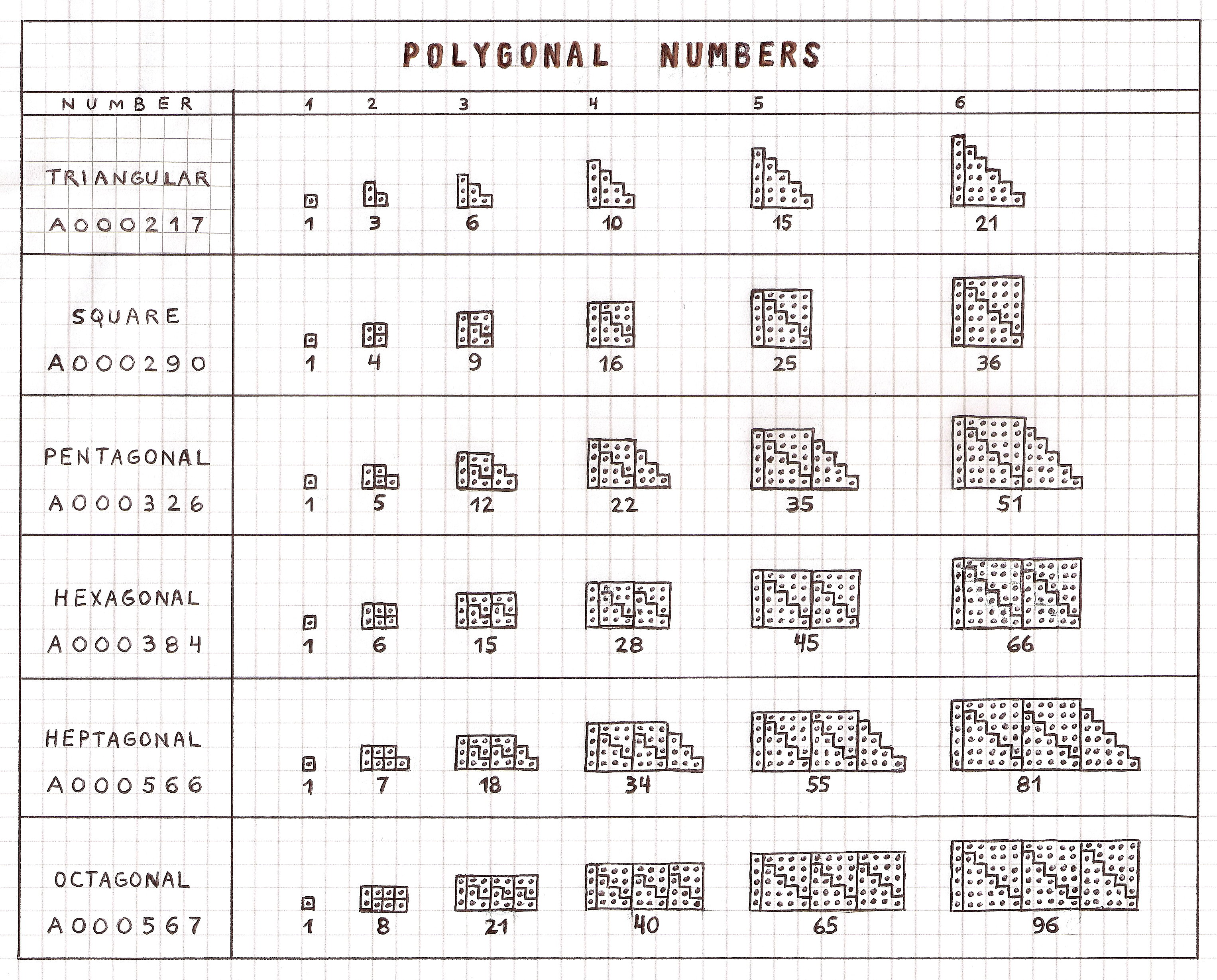
N. J. A. Sloane, Illustration of initial terms of A000217, A000290, A000326

Amelia Carolina Sparavigna, The groupoids of Mersenne, Fermat, Cullen, Woodall and other Numbers and their representations by means of integer sequences, Politecnico di Torino, Italy (2019), [math.NT].
Amelia Carolina Sparavigna, The groupoid of the Triangular Numbers and the generation of related integer sequences, Politecnico di Torino, Italy (2019).
H. Stamm-Wilbrandt, Sum of Pascal's triangle reciprocals [Cached copy from the Wayback Machine]
Leo Tavares, Illustration of the formula "a(n) + a(n-1) = n^2".

T. Trotter, Some Identities for the Triangular Numbers, J. Rec. Math. vol. 6, no. 2 Spring 1973. [Cached copy from the Wayback Machine]
G. Villemin's Almanach of Numbers, Nombres Triangulaires
Manuel Vogel, Motion of a Single Particle in a Real Penning Trap, Particle Confinement in Penning Traps, Springer Series on Atomic, Optical, and Plasma Physics, Vol. 100. Springer, Cham. 2018, 61-88.
Michel Waldschmidt, Continued fractions, École de recherche CIMPA-Oujda, Théorie des Nombres et ses Applications, 18 - 29 mai 2015: Oujda (Maroc).
Eric Weisstein's World of Mathematics, Absolute Value, Binomial Coefficient, Composition, Distance, Golomb Ruler, Line Line Picking, Polygonal Number, Triangular Number, Trinomial Coefficient, and Wiener Index
Wikipedia, Triangular number; also: Floyd's triangle.
Index entries for linear recurrences with constant coefficients, signature (3,-3,1).
FORMULA
G.f.: x/(1-x)^3. - Simon Plouffe in his 1992 dissertation
E.g.f.: exp(x)*(x+x^2/2).
a(n) = a(-1-n).
a(n) + a(n-1)*a(n+1) = a(n)^2. - Terrel Trotter, Jr., Apr 08 2002
a(n) = (-1)^n*Sum_{k=1..n} (-1)^k*k^2. - Benoit Cloitre, Aug 29 2002
a(n+1) = ((n+2)/n)*a(n), Sum_{n>=1} 1/a(n) = 2. - Jon Perry, Jul 13 2003
For n > 0, a(n) = A001109(n) - Sum_{k=0..n-1} (2*k+1)*A001652(n-1-k); e.g., 10 = 204 - (1*119 + 3*20 + 5*3 + 7*0). - Charlie Marion, Jul 18 2003
With interpolated zeros, this is n*(n+2)*(1+(-1)^n)/16. - Benoit Cloitre, Aug 19 2003
a(n+1) is the determinant of the n X n symmetric Pascal matrix M_(i, j) = binomial(i+j+1, i). - Benoit Cloitre, Aug 19 2003
a(n) = ((n+1)^3 - n^3 - 1)/6. - Xavier Acloque, Oct 24 2003
a(n) = a(n-1) + (1 + sqrt(1 + 8*a(n-1)))/2. This recursive relation is inverted when taking the negative branch of the square root, i.e., a(n) is transformed into a(n-1) rather than a(n+1). - Carl R. White, Nov 04 2003
a(n) = Sum_{k=1..n} phi(k)*floor(n/k) = Sum_{k=1..n} A000010(k)*A010766(n, k) (R. Dedekind). - Vladeta Jovovic, Feb 05 2004
a(n) + a(n+1) = (n+1)^2. - N. J. A. Sloane, Feb 19 2004
a(n) = a(n-2) + 2*n - 1. - Paul Barry, Jul 17 2004
a(n) = sqrt(Sum_{i=1..n} Sum_{j=1..n} (i*j)) = sqrt(A000537(n)). - Alexander Adamchuk, Oct 24 2004
a(n) = sqrt(sqrt(Sum_{i=1..n} Sum_{j=1..n} (i*j)^3)) = (Sum_{i=1..n} Sum_{j=1..n} Sum_{k=1..n} (i*j*k)^3)^(1/6). - Alexander Adamchuk, Oct 26 2004
a(n) == 1 (mod n+2) if n is odd and a(n) == n/2+2 (mod n+2) if n is even. - Jon Perry, Dec 16 2004
a(0) = 0, a(1) = 1, a(n) = 2*a(n-1) - a(n-2) + 1. - Miklos Kristof, Mar 09 2005
a(n) = a(n-1) + n. - Zak Seidov, Mar 06 2005
a(n) = A111808(n,2) for n > 1. - Reinhard Zumkeller, Aug 17 2005
a(n)*a(n+1) = A006011(n+1) = (n+1)^2*(n^2+2)/4 = 3*A002415(n+1) = 1/2*a(n^2+2*n). a(n-1)*a(n) = (1/2)*a(n^2-1). - Alexander Adamchuk, Apr 13 2006 [Corrected and edited by Charlie Marion, Nov 26 2010]
a(n) = floor((2*n+1)^2/8). - Paul Barry, May 29 2006
For positive n, we have a(8*a(n))/a(n) = 4*(2*n+1)^2 = (4*n+2)^2, i.e., a(A033996(n))/a(n) = 4*A016754(n) = (A016825(n))^2 = A016826(n). - Lekraj Beedassy, Jul 29 2006
a(n)^2 + a(n+1)^2 = a((n+1)^2) [R B Nelsen, Math Mag 70 (2) (1997), p. 130]. - R. J. Mathar, Nov 22 2006
a(n) = A126890(n,0). - Reinhard Zumkeller, Dec 30 2006
a(n)*a(n+k)+a(n+1)*a(n+1+k) = a((n+1)*(n+1+k)). Generalizes previous formula dated Nov 22 2006 [and comments by J. M. Bergot dated May 22 2012]. - Charlie Marion, Feb 04 2011
(sqrt(8*a(n)+1)-1)/2 = n. - David W. Cantrell (DWCantrell(AT)sigmaxi.net), Feb 26 2007
8*a(n)^3 + a(n)^2 = Y(n)^2, where Y(n) = n*(n+1)*(2*n+1)/2 = 3*A000330(n). - Mohamed Bouhamida, Nov 06 2007 [Edited by Derek Orr, May 05 2015]
A general formula for polygonal numbers is P(k,n) = (k-2)*(n-1)n/2 + n = n + (k-2)*A000217(n-1), for n >= 1, k >= 3. - Omar E. Pol, Apr 28 2008 and Mar 31 2013
a(3*n) = A081266(n), a(4*n) = A033585(n), a(5*n) = A144312(n), a(6*n) = A144314(n). - Reinhard Zumkeller, Sep 17 2008
If we define f(n,i,a) = Sum_{j=0..k-1} (binomial(n,k)*Stirling1(n-k,i)*Product_{j=0..k-1} (-a-j)), then a(n) = -f(n,n-1,1), for n >= 1. - Milan Janjic, Dec 20 2008
4*a(x) + 4*a(y) + 1 = (x+y+1)^2 + (x-y)^2. - Vladimir Shevelev, Jan 21 2009
An exponential generating function for the inverse of this sequence is given by Sum_{m>=0} ((Pochhammer(1, m)*Pochhammer(1, m))*x^m/(Pochhammer(3, m)*factorial(m))) = ((2-2*x)*log(1-x)+2*x)/x^2, the n-th derivative of which has a closed form which must be evaluated by taking the limit as x->0. A000217(n+1) = (lim_{x->0} d^n/dx^n (((2-2*x)*log(1-x)+2*x)/x^2))^-1 = (lim_{x->0} (2*Gamma(n)*(-1/x)^n*(n*(x/(-1+x))^n*(-x+1+n)*LerchPhi(x/(-1+x), 1, n) + (-1+x)*(n+1)*(x/(-1+x))^n + n*(log(1-x)+log(-1/(-1+x)))*(-x+1+n))/x^2))^-1. - Stephen Crowley, Jun 28 2009
a(n) = A034856(n+1) - A005408(n) = A005843(n) + A000124(n) - A005408(n). - Jaroslav Krizek, Sep 05 2009
a(A006894(n)) = a(A072638(n-1)+1) = A072638(n) = A006894(n+1)-1 for n >= 1. For n=4, a(11) = 66. - Jaroslav Krizek, Sep 12 2009
With offset 1, a(n) = floor(n^3/(n+1))/2. - Gary Detlefs, Feb 14 2010
a(n) = 4*a(floor(n/2)) + (-1)^(n+1)*floor((n+1)/2). - Bruno Berselli, May 23 2010
a(n) = 3*a(n-1) - 3*a(n-2) + a(n-3); a(0)=0, a(1)=1. - Mark Dols, Aug 20 2010
From Charlie Marion, Oct 15 2010: (Start)
a(n) + 2*a(n-1) + a(n-2) = n^2 + (n-1)^2; and
a(n) + 3*a(n-1) + 3*a(n-2) + a(n-3) = n^2 + 2*(n-1)^2 + (n-2)^2.
In general, for n >= m > 2, Sum_{k=0..m} binomial(m,m-k)*a(n-k) = Sum_{k=0..m-1} binomial(m-1,m-1-k)*(n-k)^2.
a(n) - 2*a(n-1) + a(n-2) = 1, a(n) - 3*a(n-1) + 3*a(n-2) - a(n-3) = 0 and a(n) - 4*a(n-1) + 6*a(n-2) - 4*(a-3) + a(n-4) = 0.
In general, for n >= m > 2, Sum_{k=0..m} (-1)^k*binomial(m,m-k)*a(n-k) = 0.
(End)
a(n) = sqrt(A000537(n)). - Zak Seidov, Dec 07 2010
For n > 0, a(n) = 1/(Integral_{x=0..Pi/2} 4*(sin(x))^(2*n-1)*(cos(x))^3). - Francesco Daddi, Aug 02 2011
a(n) + a(a(n)) + 1 = a(a(n)+1). - J. M. Bergot, Apr 27 2012
a(n) = -s(n+1,n), where s(n,k) are the Stirling numbers of the first kind, A048994. - Mircea Merca, May 03 2012
a(n)*a(n+1) = a(Sum_{m=1..n} A005408(m))/2, for n >= 1. For example, if n=8, then a(8)*a(9) = a(80)/2 = 1620. - Ivan N. Ianakiev, May 27 2012
G.f.: x * (1 + 3x + 6x^2 + ...) = x * Product_{j>=0} (1+x^(2^j))^3 = x * A(x) * A(x^2) * A(x^4) * ..., where A(x) = (1 + 3x + 3x^2 + x^3). - Gary W. Adamson, Jun 26 2012
G.f.: G(0) where G(k) = 1 + (2*k+3)*x/(2*k+1 - x*(k+2)*(2*k+1)/(x*(k+2) + (k+1)/G(k+1))); (continued fraction, 3rd kind, 3-step). - Sergei N. Gladkovskii, Nov 23 2012
G.f.: x + 3*x^2/(Q(0)-3*x) where Q(k) = 1 + k*(x+1) + 3*x - x*(k+1)*(k+4)/Q(k+1); (continued fraction). - Sergei N. Gladkovskii, Mar 14 2013
a(n) + a(n+1) + a(n+2) + a(n+3) + n = a(2*n+4). - Ivan N. Ianakiev, Mar 16 2013
a(n) + a(n+1) + ... + a(n+8) + 6*n = a(3*n+15). - Charlie Marion, Mar 18 2013
a(n) + a(n+1) + ... + a(n+20) + 2*n^2 + 57*n = a(5*n+55). - Charlie Marion, Mar 18 2013
3*a(n) + a(n-1) = a(2*n), for n > 0. - Ivan N. Ianakiev, Apr 05 2013
In general, a(k*n) = (2*k-1)*a(n) + a((k-1)*n-1). - Charlie Marion, Apr 20 2015
Also, a(k*n) = a(k)*a(n) + a(k-1)*a(n-1). - Robert Israel, Apr 20 2015
a(n+1) = det(binomial(i+2,j+1), 1 <= i,j <= n). - Mircea Merca, Apr 06 2013
a(n) = floor(n/2) + ceiling(n^2/2) = n - floor(n/2) + floor(n^2/2). - Wesley Ivan Hurt, Jun 15 2013
a(n) = floor((n+1)/(exp(2/(n+1))-1)). - Richard R. Forberg, Jun 22 2013
Sum_{n>=1} a(n)/n! = 3*exp(1)/2 by the e.g.f. Also see A067764 regarding ratios calculated this way for binomial coefficients in general. - Richard R. Forberg, Jul 15 2013
Sum_{n>=1} (-1)^(n+1)/a(n) = 4*log(2) - 2 = 0.7725887... . - Richard R. Forberg, Aug 11 2014
2/(Sum_{n>=m} 1/a(n)) = m, for m > 0. - Richard R. Forberg, Aug 12 2014
A228474(a(n))=n; A248952(a(n))=0; A248953(a(n))=a(n); A248961(a(n))=A000330(n). - Reinhard Zumkeller, Oct 20 2014
a(a(n)-1) + a(a(n+2)-1) + 1 = A000124(n+1)^2. - Charlie Marion, Nov 04 2014
Sum_{k=0..n} k*a(k+1) = a(A000096(n+1)). - Charlie Marion, Jul 15 2015
Let O(n) be the oblong number n(n+1) = A002378(n) and S(n) the square number n^2 = A000290(n). Then a(n) + a(n+2k) = O(n+k) + S(k) and a(n) + a(n+2k+1) = S(n+k+1) + O(k). - Charlie Marion, Jul 16 2015
A generalization of the Nov 22 2006 formula, a(n)^2 + a(n+1)^2 = a((n+1)^2), follows. Let T(k,n) = a(n) + k. Then for all k, T(k,n)^2 + T(k,n+1)^2 = T(k,(n+1)^2 + 2*k) - 2*k. - Charlie Marion, Dec 10 2015
a(n)^2 + a(n+1)^2 = a(a(n) + a(n+1)). Deducible from N. J. A. Sloane's a(n) + a(n+1) = (n+1)^2 and R. B. Nelson's a(n)^2 + a(n+1)^2 = a((n+1)^2). - Ben Paul Thurston, Dec 28 2015
Dirichlet g.f.: (zeta(s-2) + zeta(s-1))/2. - Ilya Gutkovskiy, Jun 26 2016
a(n)^2 - a(n-1)^2 = n^3. - Miquel Cerda, Jun 29 2016
a(n) = A080851(0,n-1). - R. J. Mathar, Jul 28 2016
a(n)^2 + a(n+3)^2 + 19 = a(n^2 + 4*n + 10). - Charlie Marion, Nov 23 2016
2*a(n)^2 + a(n) = a(n^2+n). - Charlie Marion, Nov 29 2016
G.f.: x/(1-x)^3 = (x * r(x) * r(x^3) * r(x^9) * r(x^27) * ...), where r(x) = (1 + x + x^2)^3 = (1 + 3*x + 6*x^2 + 7*x^3 + 6*x^4 + 3*x^5 + x^6). - Gary W. Adamson, Dec 03 2016
a(n) = sum of the elements of inverse of matrix Q(n), where Q(n) has elements q_i,j = 1/(1-4*(i-j)^2). So if e = appropriately sized vector consisting of 1's, then a(n) = e'.Q(n)^-1.e. - Michael Yukish, Mar 20 2017
a(n) = Sum_{k=1..n} ((2*k-1)!!*(2*n-2*k-1)!!)/((2*k-2)!!*(2*n-2*k)!!). - Michael Yukish, Mar 20 2017
Sum_{i=0..k-1} a(n+i) = (3*k*n^2 + 3*n*k^2 + k^3 - k)/6. - Christopher Hohl, Feb 23 2019
a(n) == 0 (mod n) iff n is odd (see De Koninck reference). - Bernard Schott, Jan 10 2020
8*a(k)*a(n) + ((a(k)-1)*n + a(k))^2 = ((a(k)+1)*n + a(k))^2. This formula reduces to the well-known formula, 8*a(n) + 1 = (2*n+1)^2, when k = 1. - Charlie Marion, Jul 23 2020
a(k)*a(n) = Sum_{i = 0..k-1} (-1)^i*a((k-i)*(n-i)). - Charlie Marion, Dec 04 2020
From Amiram Eldar, Jan 20 2021: (Start)
Product_{n>=1} (1 + 1/a(n)) = cosh(sqrt(7)*Pi/2)/(2*Pi).
Product_{n>=2} (1 - 1/a(n)) = 1/3. (End)
a(n) = Sum_{k=1..2*n-1} (-1)^(k+1)*a(k)*a(2*n-k). For example, for n = 4, 1*28 - 3*21 + 6*15 - 10*10 + 15*6 - 21*3 + 28*1 = 10. - Charlie Marion, Mar 23 2022
2*a(n) = A000384(n) - n^2 + 2*n. In general, if P(k,n) = the n-th k-gonal number, then (j+1)*a(n) = P(5 + j, n) - n^2 + (j+1)*n. More generally, (j+1)*P(k,n) = P(2*k + (k-2)*(j-1),n) - n^2 + (j+1)*n. - Charlie Marion, Mar 14 2023
EXAMPLE
G.f.: x + 3*x^2 + 6*x^3 + 10*x^4 + 15*x^5 + 21*x^6 + 28*x^7 + 36*x^8 + 45*x^9 + ...
When n=3, a(3) = 4*3/2 = 6.
Example(a(4)=10): ABCD where A, B, C and D are different links in a chain or different amino acids in a peptide possible fragments: A, B, C, D, AB, ABC, ABCD, BC, BCD, CD = 10.
a(2): hollyhock leaves on the Tokugawa Mon, a(4): points in Pythagorean tetractys, a(5): object balls in eight-ball billiards. - Bradley Klee, Aug 24 2015
From Gus Wiseman, Oct 28 2020: (Start)
The a(1) = 1 through a(5) = 15 ordered triples of positive integers summing to n + 2 [Beeler, McGrath above] are the following. These compositions are ranked by A014311.
(111) (112) (113) (114) (115)
(121) (122) (123) (124)
(211) (131) (132) (133)
(212) (141) (142)
(221) (213) (151)
(311) (222) (214)
(231) (223)
(312) (232)
(321) (241)
(411) (313)
(322)
(331)
(412)
(421)
(511)
(End)
MAPLE
A000217 := proc(n) n*(n+1)/2; end;
istriangular:=proc(n) local t1; t1:=floor(sqrt(2*n)); if n = t1*(t1+1)/2 then return true else return false; end if; end proc; # N. J. A. Sloane, May 25 2008
ZL := [S, {S=Prod(B, B, B), B=Set(Z, 1 <= card)}, unlabeled]:
seq(combstruct[count](ZL, size=n), n=2..55); # Zerinvary Lajos, Mar 24 2007
isA000217 := proc(n)
issqr(1+8*n) ;
end proc: # R. J. Mathar, Nov 29 2015 [This is the recipe Leonhard Euler proposes in chapter VII of his "Vollständige Anleitung zur Algebra", 1765. Peter Luschny, Sep 02 2022]
MATHEMATICA
Array[ #*(# - 1)/2 &, 54] (* Zerinvary Lajos, Jul 10 2009 *)
FoldList[#1 + #2 &, 0, Range@ 50] (* Robert G. Wilson v, Feb 02 2011 *)
Accumulate[Range[0, 70]] (* Harvey P. Dale, Sep 09 2012 *)
CoefficientList[Series[x / (1 - x)^3, {x, 0, 50}], x] (* Vincenzo Librandi, Jul 30 2014 *)
(* For Mathematica 10.4+ *) Table[PolygonalNumber[n], {n, 0, 53}] (* Arkadiusz Wesolowski, Aug 27 2016 *)
LinearRecurrence[{3, -3, 1}, {0, 1, 3}, 54] (* Robert G. Wilson v, Dec 04 2016 *)
(* The following Mathematica program, courtesy of Steven J. Miller, is useful for testing if a sequence is Benford. To test a different sequence only one line needs to be changed. This strongly suggests that the triangular numbers are not Benford, since the second and third columns of the output disagree. - N. J. A. Sloane, Feb 12 2017 *)
fd[x_] := Floor[10^Mod[Log[10, x], 1]]
benfordtest[num_] := Module[{},
For[d = 1, d <= 9, d++, digit[d] = 0];
For[n = 1, n <= num, n++,
{
d = fd[n(n+1)/2];
If[d != 0, digit[d] = digit[d] + 1];
}];
For[d = 1, d <= 9, d++, digit[d] = 1.0 digit[d]/num];
For[d = 1, d <= 9, d++,
Print[d, " ", 100.0 digit[d], " ", 100.0 Log[10, (d + 1)/d]]];
];
benfordtest[20000]
Table[Length[Join@@Permutations/@IntegerPartitions[n, {3}]], {n, 0, 15}] (* Gus Wiseman, Oct 28 2020 *)
PROG
(PARI) A000217(n) = n * (n + 1) / 2;
(PARI) is_A000217(n)=n*2==(1+n=sqrtint(2*n))*n \\ M. F. Hasler, May 24 2012
(PARI) is(n)=ispolygonal(n, 3) \\ Charles R Greathouse IV, Feb 28 2014
(PARI) list(lim)=my(v=List(), n, t); while((t=n*n++/2)<=lim, listput(v, t)); Vec(v) \\ Charles R Greathouse IV, Jun 18 2021
(Haskell)
a000217 n = a000217_list !! n
a000217_list = scanl1 (+) [0..] -- Reinhard Zumkeller, Sep 23 2011
(Magma) [n*(n+1)/2: n in [0..60]]; // Bruno Berselli, Jul 11 2014
(Magma) [n: n in [0..1500] | IsSquare(8*n+1)]; // Juri-Stepan Gerasimov, Apr 09 2016
(SageMath) [n*(n+1)/2 for n in (0..60)] # Bruno Berselli, Jul 11 2014
(Scala) (1 to 53).scanLeft(0)(_ + _) // Horstmann (2012), p. 171
(Scheme) (define (A000217 n) (/ (* n (+ n 1)) 2)) ;; Antti Karttunen, Jul 08 2017
(J) a000217=: *-:@>: NB. Stephen Makdisi, May 02 2018
(Python) for n in range(0, 60): print(n*(n+1)/2, end=', ') # Stefano Spezia, Dec 06 2018
(Python) # Intended to compute the initial segment of the sequence, not
# isolated terms. If in the iteration the line "x, y = x + y + 1, y + 1"
# is replaced by "x, y = x + y + k, y + k" then the figurate numbers are obtained,
# for k = 0 (natural A001477), k = 1 (triangular), k = 2 (squares), k = 3 (pentagonal), k = 4 (hexagonal), k = 5 (heptagonal), k = 6 (octagonal), etc.
def aList():
x, y = 1, 1
yield 0
while True:
yield x
x, y = x + y + 1, y + 1
A000217 = aList()
print([next(A000217) for i in range(54)]) # Peter Luschny, Aug 03 2019
CROSSREFS
The figurate numbers, with parameter k as in the second Python program: A001477 (k=0), this sequence (k=1), A000290 (k=2), A000326 (k=3), A000384 (k=4), A000566 (k=5), A000567 (k=6), A001106 (k=7), A001107 (k=8).
Cf. A000096, A000124, A000292, A000330, A000396, A000668, A001082, A001788, A002024, A002378, A002415, A003056 (inverse function), A004526, A006011, A007318, A008953, A008954, A010054 (characteristic function), A028347, A036666, A046092, A051942, A055998, A055999, A056000, A056115, A056119, A056121, A056126, A062717, A087475, A101859, A109613, A143320, A210569, A245031, A245300, A060544, A016754.
a(n) = A110449(n, 0).
a(n) = A110555(n+2, 2).
A diagonal of A008291.
Column 2 of A195152.
Numbers of the form n*t(n+k,h)-(n+k)*t(n,h), where t(i,h) = i*(i+2*h+1)/2 for any h (for A000217 is k=1): A005563, A067728, A140091, A140681, A212331.
Iterations: A007501 (start=2), A013589 (start=4), A050542 (start=5), A050548 (start=7), A050536 (start=8), A050909 (start=9).
Cf. A104712 (first column, starting with a(1)).
A011782 counts compositions of any length.
KEYWORD
nonn,core,easy,nice,changed
AUTHOR
EXTENSIONS
Edited by Derek Orr, May 05 2015
STATUS
approved