
OFFSET
2,2
COMMENTS
Number of lattice paths from (0,0) to (n,n) with steps E=(1,0) and N=(0,1) which touch or cross the line x-y=2. Example: For n=3 there are 6 paths EEENNN, EENENN, EENNEN, EENNNE, ENEENN and NEEENN. - Herbert Kociemba, May 23 2004
Number of dissections of a convex (n+3)-gon by noncrossing diagonals into several regions, exactly n-2 of which are triangular. Example: a(3)=6 because the convex hexagon ABCDEF is dissected by any of the diagonals AC, BD, CE, DF, EA, FB into regions containing exactly 1 triangle. - Emeric Deutsch, May 31 2004
Number of UUU's (triple rises), where U=(1,1), in all Dyck paths of semilength n+1. Example: a(3)=6 because we have UD(UUU)DDD, (UUU)DDDUD, (UUU)DUDDD, (UUU)DDUDD and (U[UU)U]DDDD, the triple rises being shown between parentheses. - Emeric Deutsch, Jun 03 2004
Inverse binomial transform of A026389. - Ross La Haye, Mar 05 2005
Sum of the jump-lengths of all full binary trees with n internal nodes. In the preorder traversal of a full binary tree, any transition from a node at a deeper level to a node on a strictly higher level is called a jump; the positive difference of the levels is called the jump distance; the sum of the jump distances in a given full binary tree is called the jump-length. - Emeric Deutsch, Jan 18 2007
a(n) = number of convex polyominoes (A005436) of perimeter 2n+4 that are directed but not parallelogram polyominoes, because the directed convex polyominoes are counted by the central binomial coefficient binomial(2n,n) and the subset of parallelogram polyominoes is counted by the Catalan number C(n+1) = binomial(2n+2,n+1)/(n+2) and a(n) = binomial(2n,n) - C(n+1). - David Callan, Nov 29 2007
a(n) = number of DUU's in all Dyck paths of semilength n+1. Example: a(3)=6 because we have UU(DUU)DDD, U(DUU)UDDD, U(DUU)DUDD, UDU(DUU)DD, U(DUU)DDUD, UUD(DUU)DD, the DUU's being shown between parentheses and no other Dyck path of semilength 4 contains a DUU. - David Callan, Jul 25 2008
C(2n,n-m) is the number of Dyck-type walks such that their graphs have one marked edge passed 2m times and the other edges are passed 2 times counting "there and back" directions. - Oleksiy Khorunzhiy, Jan 09 2015
Number of paths in the half-plane x >= 0, from (0,0) to (2n,4), and consisting of steps U=(1,1) and D=(1,-1). For example, for n=3, we have the 6 paths: UUUUUD, UUUUDU, UUUDUU, UUDUUU, UDUUUU, DUUUUU, DUUUUU. - José Luis Ramírez Ramírez, Apr 19 2015
REFERENCES
M. Abramowitz and I. A. Stegun, eds., Handbook of Mathematical Functions, National Bureau of Standards Applied Math. Series 55, 1964 (and various reprintings), p. 828.
Cornelius Lanczos, Applied Analysis. Prentice-Hall, Englewood Cliffs, NJ, 1956, p. 517.
N. J. A. Sloane, A Handbook of Integer Sequences, Academic Press, 1973 (includes this sequence).
N. J. A. Sloane and Simon Plouffe, The Encyclopedia of Integer Sequences, Academic Press, 1995 (includes this sequence).
LINKS
T. D. Noe, Table of n, a(n) for n = 2..200
M. Abramowitz and I. A. Stegun, eds., Handbook of Mathematical Functions, National Bureau of Standards, Applied Math. Series 55, Tenth Printing, 1972 [alternative scanned copy].
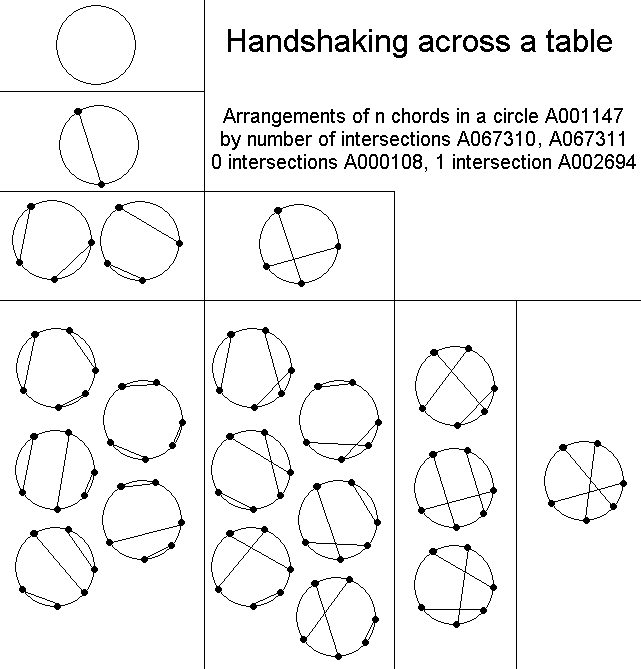
Henry Bottomley, Illustration for A000108, A001147, A002694, A067310 and A067311.
Sela Fried and Mark Shattuck, Counting s-Catalan Words According to Total Variation, ECA 6:2 (2026) Article #S2R16, pp. 1-15. See p. 4.
Milan Janjic, Two Enumerative Functions
Milan Janjic and Boris Petkovic, A Counting Function, arXiv:1301.4550 [math.CO], 2013. - N. J. A. Sloane, Feb 13 2013
Milan Janjic and Boris Petkovic, A Counting Function Generalizing Binomial Coefficients and Some Other Classes of Integers, J. Int. Seq. 17 (2014), Article 14.3.5.
Oleksiy Khorunzhiy, On high moments and the spectral norm of large dilute Wigner random matrices, arXiv:1107.5724 [math-ph], 2011-2013.
Oleksiy Khorunzhiy, On high moments and the spectral norm of large dilute Wigner random matrices, Zh. Mat. Fiz. Anal. Geom. 10 (1) (2014), pp. 64-125.
Werner Krandick, Trees and jumps and real roots, J. Computational and Applied Math., 162 (2004), 51-55.
Cornelius Lanczos, Applied Analysis. (Annotated scans of selected pages)
Asamoah Nkwanta and Earl R. Barnes, Two Catalan-type Riordan Arrays and their Connections to the Chebyshev Polynomials of the First Kind, Journal of Integer Sequences, Vol. 15 (2012), Article 12.3.3. - From N. J. A. Sloane, Sep 16 2012
Vincent Pilaud and Juanjo Rué, Analytic combinatorics of chord and hyperchord diagrams with k crossings, Adv. Appl. Math., Vol. 57 (2014), 60-100; arXiv preprint, arXiv:1307.6440 [math.CO], 2013.
Mark Shattuck, Enumeration of non-crossing partitions according to subwords with repeated letters, arXiv:2303.06300 [math.CO], 2023.
Mark Shattuck, Combinatorial proofs of totals of some statistics on Catalan words, arXiv:2512.07008 [math.CO], 2025. See p. 2.
Daniel W. Stasiuk, An Enumeration Problem for Sequences of n-ary Trees Arising from Algebraic Operads, Master's Thesis, University of Saskatchewan-Saskatoon (2018).
Terence Tao and Van Vu, Random matrices: localization of the eigenvalues and the necessity of four moments, arXiv:1005.2901 [math.PR], 2010-2011; Acta Math. Vietnam 36 (2) (2011) 431-449.
N. J. Wildberger and Dean Rubine, A Hyper-Catalan Series Solution to Polynomial Equations, and the Geode, Amer. Math. Monthly, Vol. 132, No. 5 (2025), pp. 383-402. See section 12.
Lin Yang and Shengliang Yang, Protected Branches in Ordered Trees, J. Math. Study, Vol. 56, No. 1 (2023), 1-17.
FORMULA
a(n) = A067310(n, 1) as this is number of ways of arranging n chords on a circle (handshakes between 2n people across a table) with exactly 1 simple intersection. - Henry Bottomley, Oct 07 2002
E.g.f.: exp(2*x) * BesselI(2, 2*x). - Vladeta Jovovic, Aug 21 2003
G.f.: (1-sqrt(1-4*z))^4/(16*z^2*sqrt(1-4*z)). - Emeric Deutsch, Jan 28 2004
a(n) = Sum_{k=0..n} C(n, k)*C(n, k+2). - Paul Barry, Sep 20 2004
D-finite with recurrence: -(n-2)*(n+2)*a(n) + 2*n*(2*n-1)*a(n-1) = 0. - R. J. Mathar, Dec 04 2012
G.f.: z^2*C(z)^4/(1-2*z*C(z)), where C(z) is the g.f. of Catalan numbers. - José Luis Ramírez Ramírez, Apr 19 2015
a(n) = Sum_{k=1..n} binomial(2*n-k,n-k-1). - Vladimir Kruchinin, Oct 22 2016
G.f.: x^2* 2F1(5/2,3;5;4*x). - R. J. Mathar, Jan 27 2020
From Amiram Eldar, May 16 2022: (Start)
Sum_{n>=2} 1/a(n) = 23/6 - 13*Pi/(9*sqrt(3)).
Sum_{n>=2} (-1)^n/a(n) = 106*log(phi)/(5*sqrt(5)) - 37/10, where phi is the golden ratio (A001622). (End)
From Peter Bala, Oct 13 2024: (Start)
a(n) = Integral_{x = 0..4} x^n * w(x) dx, where the weight function w(x) = 1/(2*Pi) * (x^2 - 4*x + 2)/sqrt(x*(4 - x)).
G.f. x^2 * B(x) * C(x)^4, where B(x) = 1/sqrt(1 - 4*x) is the g.f. of the central binomial coefficients A000984 and C(x) = (1 - sqrt(1 - 4*x))/(2*x) is the g.f. of the Catalan numbers A000108. (End)
a(n) ~ 4^n / sqrt(Pi*n). - Amiram Eldar, Oct 11 2025
a(n) = binomial(n+2, 4) * Product_{1 <= i, j <= n-2} (i + j + 4)/(i + j + 3). - Peter Bala, Nov 17 2025
a(n) = A002054(n-1)*2*n/(n+2). - R. J. Mathar, Mar 14 2026
MAPLE
a:=n->sum(binomial(n, j-1)*binomial(n, j+1), j=1..n): seq(a(n), n=2..25); # Zerinvary Lajos, Nov 26 2006
MATHEMATICA
CoefficientList[ Series[ 16/(((Sqrt[1 - 4 x] + 1)^4)*Sqrt[1 - 4 x]), {x, 0, 23}], x] (* Robert G. Wilson v, Aug 08 2011 *)
Table[Binomial[2n, n-2], {n, 2, 30}] (* Harvey P. Dale, Jun 12 2014 *)
PROG
(Haskell)
a002694 n = a007318' (2 * n) (n - 2) -- Reinhard Zumkeller, Jun 18 2012
(Magma) [Binomial(2*n, n-2): n in [2..30]]; // Vincenzo Librandi, Apr 20 2015
(PARI) {a(n) = binomial(2*n, n-2)}; \\ G. C. Greubel, Mar 21 2019
(SageMath) [binomial(2*n, n-2) for n in (2..30)] # G. C. Greubel, Mar 21 2019
(GAP) List([2..30], n-> Binomial(2*n, n-2)); # G. C. Greubel, Mar 21 2019
CROSSREFS
Cf. A006659.
Diagonal 5 of triangle A100257.
Cf. binomial(k*n, n-k): A000027 (k=1), this sequence (k=2), A004321 (k=3), A004334 (k=4), A004347 (k=5), A004361 (k=6), A004375 (k=7), A004389 (k=8), A281580 (k=9).
KEYWORD
nonn,easy
AUTHOR
STATUS
approved