
OFFSET
0,2
COMMENTS
-2, -4, -6, -8, -10, -12, -14, ... are the trivial zeros of the Riemann zeta function. - Vivek Suri (vsuri(AT)jhu.edu), Jan 24 2008
If a 2-set Y and an (n-2)-set Z are disjoint subsets of an n-set X then a(n-2) is the number of 2-subsets of X intersecting both Y and Z. - Milan Janjic, Sep 19 2007
Omitting the initial zero gives the number of prime divisors with multiplicity of product of terms of n-th row of A077553. - Ray Chandler, Aug 21 2003
(APSO) Alternating partial sums of (a-b+c-d+e-f+g...) = (a+b+c+d+e+f+g...) - 2*(b+d+f...), it appears that APSO(A005843) = A052928 = A002378 - 2*(A116471), with A116471=2*A008794. - Eric Desbiaux, Oct 28 2008
A056753(a(n)) = 1. - Reinhard Zumkeller, Aug 23 2009
Twice the nonnegative numbers. - Juri-Stepan Gerasimov, Dec 12 2009
The number of hydrogen atoms in straight-chain (C(n)H(2n+2)), branched (C(n)H(2n+2), n > 3), and cyclic, n-carbon alkanes (C(n)H(2n), n > 2). - Paul Muljadi, Feb 18 2010
For n >= 1; a(n) = the smallest numbers m with the number of steps n of iterations of {r - (smallest prime divisor of r)} needed to reach 0 starting at r = m. See A175126 and A175127. A175126(a(n)) = A175126(A175127(n)) = n. Example (a(4)=8): 8-2=6, 6-2=4, 4-2=2, 2-2=0; iterations has 4 steps and number 8 is the smallest number with such result. - Jaroslav Krizek, Feb 15 2010
For n >= 1, a(n) = numbers k such that arithmetic mean of the first k positive integers is not integer. A040001(a(n)) > 1. See A145051 and A040001. - Jaroslav Krizek, May 28 2010
a(k) is the (Moore lower bound on and the) order of the (k,4)-cage: the smallest k-regular graph having girth four: the complete bipartite graph with k vertices in each part. - Jason Kimberley, Oct 30 2011
For n > 0: A048272(a(n)) <= 0. - Reinhard Zumkeller, Jan 21 2012
Let n be the number of pancakes that have to be divided equally between n+1 children. a(n) is the minimal number of radial cuts needed to accomplish the task. - Ivan N. Ianakiev, Sep 18 2013
For n > 0, a(n) is the largest number k such that (k!-n)/(k-n) is an integer. - Derek Orr, Jul 02 2014
a(n) when n > 2 is also the number of permutations simultaneously avoiding 213, 231 and 321 in the classical sense which can be realized as labels on an increasing strict binary tree with 2n-1 nodes. See A245904 for more information on increasing strict binary trees. - Manda Riehl Aug 07 2014
It appears that for n > 2, a(n) = A020482(n) + A002373(n), where all sequences are infinite. This is consistent with Goldbach's conjecture, which states that every even number > 2 can be expressed as the sum of two prime numbers. - Bob Selcoe, Mar 08 2015
Number of partitions of 4n into exactly 2 parts. - Colin Barker, Mar 23 2015
Number of neighbors in von Neumann neighborhood. - Dmitry Zaitsev, Nov 30 2015
Unique solution b( ) of the complementary equation a(n) = a(n-1)^2 - a(n-2)*b(n-1), where a(0) = 1, a(1) = 3, and a( ) and b( ) are increasing complementary sequences. - Clark Kimberling, Nov 21 2017
Also the maximum number of non-attacking bishops on an (n+1) X (n+1) board (n>0). (Cf. A000027 for rooks and queens (n>3), A008794 for kings or A030978 for knights.) - Martin Renner, Jan 26 2020
Integer k is even positive iff phi(2k) > phi(k), where phi is Euler's totient (A000010) [see reference De Koninck & Mercier]. - Bernard Schott, Dec 10 2020
Number of 3-permutations of n elements avoiding the patterns 132, 213, 312 and also number of 3-permutations avoiding the patterns 213, 231, 321. See Bonichon and Sun. - Michel Marcus, Aug 20 2022
REFERENCES
T. M. Apostol, Introduction to Analytic Number Theory, Springer-Verlag, 1976, page 2.
J.-M. De Koninck and A. Mercier, 1001 Problèmes en Théorie Classique des Nombres, Problème 529a pp. 71 and 257, Ellipses, 2004, Paris.
N. J. A. Sloane and Simon Plouffe, The Encyclopedia of Integer Sequences, Academic Press, 1995 (includes this sequence).
LINKS
N. J. A. Sloane, Table of n, a(n) for n = 0..10000
Nicolas Bonichon and Pierre-Jean Morel, Baxter d-permutations and other pattern avoiding classes, arXiv:2202.12677 [math.CO], 2022.
David Callan, On Ascent, Repetition and Descent Sequences, arXiv:1911.02209 [math.CO], 2019.
Charles Cratty, Samuel Erickson, Frehiwet Negass, and Lara Pudwell, Pattern Avoidance in Double Lists, preprint, 2015.
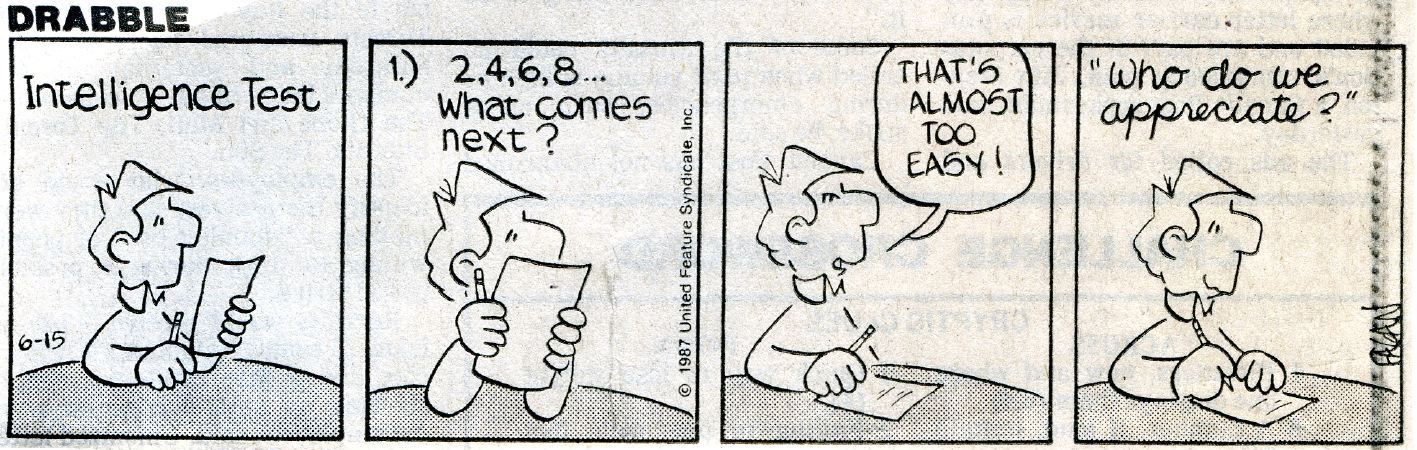
Kevin Fagan, Drabble cartoon, Jun 15 1987: Intelligence Test
Adam M. Goyt and Lara K. Pudwell, Avoiding colored partitions of two elements in the pattern sense, arXiv preprint arXiv:1203.3786 [math.CO], 2012, J. Int. Seq. 15 (2012) # 12.6.2
Milan Janjic, Two Enumerative Functions
Tanya Khovanova, Recursive Sequences
Simon Plouffe, Approximations de séries génératrices et quelques conjectures, Dissertation, Université du Québec à Montréal, 1992; arXiv:0911.4975 [math.NT], 2009.
Simon Plouffe, 1031 Generating Functions, Appendix to Thesis, Montreal, 1992.
Nathan Sun, On d-permutations and Pattern Avoidance Classes, arXiv:2208.08506 [math.CO], 2022.
Eric Weisstein's World of Mathematics, Even Number
Eric Weisstein's World of Mathematics, Hamiltonian Cycle
Eric Weisstein's World of Mathematics, Riemann Zeta Function Zeros
Wikipedia, Alkane
Index entries for linear recurrences with constant coefficients, signature (2,-1).
FORMULA
G.f.: 2*x/(1-x)^2.
E.g.f.: 2*x*exp(x). - Geoffrey Critzer, Aug 25 2012
G.f. with interpolated zeros: 2x^2/((1-x)^2 * (1+x)^2); e.g.f. with interpolated zeros: x*sinh(x). - Geoffrey Critzer, Aug 25 2012
Inverse binomial transform of A036289, n*2^n. - Joshua Zucker, Jan 13 2006
a(0) = 0, a(1) = 2, a(n) = 2a(n-1) - a(n-2). - Jaume Oliver Lafont, May 07 2008
a(n) = Sum_{k=1..n} floor(6n/4^k + 1/2). - Vladimir Shevelev, Jun 04 2009
a(n) = A034856(n+1) - A000124(n) = A000217(n) + A005408(n) - A000124(n) = A005408(n) - 1. - Jaroslav Krizek, Sep 05 2009
Digit sequence 22 read in base n-1. - Jason Kimberley, Oct 30 2011
a(n) = 3*a(n-1) - 3*a(n-2) + a(n-3). - Vincenzo Librandi, Dec 23 2011
a(n) = 2*n = Product_{k=1..2*n-1} 2*sin(Pi*k/(2*n)), n >= 0 (undefined product := 1). See an Oct 09 2013 formula contribution in A000027 with a reference. - Wolfdieter Lang, Oct 10 2013
From Ilya Gutkovskiy, Aug 19 2016: (Start)
From Bernard Schott, Dec 10 2020: (Start)
Sum_{n>=1} 1/a(n)^2 = Pi^2/24 = A222171.
Sum_{n>=1} (-1)^(n+1)/a(n)^2 = Pi^2/48 = A245058. (End)
EXAMPLE
G.f. = 2*x + 4*x^2 + 6*x^3 + 8*x^4 + 10*x^5 + 12*x^6 + 14*x^7 + 16*x^8 + ...
MAPLE
A005843 := n->2*n;
A005843:=2/(z-1)**2; # Simon Plouffe in his 1992 dissertation
MATHEMATICA
Range[0, 120, 2] (* Harvey P. Dale, Aug 16 2011 *)
PROG
(Magma) [ 2*n : n in [0..100]];
(R) seq(0, 200, 2)
(PARI) A005843(n) = 2*n
(Haskell)
a005843 = (* 2)
a005843_list = [0, 2 ..] -- Reinhard Zumkeller, Feb 11 2012
(Python) def a(n): return 2*n # Martin Gergov, Oct 20 2022
CROSSREFS
a(n)=2*A001477(n). - Juri-Stepan Gerasimov, Dec 12 2009
Cf. A000027, A002061, A005408, A001358, A077553, A077554, A077555, A002024, A087112, A157888, A157889, A140811, A157872, A157909, A157910, A165900.
Moore lower bound on the order of a (k,g) cage: A198300 (square); rows: A000027 (k=2), A027383 (k=3), A062318 (k=4), A061547 (k=5), A198306 (k=6), A198307 (k=7), A198308 (k=8), A198309 (k=9), A198310 (k=10), A094626 (k=11); columns: A020725 (g=3), this sequence (g=4), A002522 (g=5), A051890 (g=6), A188377 (g=7). - Jason Kimberley, Oct 30 2011
Cf. A231200 (boustrophedon transform).
KEYWORD
nonn,easy,core,nice
AUTHOR
STATUS
approved