
OFFSET
0,3
COMMENTS
Number of edges in the join of two complete graphs, each of order n, K_n * K_n. - Roberto E. Martinez II, Jan 07 2002
The power series expansion of the entropy function H(x) = (1+x)log(1+x) + (1-x)log(1-x) has 1/a_i as the coefficient of x^(2i) (the odd terms being zero). - Tommaso Toffoli (tt(AT)bu.edu), May 06 2002
Partial sums of A016813 (4n+1). Also with offset = 0, a(n) = (2n+1)(n+1) = A005408 * A000027 = 2n^2 + 3n + 1, i.e., a(0) = 1. - Jeremy Gardiner, Sep 29 2002
Sequence also gives the greatest semiperimeter of primitive Pythagorean triangles having inradius n-1. Such a triangle has consecutive longer sides, with short leg 2n-1, hypotenuse a(n) - (n-1) = A001844(n), and area (n-1)*a(n) = 6*A000330(n-1). - Lekraj Beedassy, Apr 23 2003
More generally, if p1 and p2 are two arbitrarily chosen distinct primes then a(n) is the number of divisors of (p1^2*p2)^(n-1) or equivalently of any member of A054753^(n-1). - Ant King, Aug 29 2011
Number of standard tableaux of shape (2n-1,1,1) (n>=1). - Emeric Deutsch, May 30 2004
It is well known that for n>0, A014105(n) [0,3,10,21,...] is the first of 2n+1 consecutive integers such that the sum of the squares of the first n+1 such integers is equal to the sum of the squares of the last n; e.g., 10^2 + 11^2 + 12^2 = 13^2 + 14^2.
Less well known is that for n>1, a(n) [0,1,6,15,28,...] is the first of 2n consecutive integers such that sum of the squares of the first n such integers is equal to the sum of the squares of the last n-1 plus n^2; e.g., 15^2 + 16^2 + 17^2 = 19^2 + 20^2 + 3^2. - Charlie Marion, Dec 16 2006
a(n) is also a perfect number A000396 when n is an even superperfect number A061652. - Omar E. Pol, Sep 05 2008
Sequence found by reading the line from 0, in the direction 0, 6, ... and the line from 1, in the direction 1, 15, ..., in the square spiral whose vertices are the generalized hexagonal numbers A000217. - Omar E. Pol, Jan 09 2009
Let Hex(n)=hexagonal number, T(n)=triangular number, then Hex(n)=T(n)+3*T(n-1). - Vincenzo Librandi, Nov 10 2010
For n>=1, 1/a(n) = Sum_{k=0..2*n-1} ((-1)^(k+1)*binomial(2*n-1,k)*binomial(2*n-1+k,k)*H(k)/(k+1)) with H(k) harmonic number of order k.
The number of possible distinct colorings of any 2 colors chosen from n colors of a square divided into quadrants. - Paul Cleary, Dec 21 2010
Central terms of the triangle in A051173. - Reinhard Zumkeller, Apr 23 2011
For n>0, a(n-1) is the number of triples (w,x,y) with all terms in {0,...,n} and max(|w-x|,|x-y|) = |w-y|. - Clark Kimberling, Jun 12 2012
a(n) is the number of positions of one domino in an even pyramidal board with base 2n. - César Eliud Lozada, Sep 26 2012
Partial sums give A002412. - Omar E. Pol, Jan 12 2013
Let a triangle have T(0,0) = 0 and T(r,c) = |r^2 - c^2|. The sum of the differences of the terms in row(n) and row(n-1) is a(n). - J. M. Bergot, Jun 17 2013
a(n+1) = A128918(2*n+1). - Reinhard Zumkeller, Oct 13 2013
With T_(i+1,i)=a(i+1) and all other elements of the lower triangular matrix T zero, T is the infinitesimal generator for A176230, analogous to A132440 for the Pascal matrix. - Tom Copeland, Dec 11 2013
a(n) is the number of length 2n binary sequences that have exactly two 1's. a(2) = 6 because we have: {0,0,1,1}, {0,1,0,1}, {0,1,1,0}, {1,0,0,1}, {1,0,1,0}, {1,1,0,0}. The ordinary generating function with interpolated zeros is: (x^2 + 3*x^4)/(1-x^2)^3. - Geoffrey Critzer, Jan 02 2014
For n > 0, a(n) is the largest integer k such that k^2 + n^2 is a multiple of k + n. More generally, for m > 0 and n > 0, the largest integer k such that k^(2*m) + n^(2*m) is a multiple of k + n is given by k = 2*n^(2*m) - n. - Derek Orr, Sep 04 2014
Binomial transform of (0, 1, 4, 0, 0, 0, ...) and second partial sum of (0, 1, 4, 4, 4, ...). - Gary W. Adamson, Oct 05 2015
a(n) also gives the dimension of the simple Lie algebras D_n, for n >= 4. - Wolfdieter Lang, Oct 21 2015
For n > 0, a(n) equals the number of compositions of n+11 into n parts avoiding parts 2, 3, 4. - Milan Janjic, Jan 07 2016
Also the number of minimum dominating sets and maximal irredundant sets in the n-cocktail party graph. - Eric W. Weisstein, Jun 29 and Aug 17 2017
As Beedassy's formula shows, this Hexagonal number sequence is the odd bisection of the Triangle number sequence. Both of these sequences are figurative number sequences. For A000384, a(n) can be found by multiplying its triangle number by its hexagonal number. For example let's use the number 153. 153 is said to be the 17th triangle number but is also said to be the 9th hexagonal number. Triangle(17) Hexagonal(9). 17*9=153. Because the Hexagonal number sequence is a subset of the Triangle number sequence, the Hexagonal number sequence will always have both a triangle number and a hexagonal number. n* (2*n-1) because (2*n-1) renders the triangle number. - Bruce J. Nicholson, Nov 05 2017
Also numbers k with the property that in the symmetric representation of sigma(k) the smallest Dyck path has a central valley and the largest Dyck path has a central peak, n >= 1. Thus all hexagonal numbers > 0 have middle divisors. (Cf. A237593.) - Omar E. Pol, Aug 28 2018
k^a(n-1) mod n = 1 for prime n and k=2..n-1. - Joseph M. Shunia, Feb 10 2019
Consider all Pythagorean triples (X, Y, Z=Y+1) ordered by increasing Z: a(n+1) gives the semiperimeter of related triangles; A005408, A046092 and A001844 give the X, Y and Z values. - Ralf Steiner, Feb 25 2020
See A002939(n) = 2*a(n) for the corresponding perimeters. - M. F. Hasler, Mar 09 2020
It appears that these are the numbers k with the property that the smallest subpart in the symmetric representation of sigma(k) is 1. - Omar E. Pol, Aug 28 2021
The above conjecture is true. See A280851 for a proof. - Hartmut F. W. Hoft, Feb 02 2022
The n-th hexagonal number equals the sum of the n consecutive integers with the same parity starting at 2*n-1; for example, 1, 2+4, 3+5+7, 4+6+8+10, etc. In general, the n-th 2k-gonal number is the sum of the n consecutive integers with the same parity starting at (k-2)*n - (k-3). When k = 1 and 2, this result generates the positive integers, A000027, and the squares, A000290, respectively. - Charlie Marion, Mar 02 2022
Conjecture: For n>0, min{k such that there exist subsets A,B of {0,1,2,...,a(n)} such that |A|=|B|=k and A+B={0,1,2,...,2*a(n)}} = 2*n. - Michael Chu, Mar 09 2022
REFERENCES
Albert H. Beiler, Recreations in the Theory of Numbers, Dover, NY, 1964, p. 189.
Louis Comtet, Advanced Combinatorics, Reidel, 1974, pp. 77-78. (In the integral formula on p. 77 a left bracket is missing for the cosine argument.)
E. Deza and M. M. Deza, Figurate numbers, World Scientific Publishing (2012), page 6.
L. E. Dickson, History of the Theory of Numbers. Carnegie Institute Public. 256, Washington, DC, Vol. 1, 1919; Vol. 2, 1920; Vol. 3, 1923, see vol. 2, p. 2.
N. J. A. Sloane, A Handbook of Integer Sequences, Academic Press, 1973 (includes this sequence).
N. J. A. Sloane and Simon Plouffe, The Encyclopedia of Integer Sequences, Academic Press, 1995 (includes this sequence).
David Wells, The Penguin Dictionary of Curious and Interesting Numbers. Penguin Books, NY, 1986, Revised edition 1987. See pp. 122-123.
LINKS
Daniel Mondot, Table of n, a(n) for n = 0..10000 (first 1000 terms by T. D. Noe)
C. K. Cook and M. R. Bacon, Some polygonal number summation formulas, Fib. Q., 52 (2014), 336-343.
Elena Deza and Michel Deza, Figurate Numbers: presentation of a book, 3rd Montreal-Toronto Workshop in Number Theory, October 7-9, 2011.
Anicius Manlius Severinus Boethius, De institutione arithmetica, Book 2, section 15.
Jonathan M. Borwein, Dirk Nuyens, Armin Straub and James Wan, Random Walk Integrals, The Ramanujan Journal, October 2011, 26:109. DOI: 10.1007/s11139-011-9325-y.
Cesar Ceballos and Viviane Pons, The s-weak order and s-permutahedra II: The combinatorial complex of pure intervals, arXiv:2309.14261 [math.CO], 2023. See p. 41.
Paul Cooijmans, Odds.
Olivier Danvy, Summa Summarum: Moessner's Theorem without Dynamic Programming, arXiv:2412.03127 [cs.DM], 2024. See p. 33.
Tomislav Došlić and Luka Podrug, Sweet division problems: from chocolate bars to honeycomb strips and back, arXiv:2304.12121 [math.CO], 2023.
Jose Manuel Garcia Calcines, Luis Javier Hernandez Paricio, and Maria Teresa Rivas Rodriguez, Semi-simplicial combinatorics of cyclinders and subdivisions, arXiv:2307.13749 [math.CO], 2023. See p. 32.
INRIA Algorithms Project, Encyclopedia of Combinatorial Structures 340.
Milan Janjic, Two Enumerative Functions.
Pakawut Jiradilok and Elchanan Mossel, Gaussian Broadcast on Grids, arXiv:2402.11990 [cs.IT], 2024. See p. 27.
Sameen Ahmed Khan, Sums of the powers of reciprocals of polygonal numbers, Int'l J. of Appl. Math. (2020) Vol. 33, No. 2, 265-282.
Clark Kimberling, Complementary Equations, Journal of Integer Sequences, Vol. 10 (2007), Article 07.1.4.
Hyun Kwang Kim, On Regular Polytope Numbers, Proc. Amer. Math. Soc., 131 (2002), 65-75.
Peter D. Loly and Ian D. Cameron, Frierson's 1907 Parameterization of Compound Magic Squares Extended to Orders 3^L, L = 1, 2, 3, ..., with Information Entropy, arXiv:2008.11020 [math.HO], 2020.
Simon Plouffe, Approximations de séries génératrices et quelques conjectures, Dissertation, Université du Québec à Montréal, 1992; arXiv:0911.4975 [math.NT], 2009.
Simon Plouffe, 1031 Generating Functions, Appendix to Thesis, Montreal, 1992.
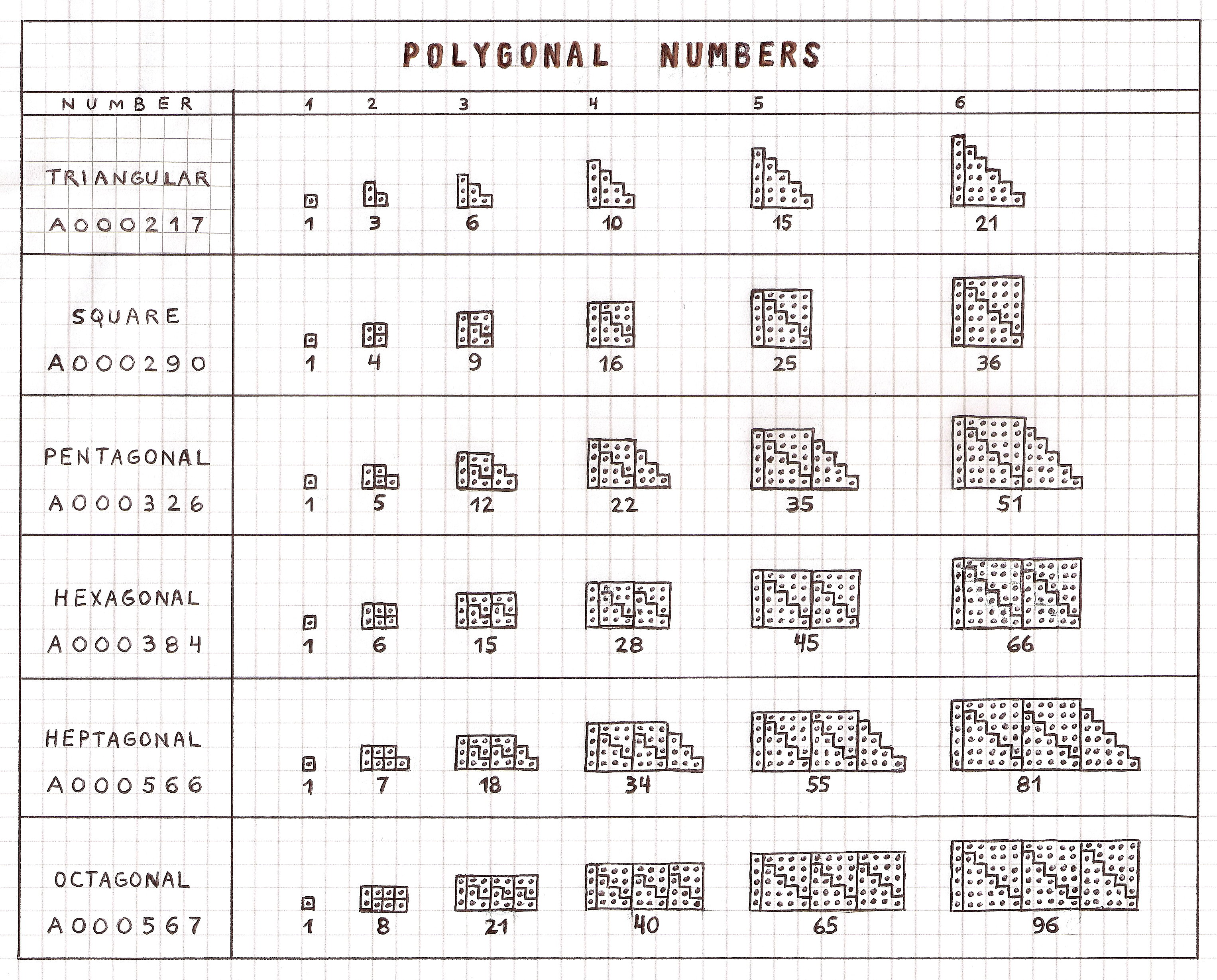
Amelia Carolina Sparavigna, The groupoids of Mersenne, Fermat, Cullen, Woodall and other Numbers and their representations by means of integer sequences, Politecnico di Torino, Italy (2019), [math.NT].
Amelia Carolina Sparavigna, The groupoid of the Triangular Numbers and the generation of related integer sequences, Politecnico di Torino, Italy (2019).
J. C. Su, On some properties of two simultaneous polygonal sequences, JIS 10 (2007) 07.10.4, example 4.6.
Leo Tavares, Illustration: Rectangles.

A. J. Turner and J. F. Miller, Recurrent Cartesian Genetic Programming Applied to Famous Mathematical Sequences, 2014.
Michel Waldschmidt, Continued fractions, Ecole de recherche CIMPA-Oujda, Théorie des Nombres et ses Applications, 18 - 29 mai 2015: Oujda (Maroc).
Eric Weisstein's World of Mathematics, Cocktail Party Graph.
Eric Weisstein's World of Mathematics, Dominating Set.
Eric Weisstein's World of Mathematics, Hexagonal Number.
Eric Weisstein's World of Mathematics, Maximal Irredundant Set.
Thomas Wieder, The number of certain k-combinations of an n-set, Applied Mathematics Electronic Notes, vol. 8 (2008), pp. 45-52.
Index entries for linear recurrences with constant coefficients, signature (3,-3,1).
FORMULA
a(n) = Sum_{k=1..n} tan^2((k - 1/2)*Pi/(2n)). - Ignacio Larrosa Cañestro, Apr 17 2001
E.g.f.: exp(x)*(x+2x^2). - Paul Barry, Jun 09 2003
G.f.: x*(1+3*x)/(1-x)^3. - Simon Plouffe in his 1992 dissertation, dropping the initial zero
a(n) = 4*A000217(n-1) + n. - Lekraj Beedassy, Jun 03 2004
a(n) = right term of M^n * [1,0,0], where M = the 3 X 3 matrix [1,0,0; 1,1,0; 1,4,1]. Example: a(5) = 45 since M^5 *[1,0,0] = [1,5,45]. - Gary W. Adamson, Dec 24 2006
Row sums of triangle A131914. - Gary W. Adamson, Jul 27 2007
Row sums of n-th row, triangle A134234 starting (1, 6, 15, 28, ...). - Gary W. Adamson, Oct 14 2007
Starting with offset 1, = binomial transform of [1, 5, 4, 0, 0, 0, ...]. Also, A004736 * [1, 4, 4, 4, ...]. - Gary W. Adamson, Oct 25 2007
a(n)^2 + (a(n)+1)^2 + ... + (a(n)+n-1)^2 = (a(n)+n+1)^2 + ... + (a(n)+2n-1)^2 + n^2; e.g., 6^2 + 7^2 = 9^2 + 2^2; 28^2 + 29^2 + 30^2 + 31^2 = 33^2 + 34^2 + 35^2 + 4^2. - Charlie Marion, Nov 10 2007
a(n) = binomial(n+1,2) + 3*binomial(n,2).
a(n) = 3*a(n-1) - 3*a(n-2) + a(n-3), a(0)=0, a(1)=1, a(2)=6. - Jaume Oliver Lafont, Dec 02 2008
a(n) = a(n-1) + 4*n - 3 (with a(0)=0). - Vincenzo Librandi, Nov 20 2010
a(n) = 2*a(n-1) - a(n-2) + 4. - Ant King, Aug 26 2011
a(n+1) = A045896(2*n). - Reinhard Zumkeller, Dec 12 2011
a(2^n) = 2^(2n+1) - 2^n. - Ivan N. Ianakiev, Apr 13 2013
a(n) = binomial(2*n,2). - Gary Detlefs, Jul 28 2013
a(4*a(n)+7*n+1) = a(4*a(n)+7*n) + a(4*n+1). - Vladimir Shevelev, Jan 24 2014
Sum_{n>=1} 1/a(n) = 2*log(2) = 1.38629436111989...= A016627. - Vaclav Kotesovec, Apr 27 2016
Sum_{n>=1} (-1)^n/a(n) = log(2) - Pi/2. - Vaclav Kotesovec, Apr 20 2018
a(n+1) = trinomial(2*n+1, 2) = trinomial(2*n+1, 4*n), for n >= 0, with the trinomial irregular triangle A027907. a(n+1) = (n+1)*(2*n+1) = (1/Pi)*Integral_{x=0..2} (1/sqrt(4 - x^2))*(x^2 - 1)^(2*n+1)*R(4*n-2, x) with the R polynomial coefficients given in A127672. [Comtet, p. 77, the integral formula for q=3, n -> 2*n+1, k = 2, rewritten with x = 2*cos(phi)]. - Wolfdieter Lang, Apr 19 2018
Sum_{n>=1} 1/(a(n))^2 = 2*Pi^2/3-8*log(2) = 1.0345588... = 10*A182448 - A257872. - R. J. Mathar, Sep 12 2019
Product_{n>=2} (1 - 1/a(n)) = 2/3. - Amiram Eldar, Jan 21 2021
a(n) = floor(Sum_{k=(n-1)^2..n^2} sqrt(k)), for n >= 1. - Amrit Awasthi, Jun 13 2021
a(n+1) = A084265(2*n), n>=0. - Hartmut F. W. Hoft, Feb 02 2022
MAPLE
MATHEMATICA
Table[n*(2 n - 1), {n, 0, 100}] (* Wesley Ivan Hurt, Sep 27 2013 *)
LinearRecurrence[{3, -3, 1}, {0, 1, 6}, 50] (* Harvey P. Dale, Sep 10 2015 *)
Join[{0}, Accumulate[Range[1, 312, 4]]] (* Harvey P. Dale, Mar 26 2016 *)
(* For Mathematica 10.4+ *) Table[PolygonalNumber[RegularPolygon[6], n], {n, 0, 48}] (* Arkadiusz Wesolowski, Aug 27 2016 *)
PolygonalNumber[6, Range[0, 20]] (* Eric W. Weisstein, Aug 17 2017 *)
CoefficientList[Series[x*(1 + 3*x)/(1 - x)^3 , {x, 0, 100}], x] (* Stefano Spezia, Sep 02 2018 *)
PROG
(PARI) a(n)=n*(2*n-1)
(PARI) a(n) = binomial(2*n, 2) \\ Altug Alkan, Oct 06 2015
(Haskell)
a000384 n = n * (2 * n - 1)
a000384_list = scanl (+) 0 a016813_list
-- Reinhard Zumkeller, Dec 16 2012
(Python) # Intended to compute the initial segment of the sequence, not isolated terms.
def aList():
x, y = 1, 1
yield 0
while True:
yield x
x, y = x + y + 4, y + 4
A000384 = aList()
print([next(A000384) for i in range(49)]) # Peter Luschny, Aug 04 2019
CROSSREFS
KEYWORD
nonn,easy,nice
AUTHOR
EXTENSIONS
Partially edited by Joerg Arndt, Mar 11 2010
STATUS
approved