
OFFSET
1,6
COMMENTS
The number of polygons meeting at a non-boundary vertex is simply the degree (or valency) of that vertex.
Row sums are A159065.
Sum_k k*T(n,k) gives A333277.
See A333274 for the degrees if the boundary vertices are included.
T(n,k) = 0 if k is odd. But the triangle includes those zero entries because this is used to construct A333274.
Equivalently, T(n,2*k) is the number of rational pairs of numbers (x,y) with 0<y<1 such that the equation x-m = y*(p-m) has exactly k integer solutions (m,p) with 0 <= m,p <= n. (x,y) are the coordinates of vertices, and the line goes through the points (m,0) and (p,1). Reinterpreting (m,p) as coordinates, each such pair (x,y) corresponds in the setting of A119437 to a line p = b*m + c with b = -y/(1-y) and c = x/(1-y), which gives all solutions enumerated by that table with negative slope b, and so half the total number of solutions unless horizontal or vertical lines play a role. This explains the formula. See Karlsson. - Andrei Zabolotskii, Jun 23 2026
LINKS
Lars Blomberg, Table of n, a(n) for n = 1..10200 (the first 100 rows)
Lars Blomberg, Scott R. Shannon, and N. J. A. Sloane, Graphical Enumeration and Stained Glass Windows, 1: Rectangular Grids, (2021). Also arXiv:2009.07918.
Jonas Karlsson, Church Windows, Jun 22 2026.
Scott R. Shannon, Colored illustration showing regions for n=1

Scott R. Shannon, Images of vertices for n=1.

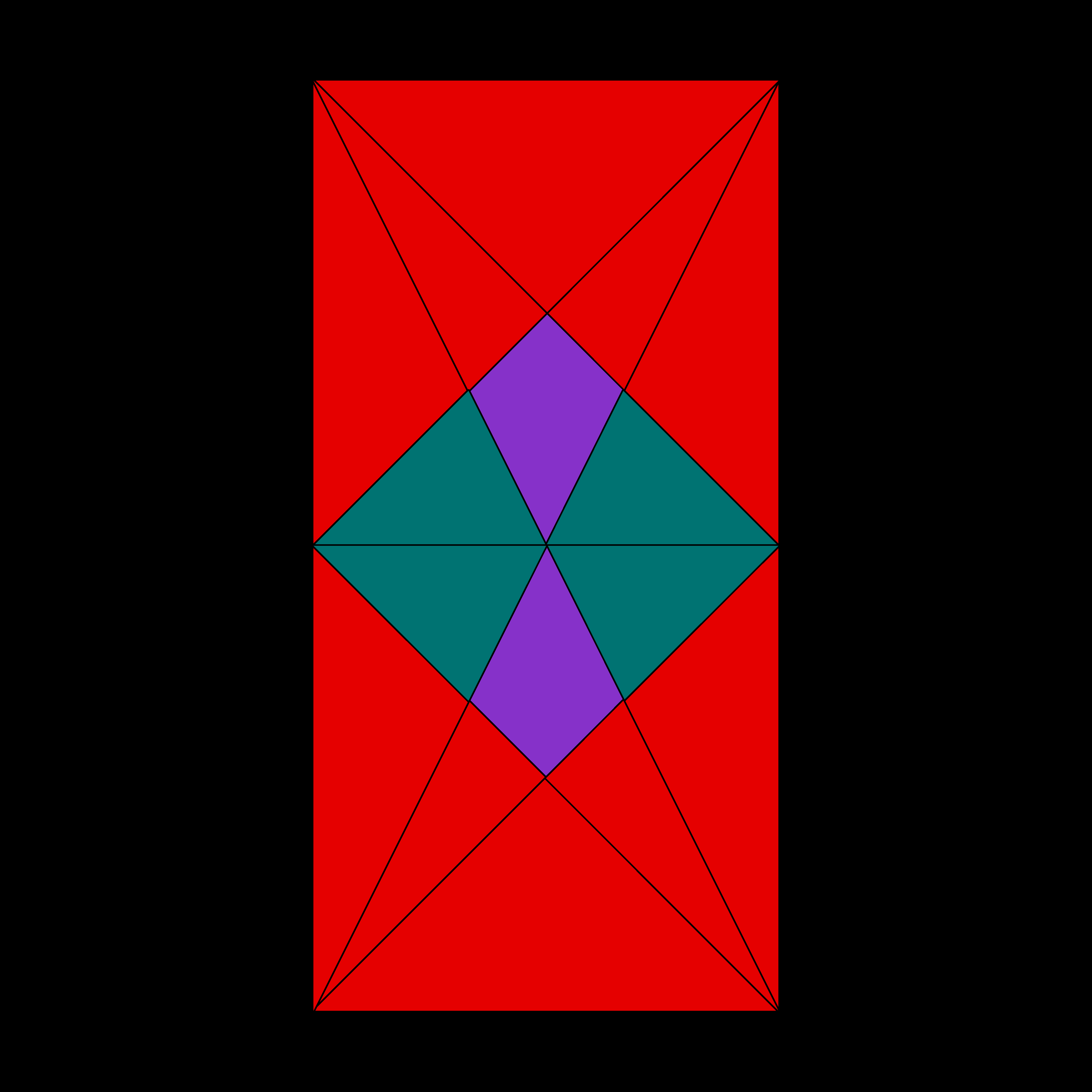
Scott R. Shannon, Colored illustration showing regions for n=2
Scott R. Shannon, Images of vertices for n=2.

Scott R. Shannon, Colored illustration showing regions for n=3

Scott R. Shannon, Images of vertices for n=3.

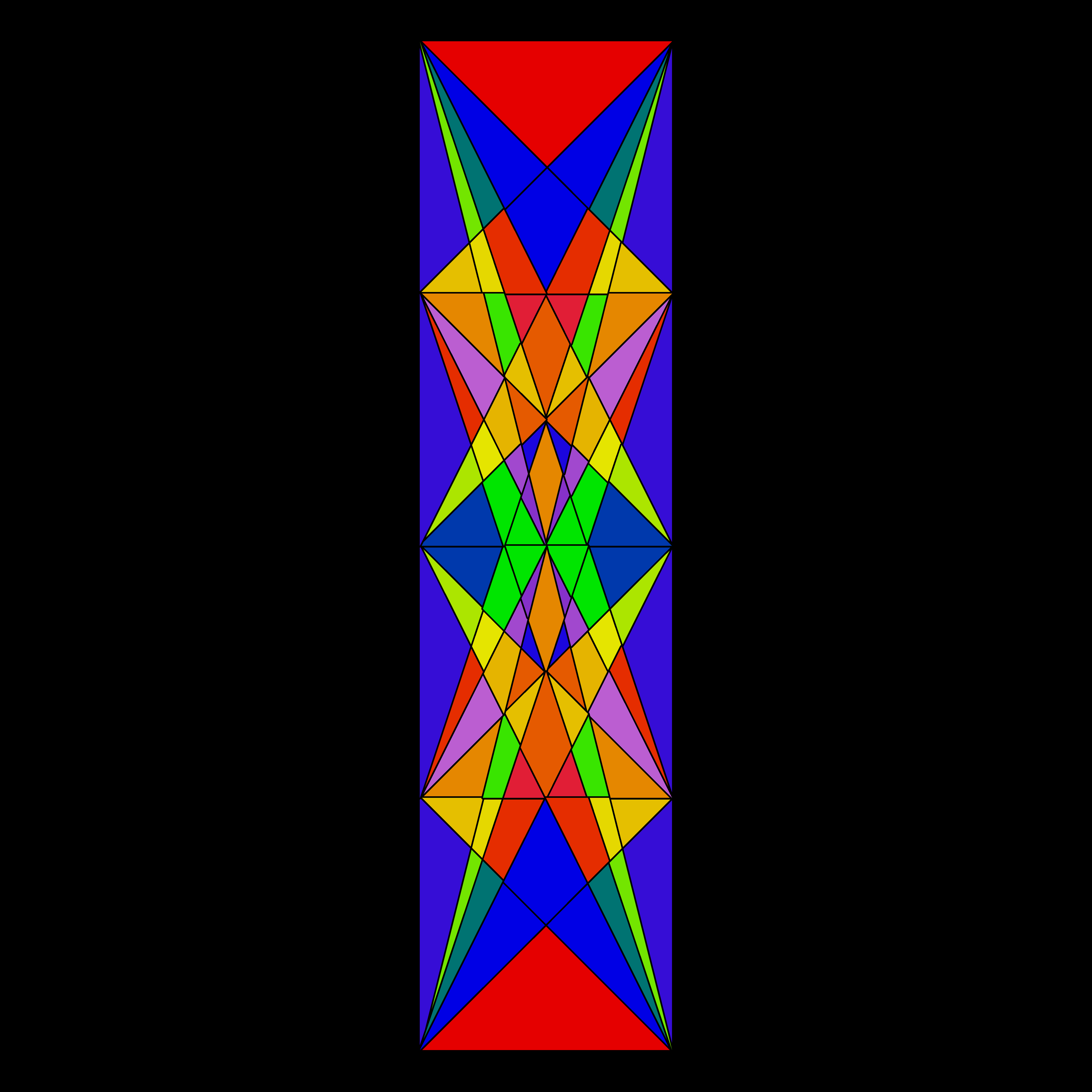
Scott R. Shannon, Colored illustration showing regions for n=4
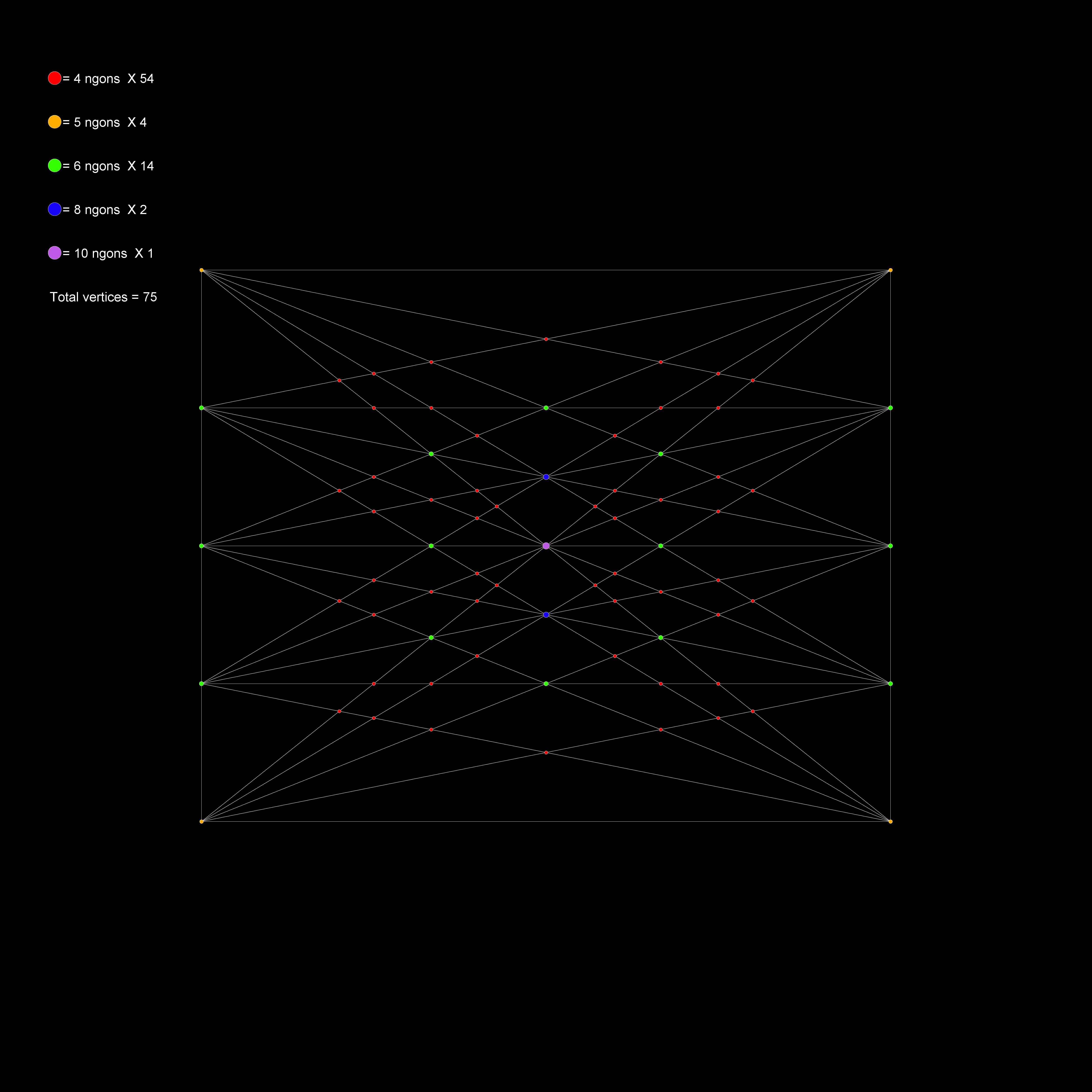
Scott R. Shannon, Images of vertices for n=4.
Scott R. Shannon, Colored illustration showing regions for n=5

Scott R. Shannon, Images of vertices for n=5

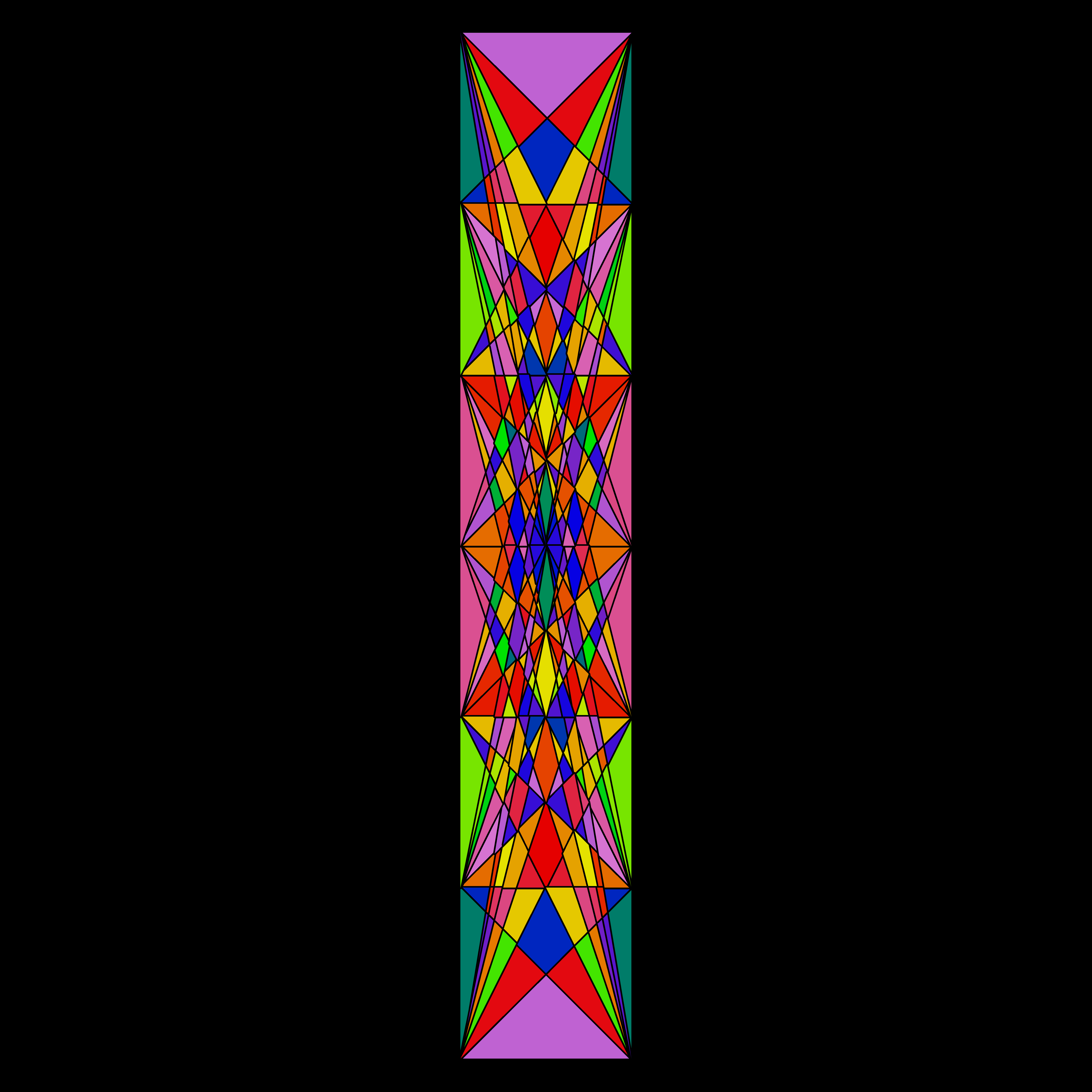
Scott R. Shannon, Colored illustration showing regions for n=6
Scott R. Shannon, Images of vertices for n=6

Scott R. Shannon, Images of vertices for n=7

Scott R. Shannon, Images of vertices for n=8

Scott R. Shannon, Images of vertices for n=9.
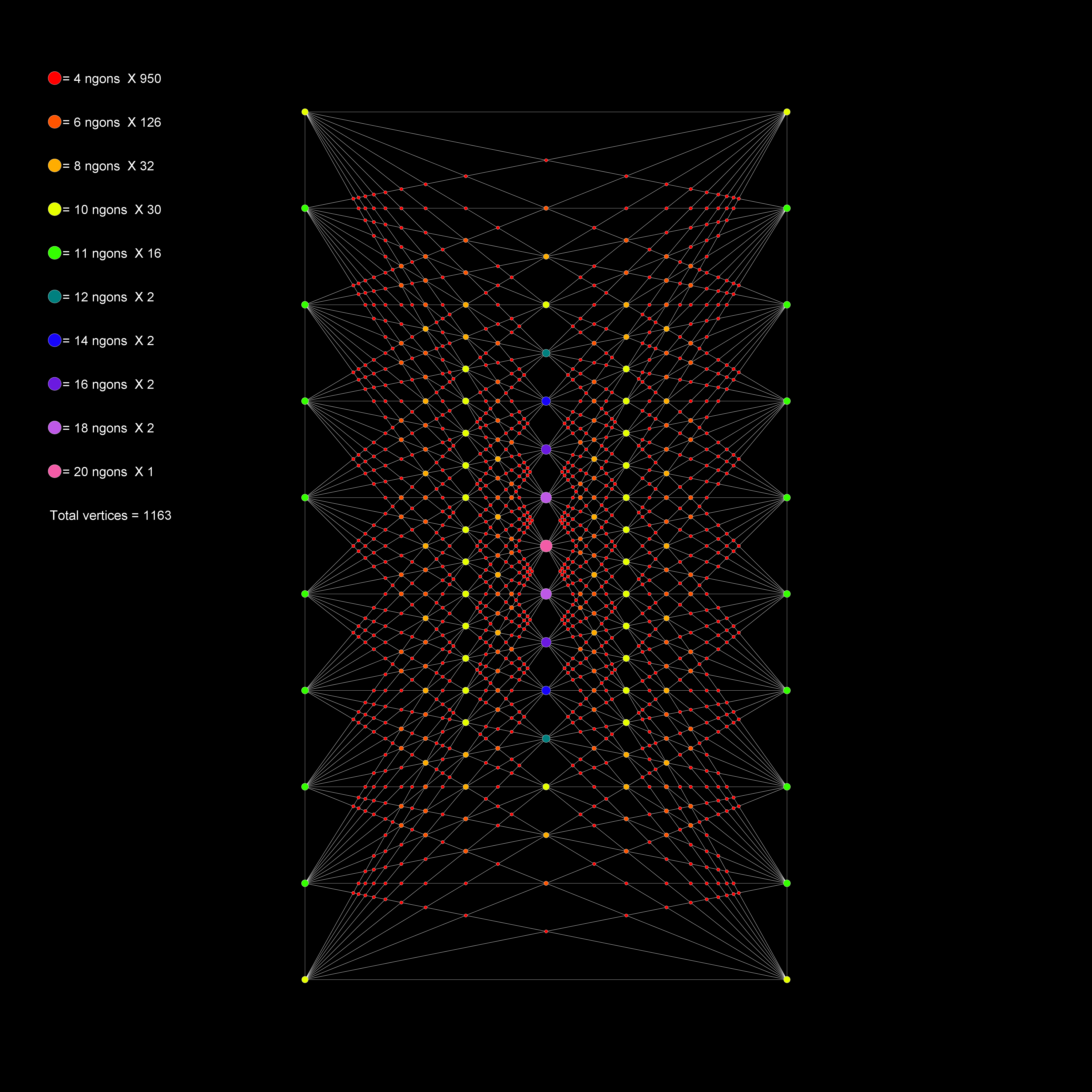
Scott R. Shannon, Images of vertices for n=11.
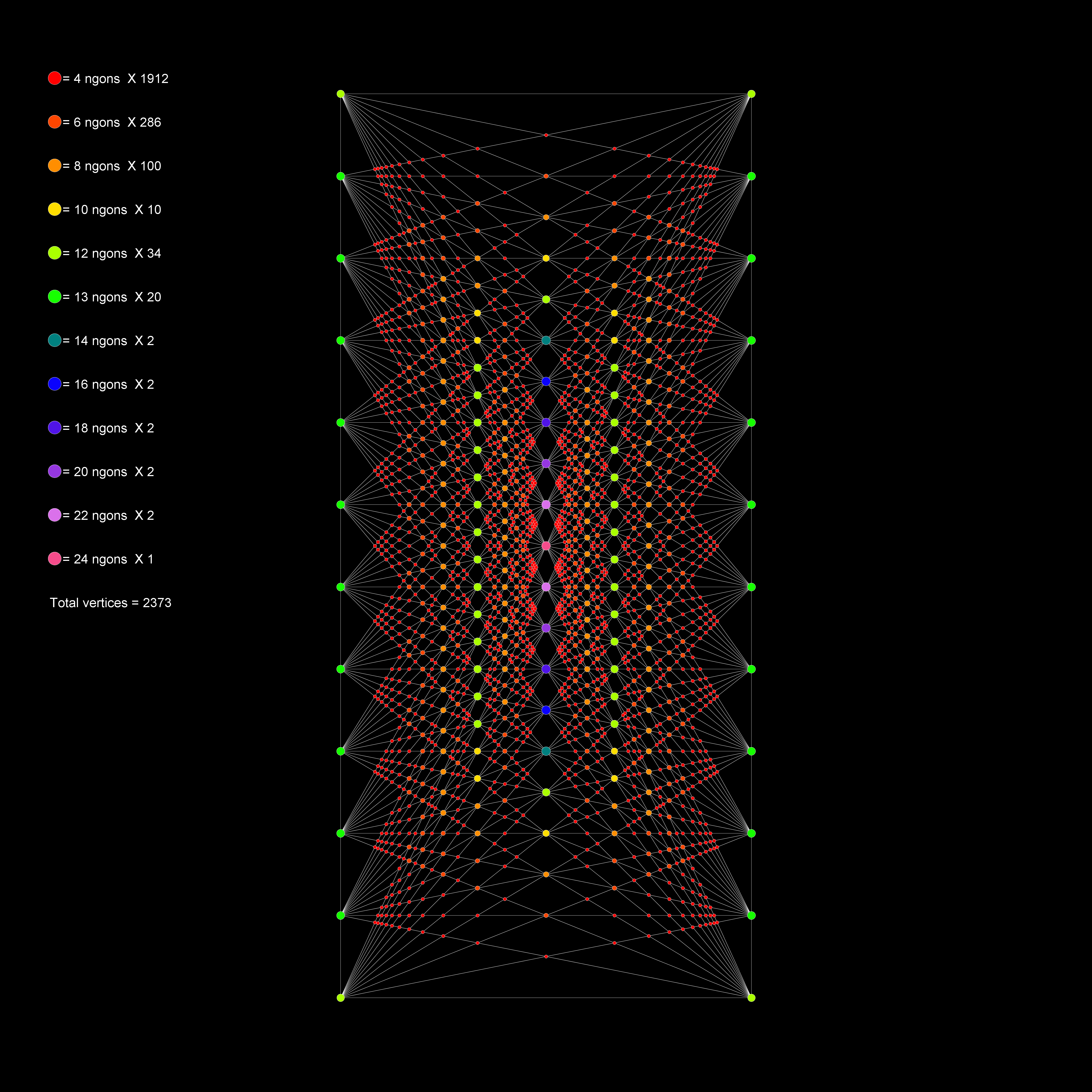
Scott R. Shannon, Images of vertices for n=14.

FORMULA
T(n, 2*k) = A119437(n+1, k) / 2 unless k = n+1. - Andrei Zabolotskii, Jun 23 2026
EXAMPLE
Led d denote the number of polygons meeting at a vertex.
For n=2, in the interiors of each of the two squares there are 3 points with d=4, and the center point has d=6.
So in total there are 6 points with d=4 and 1 with d=6. So row 2 of the triangle is [0, 0, 6, 0, 1].
The triangle begins:
0,0,1,
0,0,6,0,1,
0,0,24,0,2,0,1,
0,0,54,0,8,0,2,0,1,
0,0,124,0,18,0,2,0,2,0,1,
0,0,214,0,32,0,10,0,2,0,2,0,1,
0,0,382,0,50,0,22,0,2,0,2,0,2,0,1,
0,0,598,0,102,0,18,0,12,0,2,0,2,0,2,0,1
...
If we leave out the uninteresting zeros, the triangle begins:
[1]
[6, 1]
[24, 2, 1]
[54, 8, 2, 1]
[124, 18, 2, 2, 1]
[214, 32, 10, 2, 2, 1]
[382, 50, 22, 2, 2, 2, 1]
[598, 102, 18, 12, 2, 2, 2, 1]
[950, 126, 32, 26, 2, 2, 2, 2, 1]
[1334, 198, 62, 20, 14, 2, 2, 2, 2, 1]
[1912, 286, 100, 10, 30, 2, 2, 2, 2, 2, 1]
[2622, 390, 118, 38, 22, 16, 2, 2, 2, 2, 2, 1]
... - N. J. A. Sloane, Jul 27 2020
CROSSREFS
KEYWORD
nonn,tabf
AUTHOR
Scott R. Shannon and N. J. A. Sloane, Mar 14 2020
EXTENSIONS
a(36) and beyond from Lars Blomberg, Jun 17 2020
STATUS
approved