
OFFSET
1,3
COMMENTS
Partial sums of A010051 (characteristic function of primes). - Jeremy Gardiner, Aug 13 2002
pi(n) and prime(n) are inverse functions: a(A000040(n)) = n and A000040(n) is the least number m such that A000040(a(m)) = A000040(n). A000040(a(n)) = n if (and only if) n is prime. - Jonathan Sondow, Dec 27 2004
See the additional references and links mentioned in A143227. - Jonathan Sondow, Aug 03 2008
A lower bound that gets better with larger N is that there are at least T prime numbers less than N, where the recursive function T is: T = N - N*Sum_{i=0..T(sqrt(N))} A005867(i)/A002110(i). - Ben Paul Thurston, Aug 23 2010
Number of partitions of 2n into exactly two parts with the smallest part prime. - Wesley Ivan Hurt, Jul 20 2013
Equivalent to the Riemann hypothesis: abs(a(n) - li(n)) < sqrt(n)*log(n)/(8*Pi), for n >= 2657, where li(n) is the logarithmic integral (Lowell Schoenfeld). - Ilya Gutkovskiy, Jul 05 2016
The second Hardy-Littlewood conjecture, that pi(x) + pi(y) >= pi(x + y) for integers x and y with min{x, y} >= 2, is known to hold for (x, y) sufficiently large (Udrescu 1975). - Peter Luschny, Jan 12 2021
REFERENCES
M. Abramowitz and I. A. Stegun, eds., Handbook of Mathematical Functions, National Bureau of Standards Applied Math. Series 55, 1964 (and various reprintings), p. 870.
Tom M. Apostol, Introduction to Analytic Number Theory, Springer-Verlag, 1976, p. 8.
Raymond Ayoub, An Introduction to the Analytic Theory of Numbers, Amer. Math. Soc., 1963; p. 129.
Richard Crandall and Carl Pomerance, Prime Numbers: A Computational Perspective, Springer, NY, 2001; see p. 5.
G. H. Hardy and E. M. Wright, An Introduction to the Theory of Numbers, 5th ed., Oxford Univ. Press, 1979, Theorems 6, 7, 420.
G. J. O. Jameson, The Prime Number Theorem, Camb. Univ. Press, 2003. [See also the review by D. M. Bressoud (link below).]
Władysław Narkiewicz, The Development of Prime Number Theory, Springer-Verlag, 2000.
József Sándor, Dragoslav S. Mitrinovic and Borislav Crstici, Handbook of Number Theory I, Springer Science & Business Media, 2005, Section VII.1. (For inequalities, etc.).
N. J. A. Sloane, A Handbook of Integer Sequences, Academic Press, 1973 (includes this sequence).
N. J. A. Sloane and Simon Plouffe, The Encyclopedia of Integer Sequences, Academic Press, 1995 (includes this sequence).
Gerald Tenenbaum and Michel Mendès France, Prime Numbers and Their Distribution, AMS Providence RI, 1999.
V. Udrescu, Some remarks concerning the conjecture pi(x + y) <= pi(x) + pi(y). Math. Pures Appl. 20 (1975), 1201-1208.
LINKS
Daniel Forgues, Table of n, pi(n) for n = 1..100000 (first 20000 terms from N. J. A. Sloane; see below for links with 823852 terms (Verma) and more (Caldwell))
M. Abramowitz and I. A. Stegun, eds., Handbook of Mathematical Functions, National Bureau of Standards, Applied Math. Series 55, Tenth Printing, 1972 [alternative scanned copy].
Christian Axler, Über die Primzahl-Zählfunktion, die n-te Primzahl und verallgemeinerte Ramanujan-Primzahlen, Ph.D. thesis 2013, in German, English summary.
Paul T. Bateman and Harold G. Diamond, A Hundred Years of Prime Numbers, Amer. Math. Month., Vol. 103, No. 9 (Nov. 1996), pp. 729-741, MAA Washington DC.
Steve Bennett, The role of Riemann's zeta function in the analytic proof of the Prime Number Theorem, 2004.
Claudio Bonanno and Mirko S. Mega, Toward a dynamical model for prime numbers, Chaos, Solitons & Fractals, Vol. 20, No. 1 (2004), pp. 107-118; arXiv preprint, arXiv:cond-mat/0309251, 2003.
David M. Bressoud, Review of "The Prime Number Theorem" by G. J. O. Jameson, MAA Reviews, 2005. - from N. J. A. Sloane, Dec 29 2018
D. M. Bressoud and Stan Wagon, Computational Number Theory: Basic Algorithms, Springer/Key, 2000 (with a Mathematica package for computational number theory).
Ben Brubaker, The Prime Number Theorem.
C. K. Caldwell, The Prime Glossary: Prime number theorem.
W. W. L. Chen, Distribution of Prime Numbers.
Jean-Marie de Koninck and Aleksandar Ivić, Topics in Arithmetical Functions: Asymptotic Formulae for Sums of Reciprocals of Arithmetical Functions and Related Fields, Amsterdam, Netherlands: North-Holland, 1980. See Chapter 9, p. 231.
Marc Deléglise, Computation of large values of pi(x), 1996.
Pierre Dusart, Autour de la fonction qui compte le nombre de nombres premiers, Thèse, Université de Limoges, France (1998).
Pierre Dusart, The k-th prime is greater than k(ln k + ln ln k-1) for k>=2, Mathematics of Computation, Vo. 68, No. 225 (1999), pp. 411-415.
Encyclopedia Britannica, The Prime Number Theorem [web.archive.org's copy of a no longer available personal copy of the Encyclopedia's article]
R. Gray and J. D. Mitchell, Largest subsemigroups of the full transformation monoid, Discrete Math., 308 (2008), 4801-4810.
G. H. Hardy and J. E. Littlewood, Contributions to the theory of the Riemann zeta-function and the theory of the distribution of primes, Acta Mathematica, Vol. 41 (1916), pp. 119-196.
G. H. Hardy and J. E. Littlewood, Some problems of 'Partitio numerorum'; III: On the expression of a number as a sum of primes, Acta Math., Vol. 44, No. 1 (1923), pp. 1-70.
Mehdi Hassani, Approximation of pi(x) by Psi(x), J. Inequ. Pure Appl. Math., Vol. 7, No. 1 (2006), Article #7.
Y.-C. Kim, Note on the Prime Number Theorem, arXiv:math/0502062 [math.NT], 2005.
Tzanio V. Kolev, On the number of Prime Numbers less than a Given Quantity, 2000.
Angel V. Kumchev, The Distribution of Prime Numbers, 2005.
J. C. Lagarias, V. S. Miller and A. M. Odlyzko, Computing pi(x): The Meissel-Lehmer method, Math. Comp., Vol. 44, No. 170 (1985), pp. 537-560.
Jeffrey C. Lagarias and Andrew M. Odlyzko, Computing pi(x): An analytic method, Journal of Algorithms, Vol. 8, No. 2 (1987), pp. 173-191; alternative link.
John Lorch, The Distribution of Primes, B.S. Undergraduate Mathematics Exchange, Vol. 3, No. 1 (Fall 2005).
Nathan McKenzie, Computing the Prime Counting Function with Linnik's Identity, personal blog, March 24, 2011.
Murat Baris Paksoy, Derived Ramanujan primes: R'_n, arXiv:1210.6991 [math.NT], 2012.
Bent E. Petersen, Prime Number Theorem, Seminar Lecture Note, 1996; version 2002-05-14.
Simon Plouffe, Approximations de séries génératrices et quelques conjectures, Dissertation, Université du Québec à Montréal, 1992; arXiv:0911.4975 [math.NT], 2009.
Simon Plouffe, 1031 Generating Functions, Appendix to Thesis, Montreal, 1992
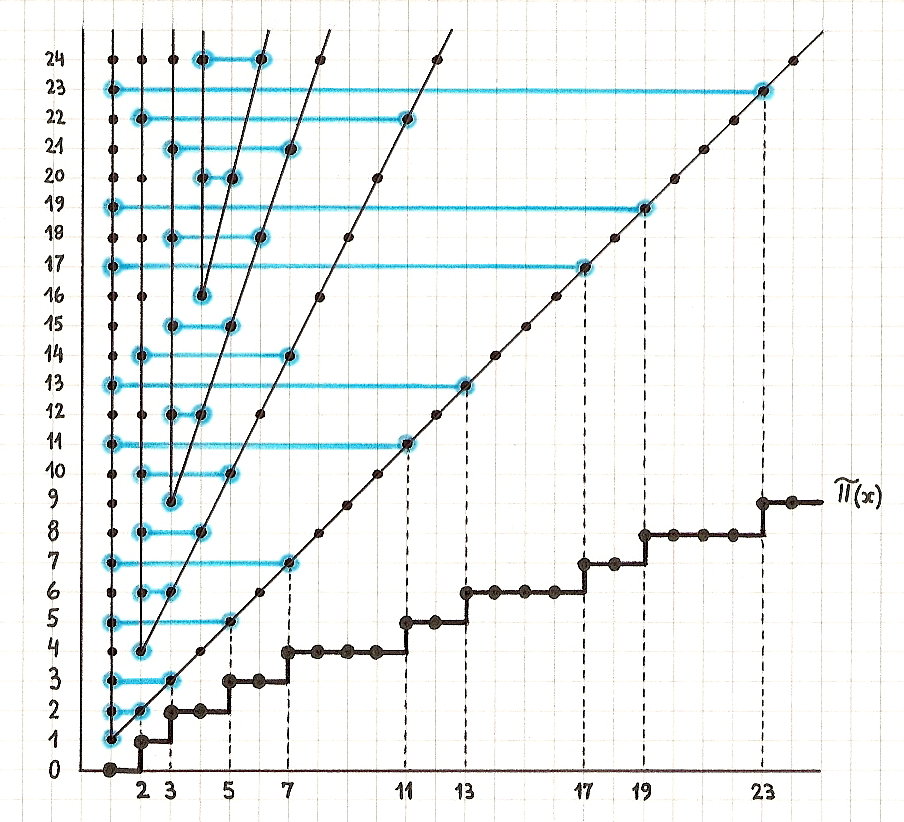
Omar E. Pol, Determinacion geometrica de los numeros primos y perfectos, personal website, 2001 (?); Illustration of initial terms: Divisors and pi(x).
Bernhard Riemann, On the Number of Prime Numbers, 1859, last page (various transcripts)
J. Barkley Rosser, Explicit Bounds for Some Functions of Prime Numbers, American Journal of Mathematics, Vol. 63, No. 1 (1941), pp. 211-232.
J. Barkley Rosser and Lowell Schoenfeld, Approximate formulas for some functions of prime numbers, Ill. Journ. Math. 6 (1962) 64-94.
J. Barkley Rosser and Lowell Schoenfeld, Approximate formulas for some functions of prime numbers (scan of some key pages from an ancient annotated photocopy).
Sebastian Martin Ruiz and Jonathan Sondow, Formulas for pi(n) and the n-th prime, arXiv:math/0210312 [math.NT], 2002, 2014.
Jeffrey Shallit, Bibliography on calculation of pi(x).
Jonathan Sondow, Ramanujan Primes and Bertrand's Postulate, The American Mathematical Monthly, Vol. 116, No. 7 (2009), pp. 630-635; arXiv preprint, arXiv:0907.5232 [math.NT], 2009-2010.
Igor Turkanov, The prime counting function, arXiv:1603.02914 [math.NT], 2016.
Gaurav Verma and Srujan Sapkal, Table of n, pi(n) for n = 1..823852.
Matthew R. Watkins, The distribution of Prime Numbers.
Matthew R. Watkins, The prime number theorem (some references).
Eric Weisstein's World of Mathematics, Prime Counting Function.
Wikipedia, Prime number theorem.
Wikipedia, Prime-counting function.
Marek Wolf, Applications of Statistical Mechanics in Number Theory, Physica A, vol. 274, no. 2, 1999, pp. 149-157; 1999 preprint.
Wolfram Research, First 50 values of pi(n).
FORMULA
The prime number theorem gives the asymptotic expression a(n) ~ n/log(n).
For x > 1, pi(x) < (x / log x) * (1 + 3/(2 log x)). For x >= 59, pi(x) > (x / log x) * (1 + 1/(2 log x)). [Rosser and Schoenfeld]
For x >= 355991, pi(x) < (x / log(x)) * (1 + 1/log(x) + 2.51/(log(x))^2 ). For x >= 599, pi(x) > (x / log(x)) * (1 + 1/log(x)). [Dusart]
For x >= 55, x/(log(x) + 2) < pi(x) < x/(log(x) - 4). [Rosser]
For n > 1, A138194(n) <= a(n) <= A138195(n) (Tschebyscheff, 1850). - Reinhard Zumkeller, Mar 04 2008
For n >= 33, a(n) = 1 + Sum_{j=3..n} ((j-2)! - j*floor((j-2)!/j)) (Hardy and Wright); for n >= 1, a(n) = n - 1 + Sum_{j=2..n} (floor((2 - Sum_{i=1..j} (floor(j/i)-floor((j-1)/i)))/j)) (Ruiz and Sondow 2000). - Benoit Cloitre, Aug 31 2003
G.f.: Sum_{p prime} x^p/(1-x) = b(x)/(1-x), where b(x) is the g.f. for A010051. - Franklin T. Adams-Watters, Jun 15 2006
a(n) = A036234(n) - 1. - Jaroslav Krizek, Mar 23 2009
From Enrique Pérez Herrero, Jul 12 2010: (Start)
a(n) = Sum_{i=2..n} floor((i+1)/A000203(i)).
a(n) = Sum_{i=2..n} floor(A000010(n)/(i-1)).
a(n) = Sum_{i=2..n} floor(2/A000005(n)). (End)
Let pf(n) denote the set of prime factors of an integer n. Then a(n) = card(pf(n!/floor(n/2)!)). - Peter Luschny, Mar 13 2011
a(n) = -Sum_{p <= n} mu(p). - Wesley Ivan Hurt, Jan 04 2013
a(n) = (1/2)*Sum_{p <= n} (mu(p)*d(p)*sigma(p)*phi(p)) + sum_{p <= n} p^2. - Wesley Ivan Hurt, Jan 04 2013
a(1) = 0 and then, for all k >= 1, repeat k A001223(k) times. - Jean-Christophe Hervé, Oct 29 2013
a(n) = n/(log(n) - 1 - Sum_{k=1..m} A233824(k)/log(n)^k + O(1/log(n)^{m+1})) for m > 0. - Jonathan Sondow, Dec 19 2013
a(n) = Sum_{j=2..n} H(-sin^2 (Pi*(Gamma(j)+1)/j)) where H(x) is the Heaviside step function, taking H(0)=1. - Keshav Raghavan, Jun 18 2016
From Steven Foster Clark, Sep 25 2018: (Start)
a(n) = Sum_{m=1..n} A143519(m) * floor(n/m).
a(n) = Sum_{m=1..n} |A143519(m)| * A002819(floor(n/m)) where A002819() is the Liouville Lambda summatory function and |x| is the absolute value of x.
a(n) = Sum_{m=1..n} A137851(m)/m * H(floor(n/m)) where H(n) = Sum_{m=1..n} 1/m is the harmonic number function.
a(n) = Sum_{m=1..log_2(n)} A008683(m) * A025528(floor(n^(1/m))) where A008683() is the Moebius mu function and A025528() is the prime-power counting function.
(End)
Sum_{k=2..n} 1/a(k) ~ (1/2) * log(n)^2 + O(log(n)) (de Koninck and Ivić, 1980). - Amiram Eldar, Mar 08 2021
a(n) ~ 1/(n^(1/n)-1). - Thomas Ordowski, Jan 30 2023
EXAMPLE
There are 3 primes <= 6, namely 2, 3 and 5, so pi(6) = 3.
MATHEMATICA
Array[ PrimePi[ # ]&, 100 ]
Accumulate[Table[Boole[PrimeQ[n]], {n, 100}]] (* Harvey P. Dale, Jan 17 2015 *)
PROG
(PARI) vector(300, j, primepi(j)) \\ Joerg Arndt, May 09 2008
(Sage) [prime_pi(n) for n in range(1, 79)] # Zerinvary Lajos, Jun 06 2009
(Magma) [ #PrimesUpTo(n): n in [1..200] ]; // Bruno Berselli, Jul 06 2011
(Haskell)
a000720 n = a000720_list !! (n-1)
a000720_list = scanl1 (+) a010051_list -- Reinhard Zumkeller, Sep 15 2011
(Python)
from sympy import primepi
for n in range(1, 100): print(primepi(n), end=', ') # Stefano Spezia, Nov 30 2018
CROSSREFS
Cf. A048989, A000040, A132090, A137588, A139328, A104272, A143223, A143224, A143225, A143226, A143227.
Cf. A143538, A036234, A033844, A034387, A034386, A179215, A010051, A212210-A212213, A233824, A056171, A304483.
Closely related:
A099802: Number of primes <= 2n.
A060715: Number of primes between n and 2n (exclusive).
A035250: Number of primes between n and 2n (inclusive).
A038107: Number of primes < n^2.
A014085: Number of primes between n^2 and (n+1)^2.
A007053: Number of primes <= 2^n.
A036378: Number of primes p between powers of 2, 2^n < p <= 2^(n+1).
A006880: Number of primes < 10^n.
A006879: Number of primes with n digits.
A033270: Number of odd primes <= n.
A065855: Number of composites <= n.
For lists of large values of a(n) see, e.g., A005669(n) = a(A002386(n)), A214935(n) = a(A205827(n)).
Related sequences:
Primes between p(n) and 2*p(n): A063124, A070046; between c(n) and 2*c(n): A376761; between n and 2*n: A035250, A060715, A077463, A108954.
KEYWORD
nonn,core,easy,nice
AUTHOR
EXTENSIONS
Additional links contributed by Lekraj Beedassy, Dec 23 2003
Edited by M. F. Hasler, Apr 27 2018 and (links recovered) Dec 21 2018
STATUS
approved