
OFFSET
0,3
COMMENTS
Studied by Holladay and Ulam circa 1960. See Fig. 1 and Example 1 of the Ulam reference. - N. J. A. Sloane, Aug 02 2009.
Singmaster calls this the Ulam-Warburton cellular automaton. - N. J. A. Sloane, Aug 05 2009
On the infinite square grid, start with all cells OFF.
Turn a single cell to the ON state.
At each subsequent step, each cell with exactly one neighbor ON is turned ON, and everything that is already ON remains ON.
Here "neighbor" refers to the four adjacent cells in the X and Y directions.
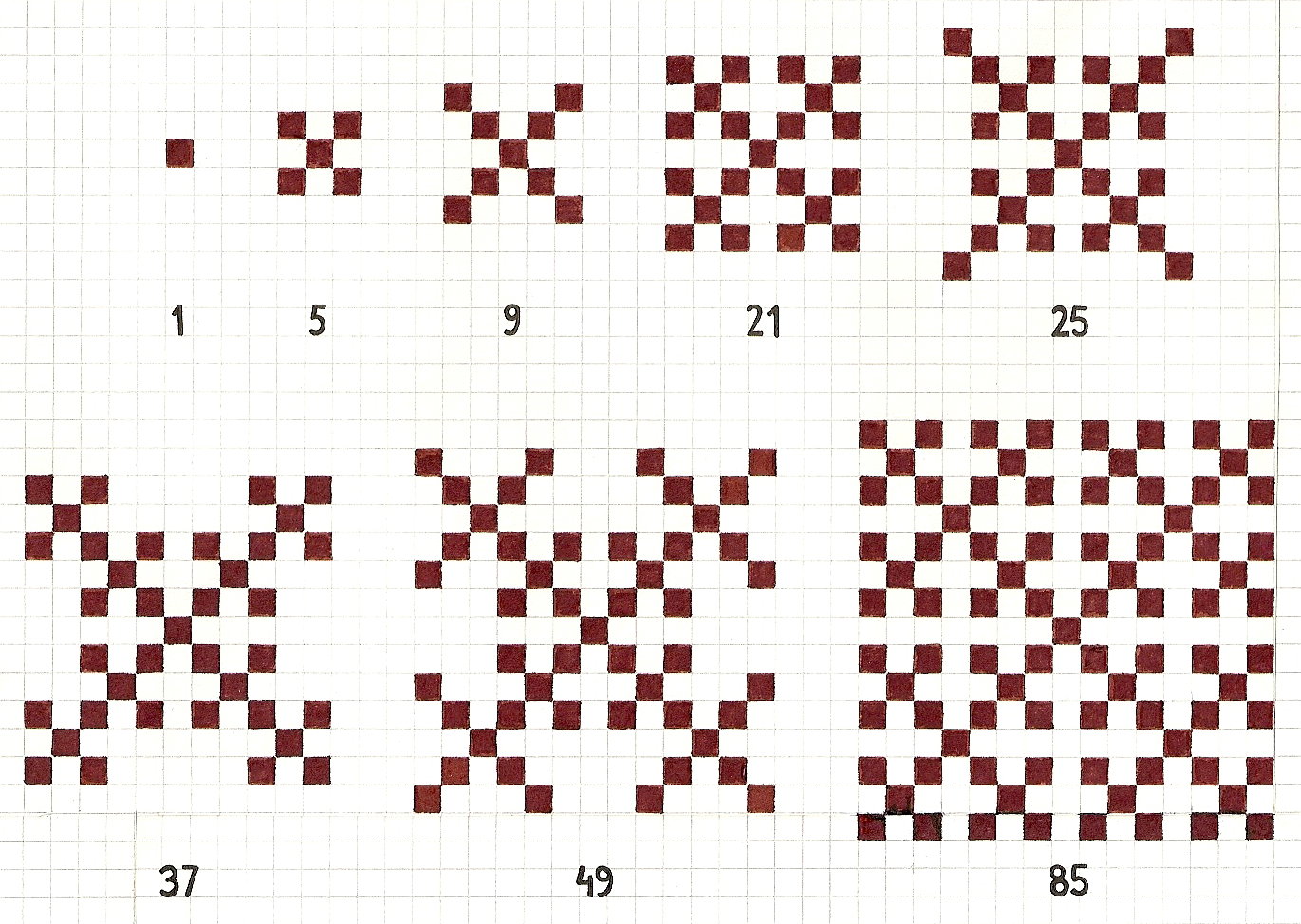
Note that "neighbor" could equally well refer to the four adjacent cells in the diagonal directions, since the graph formed by Z^2 with "one-step rook" adjacencies is isomorphic to Z^2 with "one-step bishop" adjacencies.
Also toothpick sequence starting with a central X-toothpick followed by T-toothpicks (see A160170 and A160172). The sequence gives the number of polytoothpicks in the structure after n-th stage. - Omar E. Pol, Mar 28 2011
It appears that this sequence shares infinitely many terms with both A162795 and A169707, see Formula section and Example section. - Omar E. Pol, Feb 20 2015
It appears that the positive terms are also the odd terms (a bisection) of A151920. - Omar E. Pol, Mar 06 2015
Also, the number of active (ON, black) cells in the n-th stage of growth of two-dimensional cellular automaton defined by Wolfram's "Rule 558" or "Rule 686" based on the 5-celled von Neumann neighborhood. - Robert Price, May 10 2016
From Omar E. Pol, Mar 05 2019: (Start)
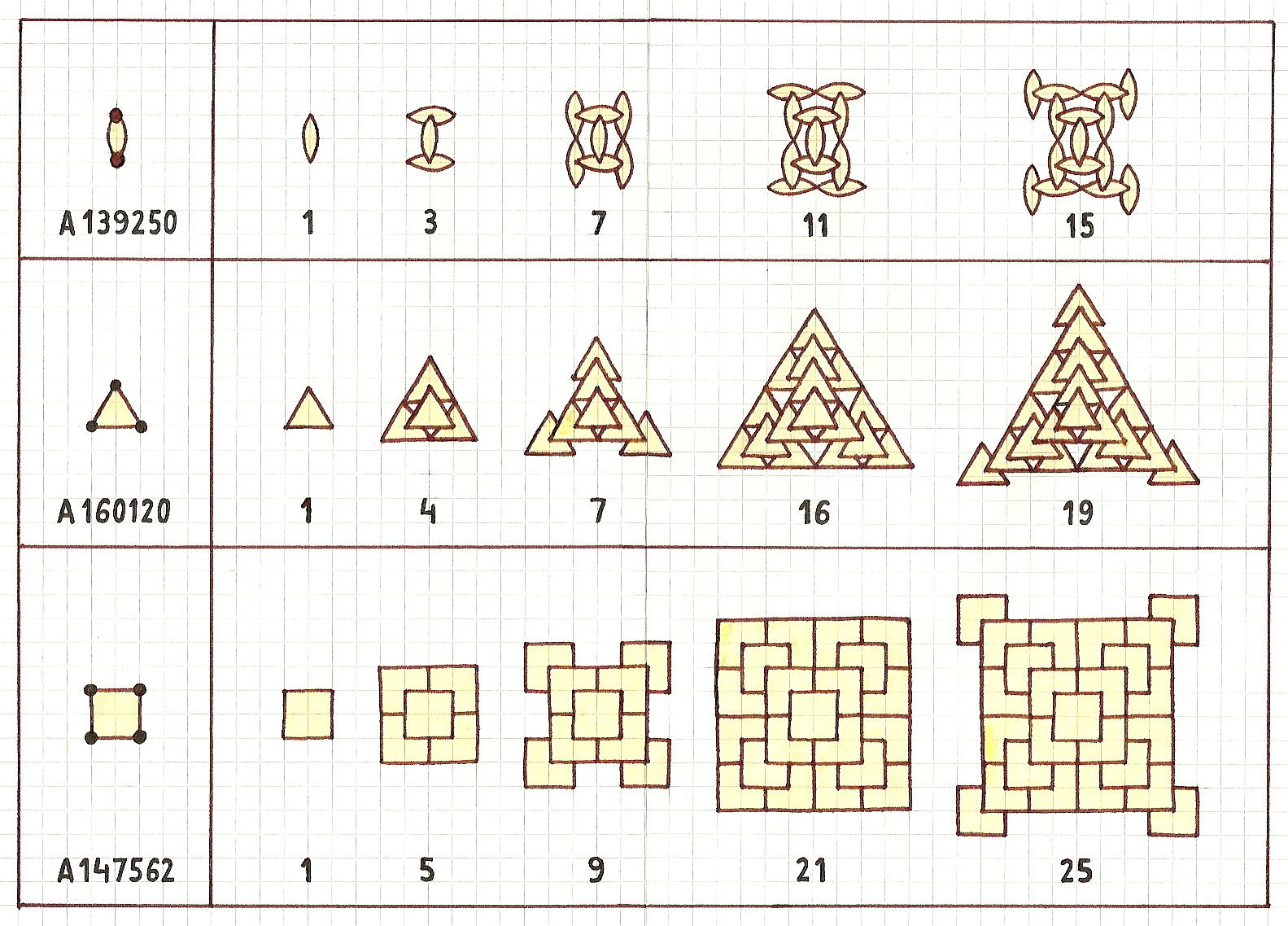
a(n) is also the total number of "hidden crosses" after 4*n stages in the toothpick structure of A139250, including the central cross, beginning to count the crosses when their nuclei are totally formed with 4 quadrilaterals.
a(n) is also the total number of "flowers with six petals" after 4*n stages in the toothpick structure of A323650.
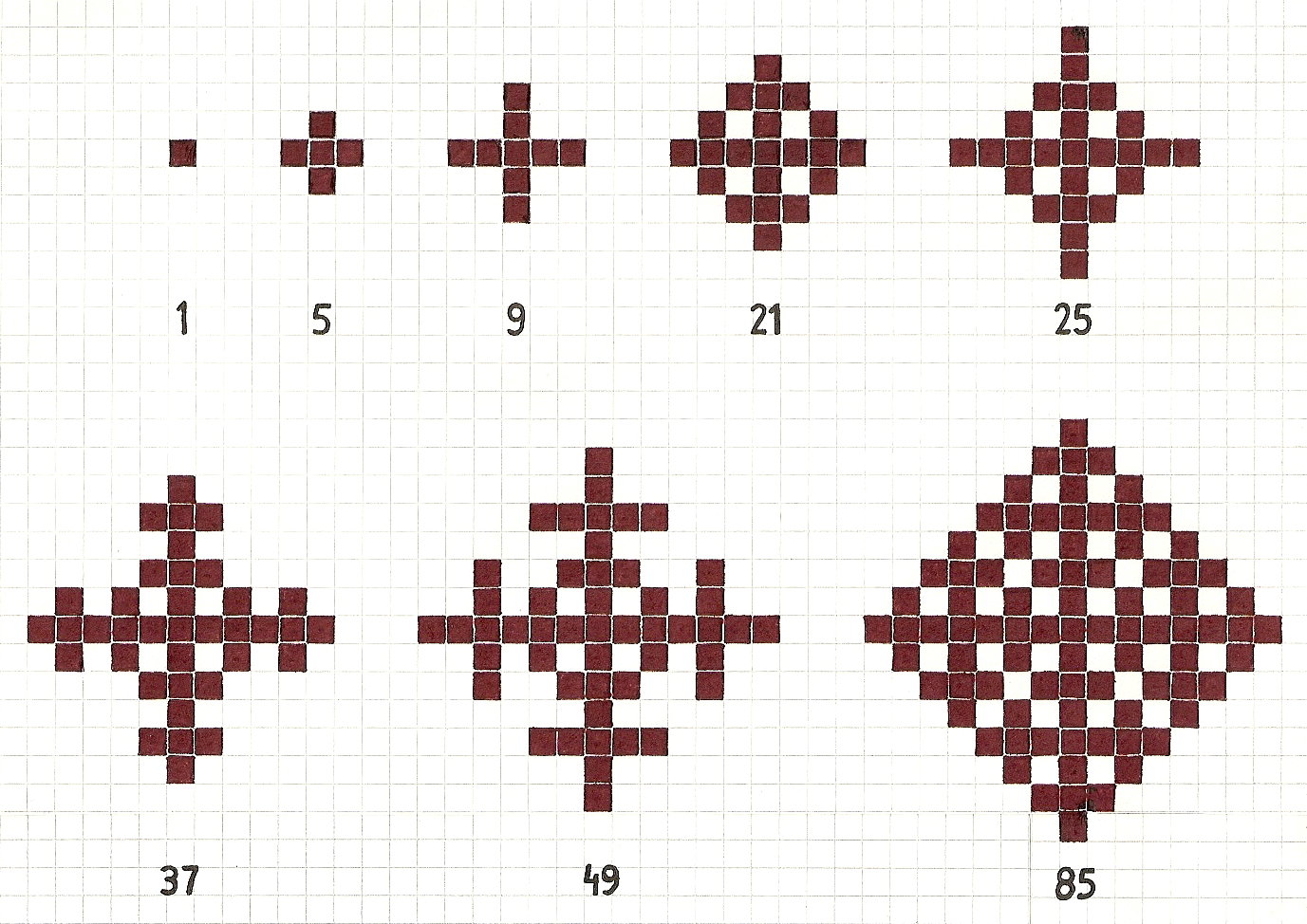
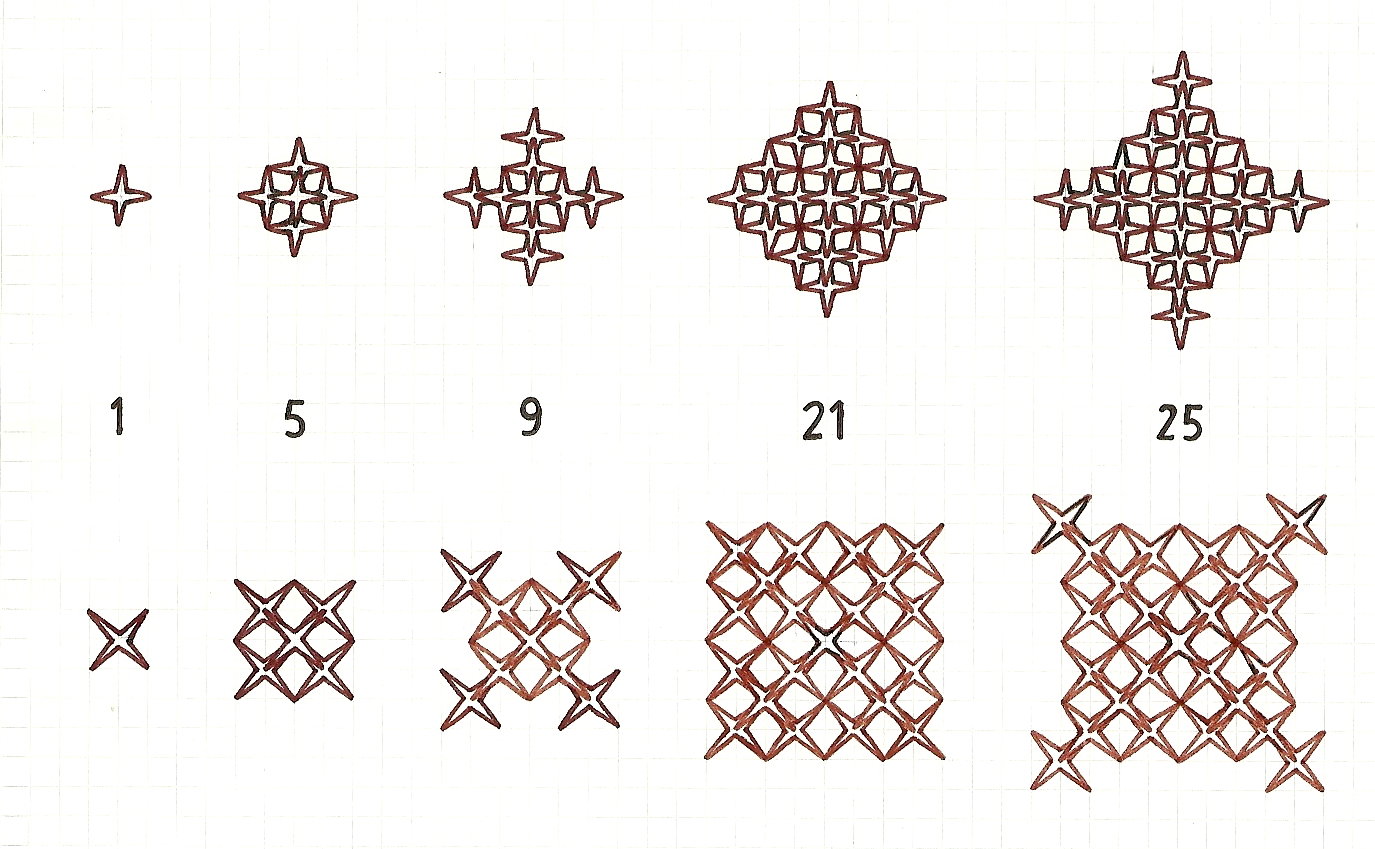
Note that the location of the "nuclei of the hidden crosses" and the "flowers with six petals" in both toothpick structures is essentially the same as the location of the "ON" cells in the version "one-step bishop" of this sequence (see the illustration of initial terms, figure 2). (End)
REFERENCES
S. Ulam, On some mathematical problems connected with patterns of growth of figures, pp. 215-224 of R. E. Bellman, ed., Mathematical Problems in the Biological Sciences, Proc. Sympos. Applied Math., Vol. 14, Amer. Math. Soc., 1962.
S. Wolfram, A New Kind of Science, Wolfram Media, 2002; p. 928.
LINKS
N. J. A. Sloane, Table of n, a(n) for n = 0..10000
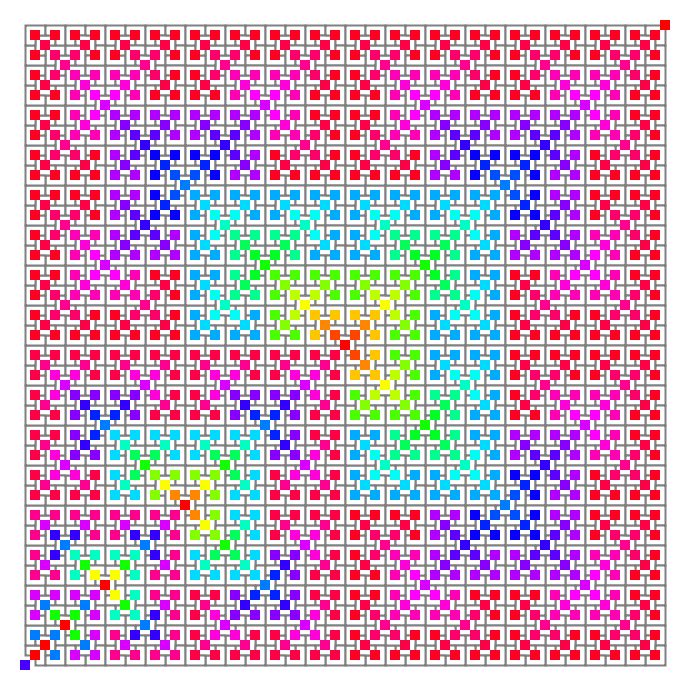
David Applegate, The movie version
David Applegate, Omar E. Pol and N. J. A. Sloane, The Toothpick Sequence and Other Sequences from Cellular Automata, Congressus Numerantium, Vol. 206 (2010), 157-191. [There is a typo in Theorem 6: (13) should read u(n) = 4.3^(wt(n-1)-1) for n >= 2.]
Steven R. Finch, Toothpicks and Live Cells, July 21, 2015. [Cached copy, with permission of the author]
Hsien-Kuei Hwang, Svante Janson, and Tsung-Hsi Tsai, Identities and periodic oscillations of divide-and-conquer recurrences splitting at half, arXiv:2210.10968 [cs.DS], 2022, p. 31.
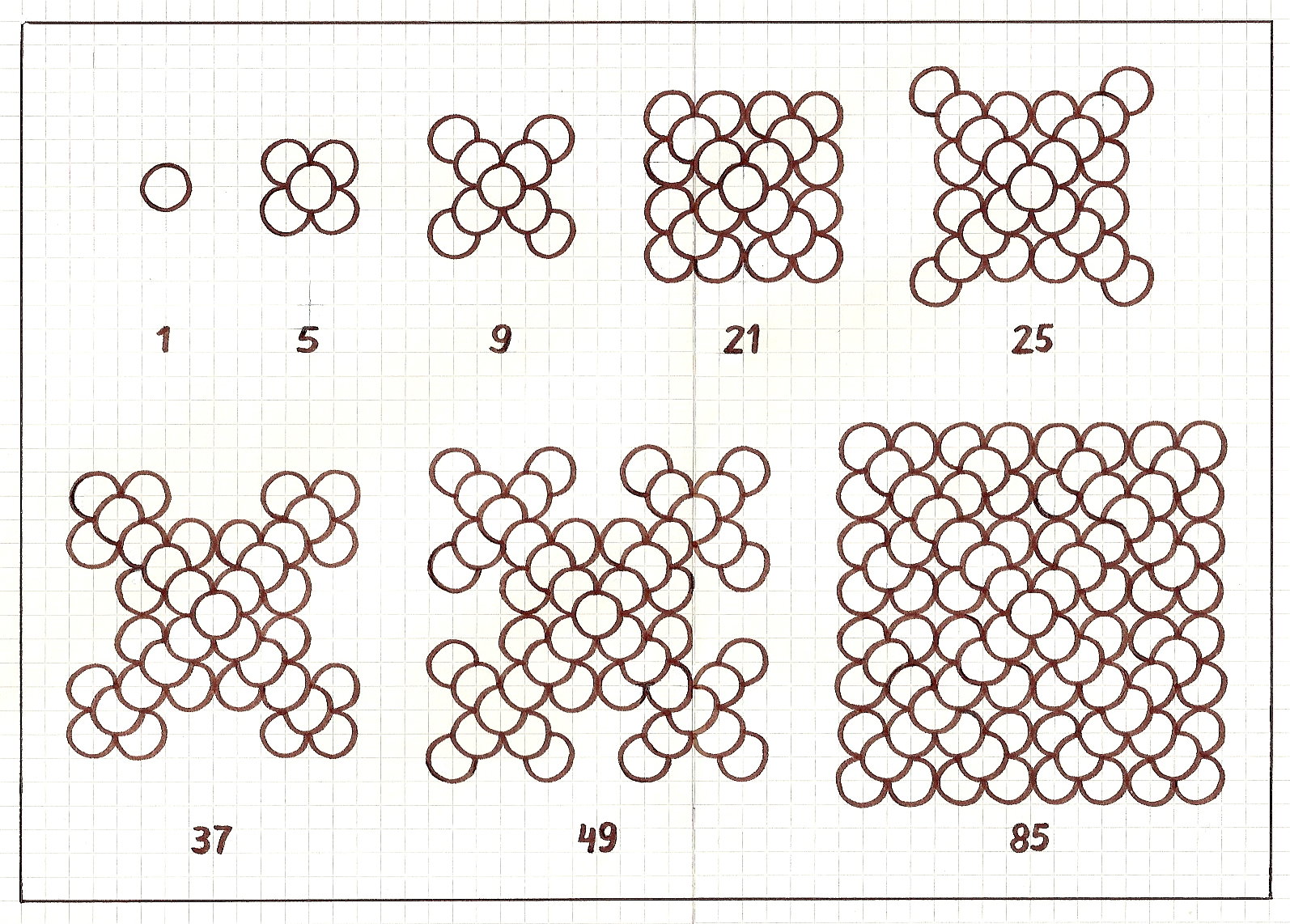
Omar E. Pol, Illustration of initial terms (Fig. 1: one-step rook - the current sequence), (Fig. 2: one-step bishop), (Fig. 3: overlapping squares), (Fig. 4: overlapping X-toothpicks), (2009), (Fig. 5: overlapping circles), (2010)
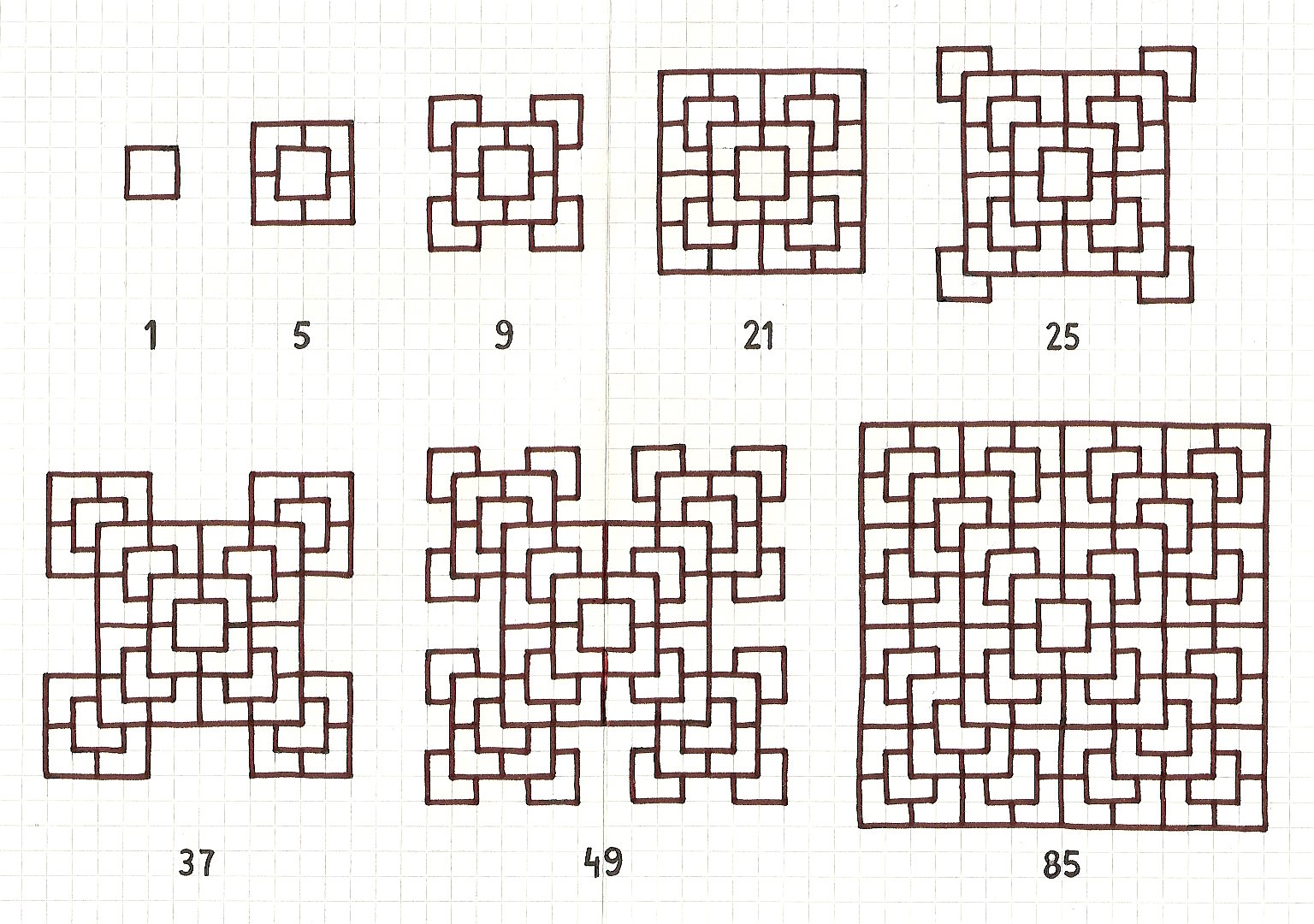
Omar E. Pol, Illustration of initial terms of A139250, A160120, A147562 (overlapping figures), (2009).
David Singmaster, On the cellular automaton of Ulam and Warburton, M500 Magazine of the Open University, #195 (December 2003), pp. 2-7. Also scanned annotated cached copy, included with permission.
N. J. A. Sloane, Illustration of terms 0 through 9
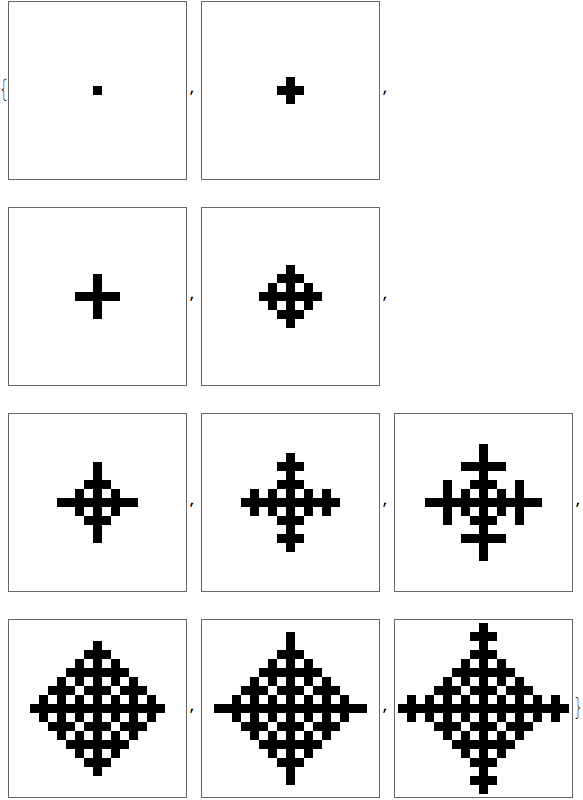
N. J. A. Sloane, Catalog of Toothpick and Cellular Automata Sequences in the OEIS
N. J. A. Sloane, On the Number of ON Cells in Cellular Automata, arXiv:1503.01168 [math.CO], 2015.
N. J. A. Sloane, Exciting Number Sequences (video of talk), Mar 05 2021
N. J. A. Sloane and Brady Haran, Terrific Toothpick Patterns, Numberphile video (2018).
Mike Warburton, Ulam-Warburton Automaton - Counting Cells with Quadratics, arXiv:1901.10565 [math.CO], 2019.
Eric Weisstein's World of Mathematics, Elementary Cellular Automaton
S. Wolfram, A New Kind of Science
FORMULA
a(n) = 1 + 4*Sum_{k=1..n-1} 3^(wt(k)-1) for n>1, where wt() = A000120(). [Corrected by Paolo Xausa, Aug 12 2022]
For asymptotics see the discussion in the comments in A006046. - N. J. A. Sloane, Mar 11 2021
From Omar E. Pol, Mar 13 2011: (Start)
a(n) = 2*A151917(n) - 1, for n >= 1.
a(n) = 1 + 4*A151920(n-2), for n >= 2.
(End)
It appears that a(n) = A162795(n) = A169707(n), if n is a member of A048645, otherwise a(n) < A162795(n) < A169707(n). - Omar E. Pol, Feb 20 2015
It appears that a(n) = A151920(2n-2), n >= 1. - Omar E. Pol, Mar 06 2015
It appears that a(n) = (A130665(2n-1) - 1)/3, n >= 1. - Omar E. Pol, Mar 07 2015
a(n) = 1 + 4*(A130665(n-1) - 1)/3, n >= 1. Omar E. Pol, Mar 07 2015
a(n) = A323650(2n)/3. - Omar E. Pol, Mar 04 2019
EXAMPLE
If we label the generations of cells turned ON by consecutive numbers we get a rosetta cell pattern:
. . . . . . . . . . . . . . . . .
. . . . . . . . 4 . . . . . . . .
. . . . . . . 4 3 4 . . . . . . .
. . . . . . 4 . 2 . 4 . . . . . .
. . . . . 4 3 2 1 2 3 4 . . . . .
. . . . . . 4 . 2 . 4 . . . . . .
. . . . . . . 4 3 4 . . . . . . .
. . . . . . . . 4 . . . . . . . .
. . . . . . . . . . . . . . . . .
In the first generation, only the central "1" is ON, a(1)=1. In the next generation, we turn ON four "2", leading to a(2)=a(1)+4=5. In the third generation, four "3" are turned ON, a(3)=a(2)+4=9. In the fourth generation, each of the four wings allows three 4's to be turned ON, a(4)=a(3)+4*3=21.
From Omar E. Pol, Feb 18 2015: (Start)
Also, written as an irregular triangle T(j,k), j>=0, k>=1, in which the row lengths are the terms of A011782:
1;
5;
9, 21;
25, 37, 49, 85;
89, 101,113,149,161,197,233,341;
345,357,369,405,417,453,489,597,609,645,681,789,825,933,1041,1365;
...
The right border gives the positive terms of A002450.
(End)
It appears that T(j,k) = A162795(j,k) = A169707(j,k), if k is a power of 2, for example: it appears that the three mentioned triangles only share the elements from the columns 1, 2, 4, 8, 16, ... - Omar E. Pol, Feb 20 2015
MAPLE
Since this is the partial sum sequence of A147582, it is most easily obtained using the Maple code given in A147582.
# [x, y] coordinates of cells on
Lse := [[0, 0]] ;
# enclosing rectangle of the cells on (that is, minima and maxima in Lse)
xmin := 0 ;
xmax := 0 ;
ymin := 0 ;
ymax := 0 ;
# count neighbors of x, y which are on; return 0 if [x, y] is in L
cntnei := proc(x, y, L)
local a, p, xpt, ypt;
a := 0 ;
if not [x, y] in L then
for p in Lse do
xpt := op(1, p) ;
ypt := op(2, p) ;
if ( abs(xpt-x) = 1 and ypt=y ) or ( x=xpt and abs(ypt-y) = 1) then
a := a+1 ;
fi;
od:
fi:
RETURN(a) ;
end:
# loop over generations/steps
for stp from 1 to 10 do
Lnew := [] ;
for x from xmin-1 to xmax+1 do
for y from ymin-1 to ymax+1 do
if cntnei(x, y, Lse) = 1 then
Lnew := [op(Lnew), [x, y]] ;
fi;
od:
od:
for p in Lnew do
xpt := op(1, p) ;
ypt := op(2, p) ;
xmin := min(xmin, xpt) ;
xmax := max(xmax, xpt) ;
ymin := min(ymin, ypt) ;
ymax := max(ymax, ypt) ;
od:
Lse := [op(Lse), op(Lnew)] ;
print(nops(Lse)) ;
MATHEMATICA
Join[{0}, Map[Function[Apply[Plus, Flatten[ #1]]], CellularAutomaton[{686, {2, {{0, 2, 0}, {2, 1, 2}, {0, 2, 0}}}, {1, 1}}, {{{1}}, 0}, 200]]] (* Nadia Heninger and N. J. A. Sloane, Aug 11 2009; modified by Paolo Xausa, Aug 12 2022 to include the a(0) term *)
ArrayPlot /@ CellularAutomaton[{686, {2, {{0, 2, 0}, {2, 1, 2}, {0, 2, 0}}}, {1, 1}}, {{{1}}, 0}, 16] (* N. J. A. Sloane, Nov 08 2014 *)
A147562list[nmax_]:=Accumulate[Join[{0, 1}, 4*3^(DigitCount[Range[nmax-1], 2, 1]-1)]]; A147562list[100] (* Paolo Xausa, May 21 2023 *)
PROG
(PARI) a(n) = if (n, 1 + 4*sum(k=1, n-1, 3^(hammingweight(k)-1)), 0); \\ Michel Marcus, Jul 05 2022
CROSSREFS
KEYWORD
nonn,nice,changed
AUTHOR
N. J. A. Sloane, based on emails from Franklin T. Adams-Watters, R. J. Mathar and David W. Wilson, Apr 29 2009
EXTENSIONS
Offset and initial terms changed by N. J. A. Sloane, Jun 07 2009
Numbers in the comment adapted to the offset by R. J. Mathar, Mar 03 2010
STATUS
approved