
OFFSET
1,2
COMMENTS
Irregular triangle read by rows. The n-th row, containing 2^(n-1) elements, consists of the reciprocals of the first differences of the sequence formed by combining the first n levels of the Stern-Brocot tree, that is, the reciprocals of the first differences of A049455(n,k) / A049456(n,k) for k = 0, .., 2^(n-1). - William P. Orrick, Apr 25 2026
LINKS
Indranil Ghosh, Table of n, a(n) for n = 1..16384
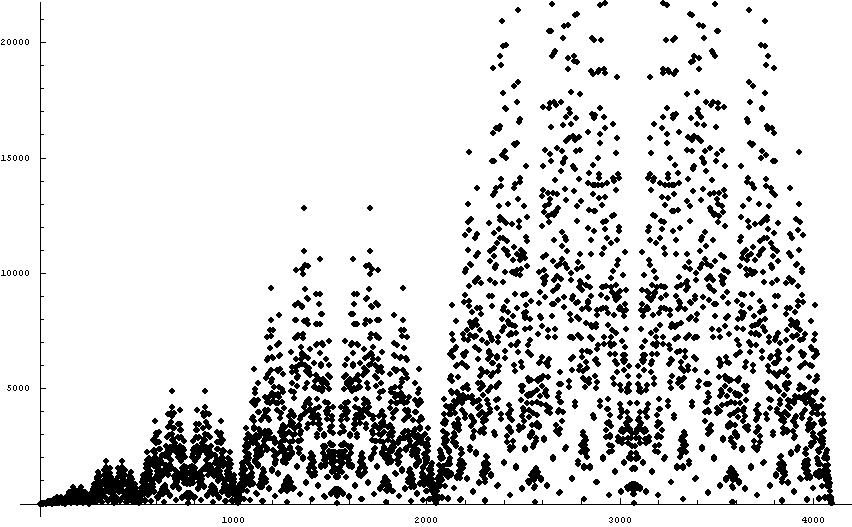
Robert G. Wilson v, Plot of first 4096 terms
FORMULA
Sum of reciprocals of k-th "chunk" (between two entries k) = 1 (for example for the third chunk, 1/3 + 1/6 + 1/6 + 1/3 = 1).
Sum of the n-th row equals A052913(n-1). - William P. Orrick, Apr 25 2026
Apart from c = 0, the entries in column c grow quadratically. The k-th entry in column c > 0, where k = 1 indexes the first appearance of an entry in that column, is given by a(c) * (k+1) * (k+2) - a(c+2^(floor(log_2(c)))) * (k+1) + a(c-2^(floor(log_2(c)))) * (k+2). The k-th entry in column 0 is k. - William P. Orrick, Apr 28 2026
EXAMPLE
From William P. Orrick, Apr 25 2026: (Start)
Array begins
1;
2, 2;
3, 6, 6, 3;
4, 12, 15, 10, 10, 15, 12, 4;
5, 20, 28, 21, 24, 40, 35, 14, 14, 35, 40, 24, 21, 28, 20, 5;
...
n = 3. The elements of the Stern-Brocot tree up to the third level, in left to right order, are 0/1, 1/3, 1/2, 2/3, 1/1. The first differences are 1/3, 1/6, 1/6, 1/3, whose reciprocals are 3, 6, 6, 3. (End)
MAPLE
b:= proc(n) option remember; `if`(n<2, n,
(q-> b(q)+(n-2*q)*b(n-q))(iquo(n, 2)))
end:
a:= n-> b(n)*b(n+1):
seq(a(n), n=1..100); # Alois P. Heinz, Feb 11 2021
MATHEMATICA
a[0] = 1; a[n_] := If[ OddQ[n], a[n/2 - 1/2], a[n/2] + a[n/2 - 1]]; Table[ a[n - 1]*a[n], {n, 1, 70}]
PROG
(Python)
def a002487(n): return n if n<2 else a002487(n/2) if n%2==0 else a002487((n - 1)/2) + a002487((n + 1)/2)
def a(n): return a002487(n)*a002487(n + 1) # Indranil Ghosh, Jun 08 2017
(Python)
from functools import reduce
def A070871(n): return sum(reduce(lambda x, y:(x[0], x[0]+x[1]) if int(y) else (x[0]+x[1], x[1]), bin(n)[-1:2:-1], (1, 0)))*sum(reduce(lambda x, y:(x[0], x[0]+x[1]) if int(y) else (x[0]+x[1], x[1]), bin(n+1)[-1:2:-1], (1, 0))) # Chai Wah Wu, May 05 2023
(PARI) a(n)= my(t=[0, 1]); foreach(binary(n), b, t[2-b]+=t[2-!b]); t[1]*t[2]; \\ Ruud H.G. van Tol, Apr 26 2026
(SageMath)
def A070871(n):
curN = Integer(n)
indList = []
rNext = curN.nbits()
while curN > 0:
r = rNext
c = curN - 2^(r-1)
if c > 0:
rNext = c.nbits()
j = r - rNext
indList.append(j)
else:
co2 = r
co1 = co2 + 1
co0 = 0
curN = c
for i in range(len(indList)-1, -1, -1):
j = indList[i]
newCo2 = co2 * (j+1) * (j+2) - co1 * (j+1) + co0 * (j+2)
newCo1 = newCo2 + co2 * (2*j+4) - co1 + co0
co0 = co2
co2 = newCo2
co1 = newCo1
return(co2) # William P. Orrick, Apr 28 2026
CROSSREFS
KEYWORD
AUTHOR
N. J. A. Sloane, May 19 2002
STATUS
approved