
OFFSET
0,3
COMMENTS
The first g.f. identity in the Formula section is proven: multiplying both sides by theta_3(q)^3, where theta_3(q) = A2^5/(A1^2*A4^2), gives modular forms of weight 7 on Gamma_0(32) with character Kronecker(-2, .). The left side is the theta series of the even lattice LAMBDA_11^{max} + sqrt(2)Z^3, of determinant 8192, by Schoeneberg's theorem; each right-side eta quotient after multiplication by theta_3(q)^3 is in the same comparison space by Ligozat's criteria. The two sides agree to n = 519, beyond the Sturm bound 448 for Gamma_1(32). - Steven Kotlarz, Jun 23 2026
The character Kronecker(-2, .) in the preceding comment is for the integer-weight theta_3(q)^3 lift, not for the raw half-integral-weight theta series. - Steven Kotlarz, Jun 23 2026
The second g.f. is proven by decomposing LAMBDA_11^{max} into the 64 cosets of an orthogonal norm-4 frame. Among these cosets, the numbers having 0, 4, 6, and 8 half-shifted frame coordinates are respectively 1, 26, 24, and 13; summing the corresponding products of one-dimensional theta series gives the displayed formula. Its four summands are also the first four summands of the corresponding theta form of A006910. - Steven Kotlarz, Jul 12 2026
REFERENCES
J. H. Conway and N. J. A. Sloane, Laminated lattices, Annals of Math., 116 (1982), pp. 593-620. A revised version appears as Chapter 6 of ``Sphere Packings, Lattices and Groups'' by J. H. Conway and N. J. A. Sloane, Springer-Verlag, NY, 1988.
J. H. Conway and N. J. A. Sloane, "Sphere Packings, Lattices and Groups", Springer-Verlag. See Chap. 6.
E. C. Pervin, personal communication.
N. J. A. Sloane and Simon Plouffe, The Encyclopedia of Integer Sequences, Academic Press, 1995 (includes this sequence).
LINKS
Andy Huchala, Table of n, a(n) for n = 0..20000
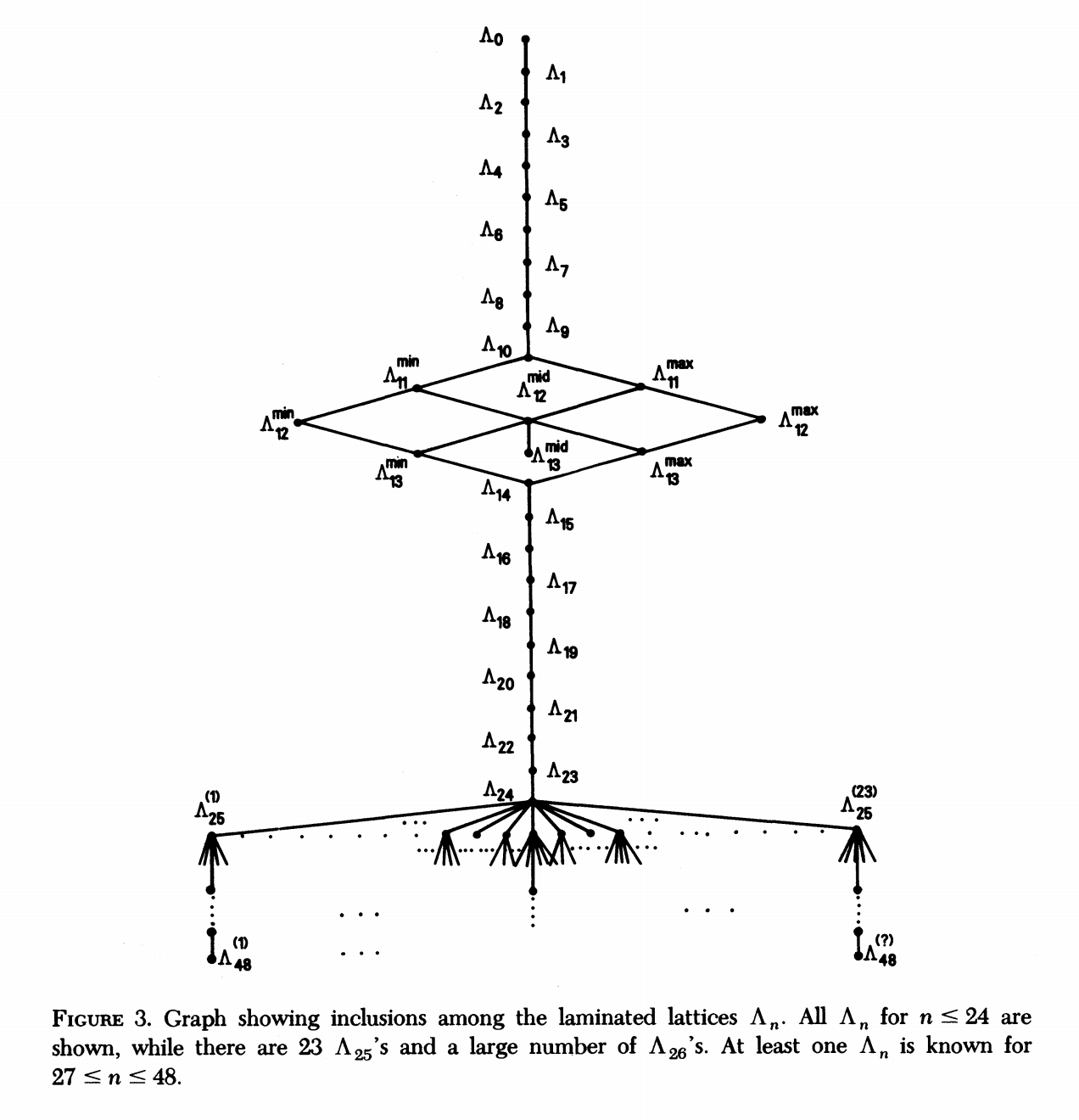
J. H. Conway and N. J. A. Sloane, The "shower" showing containments among the laminated lattices up to dimension 48 (Fig 3 from the Annals paper, also Fig. 6.1 in the Sphere packing book).
FORMULA
G.f.: 169*A2^12*A4^8*A16/(A1^8*A32^2) + 130*q^2*A2^12*A4^8*A8^2*A32^2/(A1^8*A16^5) - 8*q*A2^12*A4^10*A16^5/(A1^8*A8^6*A32^2) - 16*q^3*A2^12*A4^10*A32^2/(A1^8*A8^4*A16) + 4*q^2*A2^12*A4^12*A16^9/(A1^8*A8^12*A32^2) + 8*q^4*A2^12*A4^12*A16^3*A32^2/(A1^8*A8^10) - 256*A2^7*A4^8*A8^5/(A1^6*A16*A32^2) - 512*q^2*A2^7*A4^8*A8^7*A32^2/(A1^6*A16^7) - 104*A2^9*A4^3*A8^5*A16^4/(A1^6*A32^4) - 208*q*A2^9*A4^5*A16^8/(A1^6*A8*A32^4) + 448*A2^2*A4^8*A8^10/(A1^4*A16^3*A32^2) + 384*q^2*A2^2*A4^8*A8^12*A32^2/(A1^4*A16^9) - 768*q*A4^10*A8^9/(A1^2*A2^3*A16*A32^2) + 512*q^3*A4^10*A8^11*A32^2/(A1^2*A2^3*A16^7) - 256*A4^12*A8^6*A16^7/(A2^8*A32^6) + 1536*q^2*A4^12*A8^8*A16/(A2^8*A32^2), where A_k = Product_{m>=1} (1 - q^(k*m)). - Steven Kotlarz, Jun 23 2026
G.f.: theta_3(q^2)^11 + 26*theta_3(q^2)^7*theta_2(q^2)^4 + 24*theta_3(q^2)^5*theta_2(q^2)^6 + 13*theta_3(q^2)^3*theta_2(q^2)^8, where theta_2(q) = Sum_{k in Z} q^((k+1/2)^2) and theta_3(q) = Sum_{k in Z} q^(k^2). - Steven Kotlarz, Jul 12 2026
a(n) - A006910(n) = [q^n] (1/2)*theta_4(q)^8*(theta_3(q^2)^3 - theta_4(q^2)^3), where theta_4(q) = Sum_{k in Z} (-1)^k*q^(k^2). - Steven Kotlarz, Jul 12 2026
PROG
(Magma)
L := Lattice("Lambda", 11);
B := Basis(ThetaSeriesModularFormSpace(L), 20);
Coefficients(B[1] + 438*B[3] + 1536*B[4] + 9372*B[5] + 15360*B[6]); // Andy Huchala, Jun 16 2021
(PARI) a(n) = my(q='q+O('q^(n+1)), L=sqrtint(n)+2, b=1+2*sum(k=1, L, q^(2*k^2)), p=2*sum(k=0, L, q^((2*k+1)^2)), d=1+2*sum(k=1, L, q^(4*k^2)), Y=2*p*d); polcoef(b^11 + 26*b^7*Y^2 + 24*b^5*Y^3 + 13*b^3*Y^4, n) \\ Steven Kotlarz, Jul 12 2026
(Python)
def A006911_list(T):
from math import isqrt
def mul(a, b):
c = [0]*T
for i, ai in enumerate(a):
if ai:
for j in range(T-i):
if b[j]: c[i+j] += ai*b[j]
return c
def pw(a, e):
r = [0]*T; r[0] = 1
while e:
if e & 1: r = mul(r, a)
a = mul(a, a); e >>= 1
return r
L = isqrt(T) + 2
b = [0]*T; b[0] = 1 # theta_3(q^2)
for k in range(1, L):
if 2*k*k < T: b[2*k*k] = 2
p = [0]*T # theta_2(q^4)
for k in range(L):
if (2*k+1)**2 < T: p[(2*k+1)**2] = 2
d = [0]*T; d[0] = 1 # theta_3(q^4)
for k in range(1, L):
if 4*k*k < T: d[4*k*k] = 2
Y = [2*y for y in mul(p, d)] # theta_2(q^2)^2
b2 = mul(b, b); b3 = mul(b2, b)
return mul(b3, [x + 26*y2 + 24*y3 + 13*y4 for x, y2, y3, y4 in
zip(pw(b, 8), mul(pw(b, 4), pw(Y, 2)), mul(b2, pw(Y, 3)), pw(Y, 4))])
print(A006911_list(35)) # Steven Kotlarz, Jul 12 2026
CROSSREFS
KEYWORD
nonn,changed
AUTHOR
STATUS
approved