
OFFSET
0,3
COMMENTS
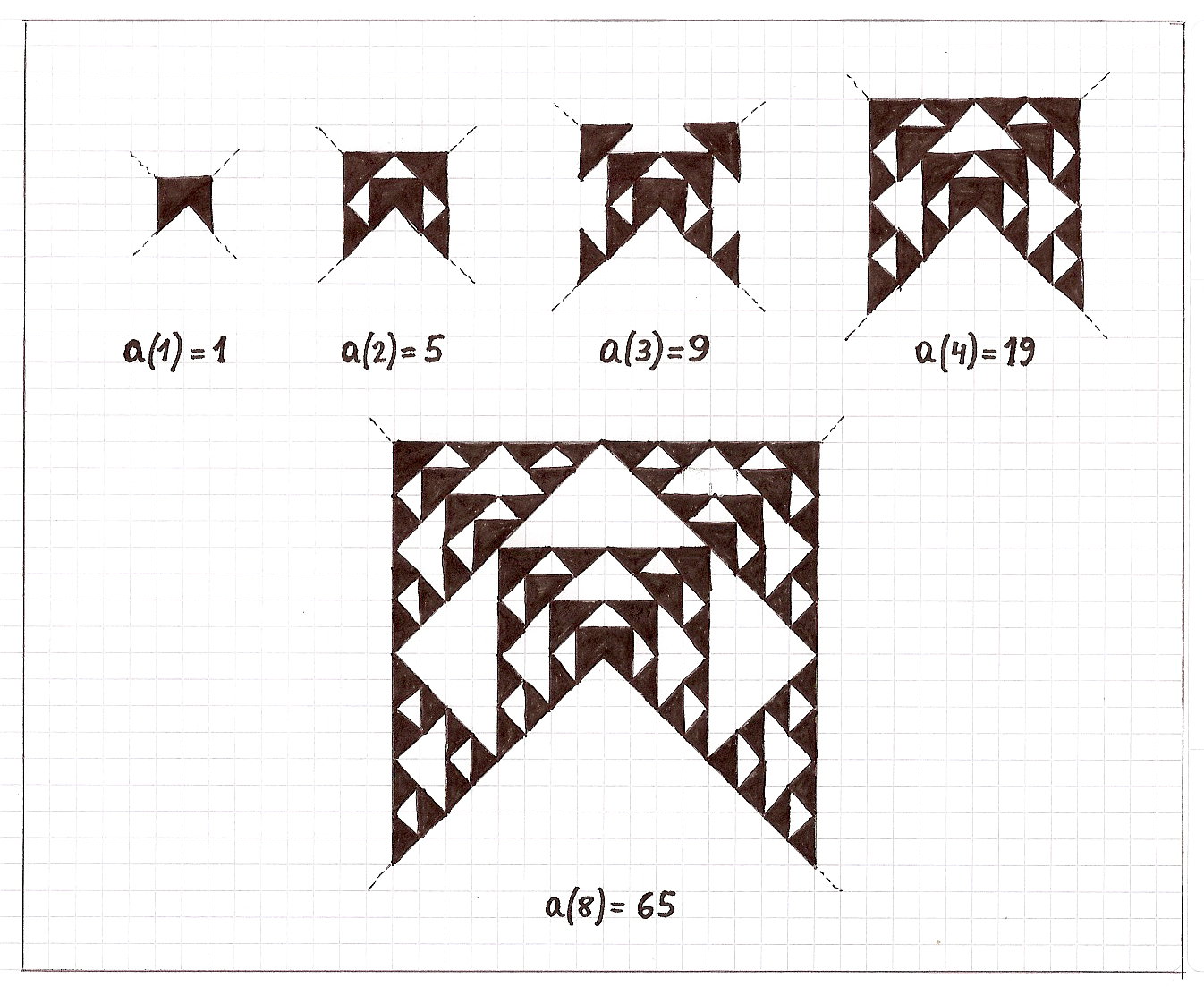
This cellular automata is formed by the concatenation of three Sierpinski triangles, starting from a central vertex. Adjacent polygons are fused. The ON cells are triangles, but we only count after fusion. The sequence gives the number of polygons at the n-th round.
If instead we start from four Sierpinski triangles we get A160720.
LINKS
Michael De Vlieger, Table of n, a(n) for n = 0..9999
David Applegate, Omar E. Pol and N. J. A. Sloane, The Toothpick Sequence and Other Sequences from Cellular Automata, Congressus Numerantium, Vol. 206 (2010), 157-191. [There is a typo in Theorem 6: (13) should read u(n) = 4.3^(wt(n-1)-1) for n >= 2.]
Hsien-Kuei Hwang, Svante Janson, and Tsung-Hsi Tsai, Identities and periodic oscillations of divide-and-conquer recurrences splitting at half, arXiv:2210.10968 [cs.DS], 2022, p. 30.
Omar E. Pol, Illustration if initial terms
N. J. A. Sloane, Catalog of Toothpick and Cellular Automata Sequences in the OEIS
FORMULA
a(n) = 3*A006046(n) - 2*n. - Max Alekseyev, Jan 21 2010
EXAMPLE
We start at round 0 with no polygons, a(0) = 0.
At round 1 we turn ON the first triangle in each of the three Sierpinski triangles. After fusion we have a concave pentagon, so a(1) = 1.
At round 2 we turn ON two triangles in each the three Sierpinski triangles. After fusions we have the concave pentagon and four triangles. So a(2) = 1 + 4 = 5.
MATHEMATICA
a[0] = 0; a[1] = 1; a[n_] := a[n] = 2 a[Floor[#]] + a[Ceiling[#]] &[n/2]; Array[3 a[#] - 2 # &, 54, 0] (* Michael De Vlieger, Nov 01 2022 *)
CROSSREFS
KEYWORD
nonn
AUTHOR
Omar E. Pol, May 25 2009, Jan 03 2010
EXTENSIONS
Extended by Max Alekseyev, Jan 21 2010
STATUS
approved