
OFFSET
1,2
COMMENTS
Row sums of triangle A220504. - Omar E. Pol, Jan 19 2013
LINKS
Alois P. Heinz, Table of n, a(n) for n = 1..10000 (first 550 terms from Joerg Arndt)
F. G. Garvan, Table of a(n) for n = 1..10000 (Coefficients of Andrews spt-function)
G. E. Andrews, The number of smallest parts in the partitions of n, Journal für die reine und angewandte Mathematik, Volume 2008 Issue 624, 133-142.
Scott Ahlgren, Nickolas Andersen, Euler-like recurrences for smallest parts functions, arXiv:1402.5366
George E. Andrews, Song Heng Chan and Byungchan Kim, The Odd Moments of Ranks and Cranks, Journal of Combinatorial Theory, Series A, Volume 120, Issue 1, January 2013, Pages 77-91. - From N. J. A. Sloane, Sep 04 2012
G. E. Andrews, F. G. Garvan, and J. Liang, Combinatorial interpretation of congruences for the spt-function
G. E. Andrews, F. G. Garvan, and J. Liang, Self-conjugate vector partitions and the parity of the spt-function
William Y.C. Chen, The spt-Function of Andrews, arXiv:1707.04369 [math.CO], Jul 14 2017.
A. Folsom and K. Ono, The spt-function of Andrews, PNAS, December 23 2008, 105 (51) 20152-20156.
F. G. Garvan, Congruences for Andrews' smallest parts partition function and new congruences for Dyson's rank
F. G. Garvan, Congruences for Andrews' spt-function modulo powers of 5, 7 and 13, arXiv:1011.1955 [math.NT], Nov 9 2010.
F. G. Garvan, Congruences for Andrews' spt-function modulo 32760 and extension of Atkin's Hecke-type partition congruences, arXiv:1011.1957 [math.NT], Nov 9 2010.
F. G. Garvan, Higher Order Spt-functions, Adv. Math. 228 (2011), no. 1, 241-265. - From N. J. A. Sloane, Jan 02 2013
F. G. Garvan, The smallest parts partition function, 2012.
F. G. Garvan, Dyson's rank function and Andrews's SPT-function, slides 11, 12.
M. H. Mertens, K. Ono, L. Rolen, Mock modular Eisenstein series with Nebentypus, arXiv:1906.07410 [math.NT], 2019.
K. Ono, Congruences for the Andrews spt-function, PNAS, December 21 2010, 108 (2) 473-476.
Omar E. Pol, Illustration of initial terms
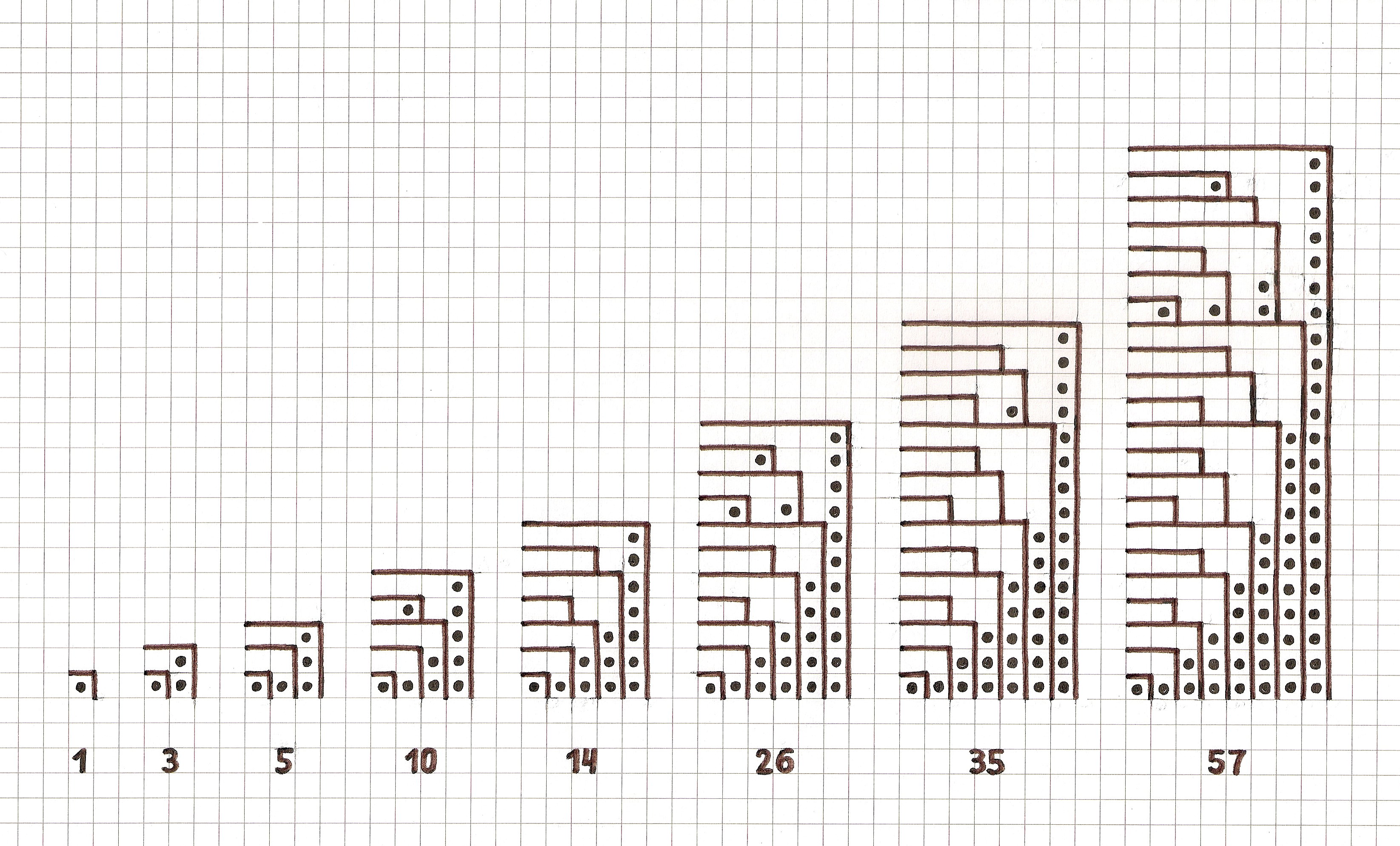
Wikipedia, Spt function
FORMULA
G.f.: Sum_{n>=1} x^n/(1-x^n) * Product_{k>=n} 1/(1-x^k).
a(n) = n*p(n) - N_2(n)/2 = n*A000041(n) - A220908(n)/2 = A066186(n) - A220907(n) = (A220909(n) - A220908(n))/2 = A211982(n)/2 (from Andrews's paper and Garvan's paper). - Omar E. Pol, Jan 03 2013
Asymptotics (Bringmann-Mahlburg, 2009): a(n) ~ exp(Pi*sqrt(2*n/3)) / (Pi*sqrt(8*n)) ~ sqrt(6*n)*A000041(n)/Pi. - Vaclav Kotesovec, Jul 30 2017
EXAMPLE
Partitions of 4 are [1,1,1,1], [1,1,2], [2,2], [1,3], [4]. 1 appears 4 times in the first, 1 twice in the second, 2 twice in the third, etc.; thus a(4)=4+2+2+1+1=10.
MAPLE
b:= proc(n, i) option remember; `if`(n=0 or i=1, n,
`if`(irem(n, i, 'r')=0, r, 0)+add(b(n-i*j, i-1), j=0..n/i))
end:
a:= n-> b(n, n):
seq(a(n), n=1..60); # Alois P. Heinz, Jan 16 2013
MATHEMATICA
terms = 47; gf = Sum[x^n/(1 - x^n)*Product[1/(1 - x^k), {k, n, terms}], {n, 1, terms}]; CoefficientList[ Series[gf, {x, 0, terms}], x] // Rest (* Jean-François Alcover, Jan 17 2013 *)
b[n_, i_] := b[n, i] = If[n==0 || i==1, n, {q, r} = QuotientRemainder[n, i]; If[r==0, q, 0] + Sum[b[n-i*j, i-1], {j, 0, n/i}]]; a[n_] := b[n, n]; Table[a[n], {n, 1, 60}] (* Jean-François Alcover, Nov 23 2015, after Alois P. Heinz *)
PROG
(PARI)
N = 66; x = 'x + O('x^N);
gf = sum(n=1, N, x^n/(1-x^n) * prod(k=n, N, 1/(1-x^k) ) );
v = Vec(gf)
/* Joerg Arndt, Jan 12 2013 */
CROSSREFS
KEYWORD
nonn
AUTHOR
Vladeta Jovovic, Feb 16 2004
EXTENSIONS
More terms from Pab Ter (pabrlos(AT)yahoo.com), May 25 2004
STATUS
approved