
OFFSET
0,3
COMMENTS
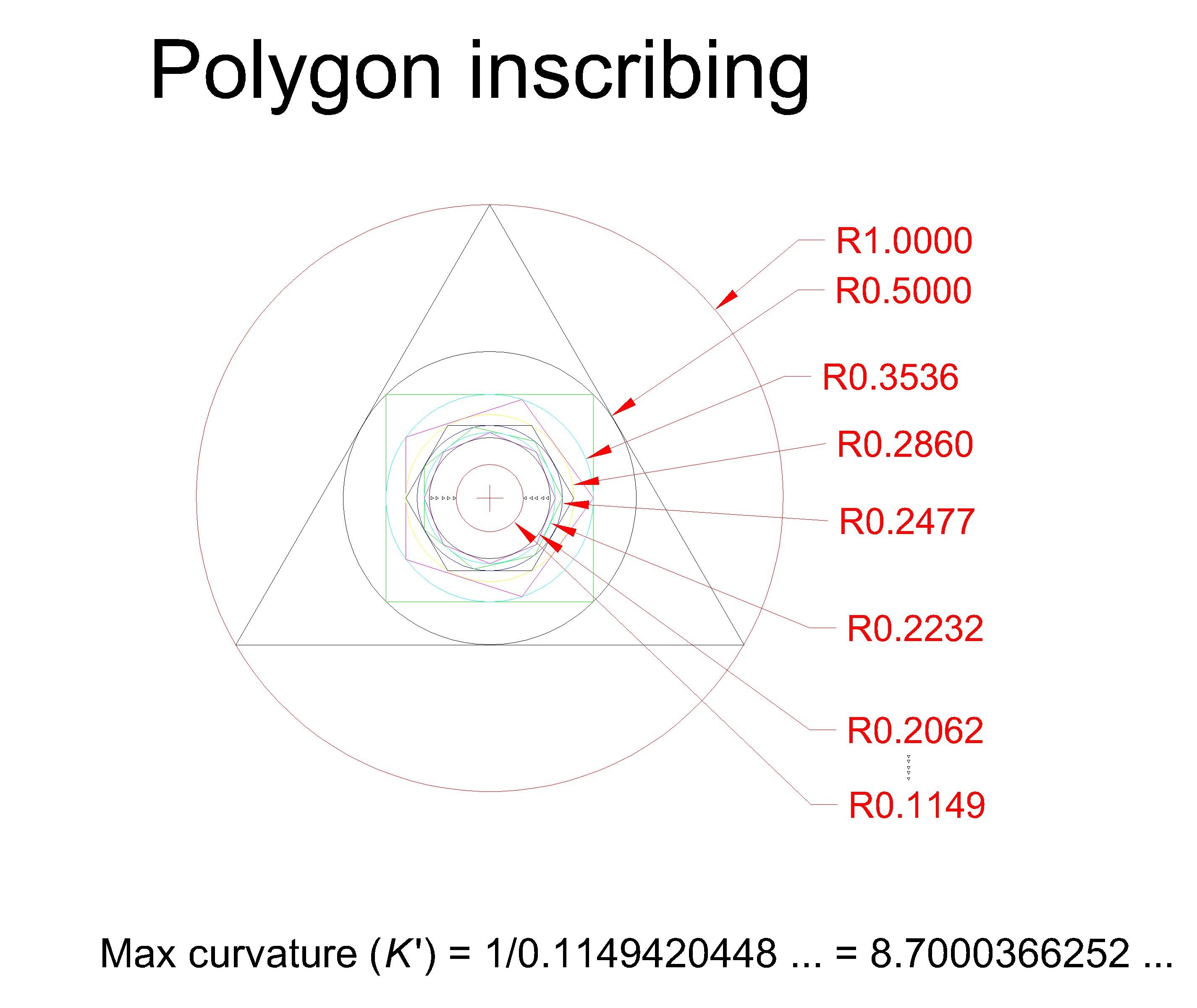
Inscribe an equilateral triangle in a circle of unit radius. Inscribe a circle in the triangle. Inscribe a square in the second circle and inscribe a circle in the square. Inscribe a regular pentagon in the third circle and so on. The radii of the circles converge to Product_{ k = 3..infinity } cos(Pi/k), which is this number. - N. J. A. Sloane, Feb 10 2008
"It is stated in Kasner and Newman's 'Mathematics and the Imagination' (pp. 269-270 in the Pelican edition) that P=Product{k=3..infinity} cos(Pi/k) is approximately equal to 1/12. Not so! ..., so that a very good approximation to P is 10/87 ...", by Grimstone. - Robert G. Wilson v, Dec 22 2013
Named after the German astronomer and mathematician Johannes Kepler (1571 - 1630) and the Dutch mathematician Christoffel Jacob Bouwkamp (1915 - 2003). - Amiram Eldar, Aug 21 2020
REFERENCES
Dick Katz, Problem 91:24, in R. K. Guy, ed., Western Number Theory Problems, 1992-12-19 & 22.
Steven R. Finch, Mathematical Constants, Encyclopedia of Mathematics and its Applications, vol. 94, Cambridge University Press, 2003, Section 6.3, p. 428.
Clifford A. Pickover, The Math Book, From Pythagoras to the 57th Dimension, 250 Milestones in the History of Mathematics, Sterling Publ., NY, 2009, p. 382.
LINKS
Vaclav Kotesovec, Table of n, a(n) for n = 0..1000
C. J. Bouwkamp, An infinite product, Proceedings of the Koninklijke Nederlandse Akademie van Wetenschappen: Series A: Mathematical Sciences, Vol. 68 (1965), pp. 40-46.
Hugo Brandt, Problem 2356, solved by Julian H. Braun, School Science and Mathematics, Vol. 53, No. 7 (1953), pp. 575-576.
Marc Chamberland and Armin Straub, On gamma quotients and infinite products, Advances in Applied Mathematics, Vol. 51, No. 5 (2013), pp. 546-562, preprint, arXiv:1309.3455 [math.NT], 2013. See Section 4.
Tamara Curnow, Falling down a polygonal well, Mathematical Spectrum, Vol. 26, No. 4 (1994), pp. 110-118.
Tomislav Doslic, Kepler-Bouwkamp Radius of Combinatorial Sequences, J. Int. Seq. 17 (2014) # 14.11.3.
Steven R. Finch, Errata and Addenda to Mathematical Constants, p. 58.
Clive J. Grimstone, A product of cosines, Math. Gaz. 64 (428) (1980) 120-121.
Johannes Kepler, Mysterium Cosmographicum, Tübingen, 1596. See p. 39.
M. H. Lietzke and C. W. Nestor, Jr., Problem 4793, The American Mathematical Monthly, Vol. 65, No. 6 (1958), pp. 451-452, An Infinite Sequence of Inscribed Polygons, solution to Problem 4793, solved by Julian Braun and others, ibid., Vol. 66, No. 3 (1959), pp. 242-243.
Kival Ngaokrajang, Illustration of polygon inscribing.
David Singmaster, Letter to the Editor: Kepler's polygonal well, Mathematical Spectrum, Vol. 27, No. 3 (1995), pp. 63-64.
E. Stephens, 79.52 Slowly convergent infinite products, The Mathematical Gazette, Vol. 79, No. 486 (1995), pp. 561-565.
Eric Weisstein's World of Mathematics, Polygon Inscribing.
Wikipedia, Kepler-Bouwkamp constant.
FORMULA
Equals Product_{n>=3} cos(Pi/n).
The log of this constant is equal to Sum_{n=1..infinity} -((2^(2*n)-1)/n) * zeta(2*n) * (zeta(2*n)-1-1/2^(2*n)). [Richard McIntosh] - N. J. A. Sloane, Feb 10 2008
Equals 1/A051762. - M. F. Hasler, May 18 2014
EXAMPLE
0.1149420448532...
MAPLE
evalf(1/(product(sec(Pi/k), k=3..infinity)), 104) # Vaclav Kotesovec, Sep 20 2014
MATHEMATICA
(* The naive approach, N[ Product[ Cos[ Pi/n], {n, 3, Infinity}], 111], yields only 27 correct decimals. - Vaclav Kotesovec, Sep 20 2014 *)
Block[{$MaxExtraPrecision = 1000}, Do[Print[N[Exp[Sum[-(2^(2*n)-1)/n * Zeta[2*n]*(Zeta[2*n] - 1 - 1/2^(2*n)), {n, 1, m}]], 110]], {m, 250, 300}]] (* over 100 decimal places are correct, Vaclav Kotesovec, Sep 20 2014 *)
PROG
(PARI) exp(sumpos(n=3, log(cos(Pi/n)))) \\ M. F. Hasler, May 18 2014
CROSSREFS
KEYWORD
nonn,cons
AUTHOR
Eric W. Weisstein, Jun 25 2003
EXTENSIONS
Edited by M. F. Hasler, May 18 2014
First formula corrected (missing sign) by Vaclav Kotesovec, Sep 20 2014
Terms since 27 corrected by Vaclav Kotesovec, Sep 20 2014 (recomputed with higher precision)
STATUS
approved