
OFFSET
0,3
COMMENTS
Row n contains 1 + n(n-1)/2 entries. - Emeric Deutsch, Jun 03 2009
Row sums are A001147 (double factorials).
Coefficients of Touchard-Riordan polynomials defined on page 3 of the Chakravarty and Kodama paper, related to the array A039599 through the polynomial numerators of Eqn. 2.1. - Tom Copeland, May 26 2016
REFERENCES
P. Flajolet and M. Noy, Analytic combinatorics of chord diagrams; in Formal Power Series and Algebraic Combinatorics, pp. 191-201, Springer, 2000.
LINKS
Alt.Math, alt.math.recreational discussion
S. Chakravarty and Y. Kodama, A generating function for the N-soliton solutions of the Kadomtsev-Petviashvili II equation, arXiv preprint arXiv:0802.0524v2 [nlin.SI], 2008.
FindStat - Combinatorial Statistic Finder, The number of nestings of a perfect matching., The number of crossings of a perfect matching.
P. Flajolet and M. Noy, Analytic combinatorics of chord diagrams, [Research Report] RR-3914, INRIA. 2000.
P. Luschny, First 10 rows of triangle (taken from Luschny link below)
P. Luschny, Variants of Variations.
J.-G. Penaud, Une preuve bijective d'une formule de Touchard-Riordan, Discrete Math., 139, 1995, 347-360. [From Emeric Deutsch, Jun 03 2009]
H. Prodinger, On Touchard's continued fraction and extensions: combinatorics-free, self-contained proofs , arXiv:1102.5186 [math.CO], 2011.
J. Riordan, The distribution of crossings of chords joining pairs of 2n points on a circle, Math. Comp., 29 (1975), 215-222.
J. Riordan, The distribution of crossings of chords joining pairs of 2n points on a circle, Math. Comp., 29 (1975), 215-222. [Annotated scanned copy]
Lucas Sá and Antonio M. García-García, The Wishart-Sachdev-Ye-Kitaev model: Q-Laguerre spectral density and quantum chaos, arXiv:2104.07647 [hep-th], 2021.
FORMULA
T(n,k) = Sum_{j=0..n-1} (-1)^j * C((n-j)*(n-j+1)/2-1-k, n-1) * (C(2n, j) - C(2n, j-1)).
Generating polynomial of row n is (1-q)^(-n)*Sum_{j=-n..n} (-1)^j*q^(j*(j-1)/2)*binomial(2*n,n+j). - Emeric Deutsch, Jun 03 2009
O.g.f. as a continued fraction: 1/(1 - t/(1 - (1 + x)*t/(1 - (1 + x + x^2)*t/(1 - (1 + x + x^2 + x^3)*t/(1 - ...))))) = 1 + t + (2 + x)*t^2 + (5 + 6*x +3*x^2 + x^4)*t^3 + .... See Chakravarty and Kodama, equation 3.8. - Peter Bala, Jun 13 2019
EXAMPLE
Rows start:
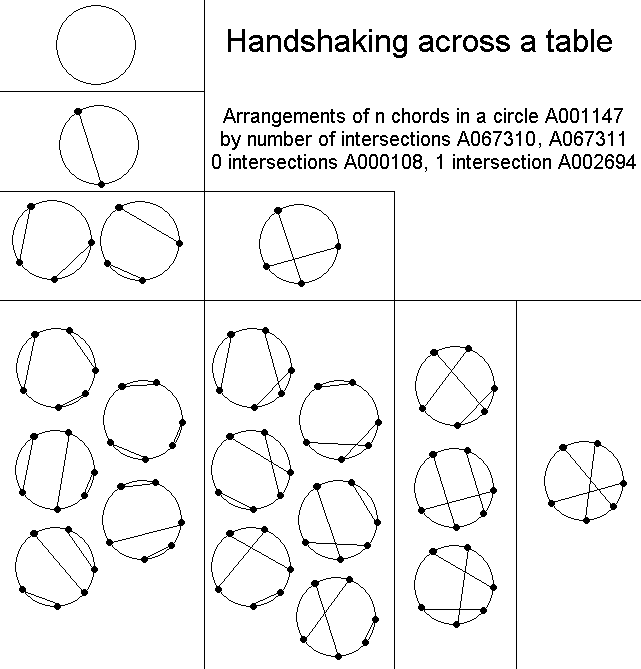
1;
1;
2, 1;
5, 6, 3, 1;
14, 28, 28, 20, 10, 4, 1;
42, 120, 180, 195, 165, 117, 70, 35, 15, 5, 1;
etc.,
i.e., there are 5 ways of arranging 3 chords with no intersections, 6 with one, 3 with two and 1 with three.
MAPLE
p := proc (n) options operator, arrow: sort(simplify((sum((-1)^j*q^((1/2)*j*(j-1))*binomial(2*n, n+j), j = -n .. n))/(1-q)^n)) end proc; for n from 0 to 7 do seq(coeff(p(n), q, i), i = 0 .. (1/2)*n*(n-1)) end do; # yields sequence in triangular form; Emeric Deutsch, Jun 03 2009
MATHEMATICA
nmax = 15; se[n_] := se[n] = Series[ Sum[(-1)^j*q^(j(j-1)/2)*Binomial[2 n, n+j], {j, -n, n}]/(1-q)^n , {q, 0, nmax}];
t[n_, k_] := Coefficient[se[n], q^k]; t[n_, 0] = Binomial[2 n, n]/(n + 1);
Select[Flatten[Table[t[n, k], {n, 0, nmax}, {k, 0, 2nmax}] ], Positive] [[1 ;; 55]]
(* Jean-François Alcover, Jun 22 2011, after Emeric Deutsch *)
PROG
(PARI)
M(n)=1/(1-q)^n*sum(k=0, n, (-1)^k * ( binomial(2*n, n-k)-binomial(2*n, n-k-1)) * q^(k*(k+1)/2) );
for (n=0, 10, print( Vec(polrecip(M(n))) ) ); /* print rows */
/* Joerg Arndt, Oct 01 2012 */
CROSSREFS
KEYWORD
nonn,tabf
AUTHOR
Henry Bottomley, Jan 14 2002
STATUS
approved