|
| |
|
|
A062011
|
|
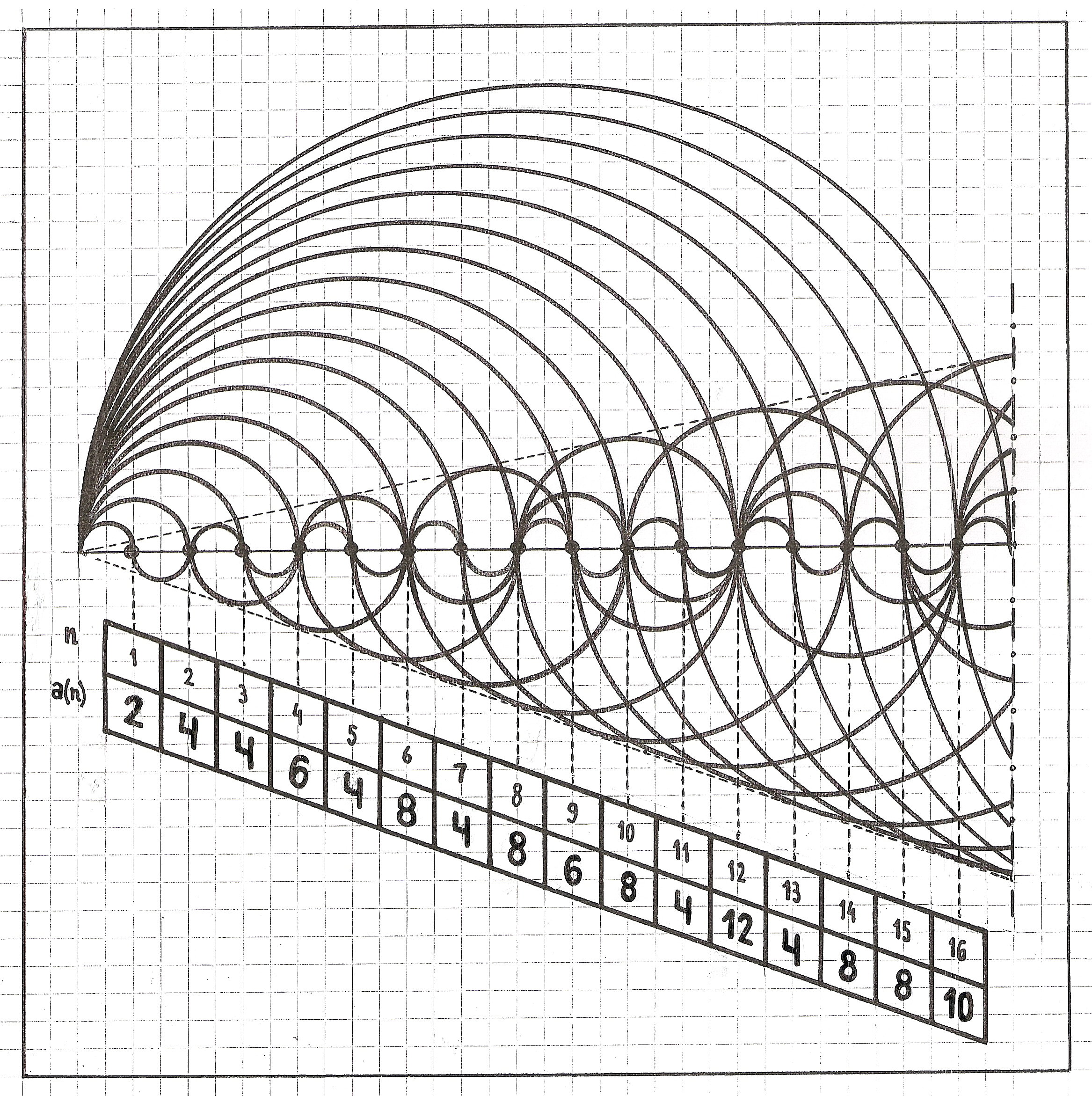
a(n) = 2*tau(n) = 2*A000005(n).
|
|
20
|
|
|
|
2, 4, 4, 6, 4, 8, 4, 8, 6, 8, 4, 12, 4, 8, 8, 10, 4, 12, 4, 12, 8, 8, 4, 16, 6, 8, 8, 12, 4, 16, 4, 12, 8, 8, 8, 18, 4, 8, 8, 16, 4, 16, 4, 12, 12, 8, 4, 20, 6, 12, 8, 12, 4, 16, 8, 16, 8, 8, 4, 24, 4, 8, 12, 14, 8, 16, 4, 12, 8, 16, 4, 24, 4, 8, 12, 12, 8, 16, 4, 20, 10, 8, 4, 24, 8, 8, 8, 16
(list;
graph;
refs;
listen;
history;
text;
internal format)
|
|
|
|
OFFSET
|
1,1
|
|
|
COMMENTS
|
Old definition was "Number of cyclic subgroups of the group C_n X C_2 (where C_n is the cyclic group with n elements)."
More generally, the number of cyclic subgroups of the group C_n X C_m is Sum_{i|n, j|m} phi(i)*phi(j)/phi(lcm(i,j)), where phi=Euler totient function, cf. A000010. - Vladeta Jovovic, Jul 15 2001
Number of divisors of p*n, where p is any prime not dividing n. - Reinhard Zumkeller, May 17 2006
If p(x) is a polynomial with integer coefficients, and if r is an integer zero of p(x), then r is a divisor of the constant term c_0 of p(x). Under this theorem, p(x) can have a(c_0) possible integer roots.
a(n) is the number of integer divisors of n, while A000005(n) is the number of positive divisors. (End)
Number of solutions to the Diophantine equation i*j = n*i + j. - Robert G. Wilson v, Apr 10 2019
a(n) is also the number of times n appears in the triangle A333119, or equivalently, the number of positive integer solutions of the equation A333119(x, y) = n for y < x. - Stefano Spezia, Oct 05 2022
|
|
|
LINKS
|
|
|
|
FORMULA
|
L.g.f.: -log(Product_{k>=1} (1 - x^k)^(2/k)) = Sum_{n>=1} a(n)*x^n/n. - Ilya Gutkovskiy, Mar 18 2018
|
|
|
MATHEMATICA
|
|
|
|
PROG
|
(PARI) for (n=1, 1000, write("b062011.txt", n, " ", 2*numdiv(n))) \\ Harry J. Smith, Jul 29 2009
|
|
|
CROSSREFS
|
|
|
|
KEYWORD
|
nonn,easy
|
|
|
AUTHOR
|
Ahmed Fares (ahmedfares(AT)my-deja.com), Jul 12 2001
|
|
|
EXTENSIONS
|
Edited by N. J. A. Sloane, Sep 20 2018, replacing old definition (which was of course correct) with a simple formula.
|
|
|
STATUS
|
approved
|
| |
|
|