
OFFSET
0,5
COMMENTS
A. W. F. Edwards writes: "It [the triangle] was first written down long before 1654, the year in which Blaise Pascal wrote his Traité du triangle arithmétique, but it was this work that brought together all the different aspects of the numbers for the first time. In it Pascal developed the properties of the number as a piece of pure mathematics ... and then, in a series of appendices, showed how these properties were relevant to the study of the figurate numbers, to the theory of combinations, to the expansion of binomial expressions, and to the solution of an important problem in the theory of probability." (A. W. F. Edwards, Pascal's Arithmetical Triangle, Johns Hopkins University Press (2002), p. xiii)
Edwards reports that the naming of the triangle after Pascal was done first by Montmort in 1708 as the "Table de M. Pascal pour les combinaisons" and then by De Moivre in 1730 as the "Triangulum Arithmeticum PASCALANIUM". (Edwards, p. xiv)
In China, Yang Hui in 1261 listed the coefficients of (a+b)^n up to n=6, crediting the expansion to Chia Hsein's Shih-so suan-shu circa 1100. Another prominent early use was in Chu Shih-Chieh's Precious Mirror of the Four Elements in 1303. (Edwards, p. 51)
In Persia, Al-Karaji discovered the binomial triangle "some time soon after 1007", and Al-Samawal published it in the Al-bahir some time before 1180. (Edwards, p. 52)
In India, Halayuda's commentary (circa 900) on Pingala's treatise on syllabic combinations (circa 200 B.C.E.) contains a clear description of the additive computation of the triangle. (Amulya Kumar Bag, Binomial Theorem in Ancient India, p. 72)
Also in India, the multiplicative formula for C(n,k) was known to Mahavira in 850 and restated by Bhaskara in 1150. (Edwards, p. 27)
In Italy, Tartaglia published the triangle in his General trattato (1556), and Cardano published it in his Opus novum (1570). (Edwards, p. 39, 44) - Russ Cox, Mar 29 2022
Also sometimes called Omar Khayyam's triangle.
Also sometimes called Yang Hui's triangle.
C(n,k) = number of k-element subsets of an n-element set.
Row n gives coefficients in expansion of (1+x)^n.
Binomial(n+k-1,n-1) is the number of ways of placing k indistinguishable balls into n boxes (the "bars and stars" argument - see Feller).
Binomial(n-1,k-1) is the number of compositions (ordered partitions) of n with k summands.
Binomial(n+k-1,k-1) is the number of weak compositions (ordered weak partitions) of n into exactly k summands. - Juergen Will, Jan 23 2016
Binomial(n,k) is the number of lattice paths from (0,0) to (n,k) using steps (1,0) and (1,1). - Joerg Arndt, Jul 01 2011
If thought of as an infinite lower triangular matrix, inverse begins:
+1
-1 +1
+1 -2 +1
-1 +3 -3 +1
+1 -4 +6 -4 +1
All 2^n palindromic binomial coefficients starting after the A006516(n)-th entry are odd. - Lekraj Beedassy, May 20 2003
Binomial(n+k-1,n-1) is the number of standard tableaux of shape (n,1^k). - Emeric Deutsch, May 13 2004
Can be viewed as an array, read by antidiagonals, where the entries in the first row and column are all 1's and A(i,j) = A(i-1,j) + A(i,j-1) for all other entries. The determinant of each of its n X n subarrays starting at (0,0) is 1. - Gerald McGarvey, Aug 17 2004
Also the lower triangular readout of the exponential of a matrix whose entry {j+1,j} equals j+1 (and all other entries are zero). - Joseph Biberstine (jrbibers(AT)indiana.edu), May 26 2006
Binomial(n-3,k-1) counts the permutations in S_n which have zero occurrences of the pattern 231 and one occurrence of the pattern 132 and k descents. Binomial(n-3,k-1) also counts the permutations in S_n which have zero occurrences of the pattern 231 and one occurrence of the pattern 213 and k descents. - David Hoek (david.hok(AT)telia.com), Feb 28 2007
Inverse of A130595 (as an infinite lower triangular matrix). - Philippe Deléham, Aug 21 2007
Consider integer lists LL of lists L of the form LL = [m#L] = [m#[k#2]] (where '#' means 'times') like LL(m=3,k=3) = [[2,2,2],[2,2,2],[2,2,2]]. The number of the integer list partitions of LL(m,k) is equal to binomial(m+k,k) if multiple partitions like [[1,1],[2],[2]] and [[2],[2],[1,1]] and [[2],[1,1],[2]] are counted only once. For the example, we find 4*5*6/3! = 20 = binomial(6,3). - Thomas Wieder, Oct 03 2007
The infinitesimal generator for Pascal's triangle and its inverse is A132440. - Tom Copeland, Nov 15 2007
Row n>=2 gives the number of k-digit (k>0) base n numbers with strictly decreasing digits; e.g., row 10 for A009995. Similarly, row n-1>=2 gives the number of k-digit (k>1) base n numbers with strictly increasing digits; see A009993 and compare A118629. - Rick L. Shepherd, Nov 25 2007
From Lee Naish (lee(AT)cs.mu.oz.au), Mar 07 2008: (Start)
Binomial(n+k-1, k) is the number of ways a sequence of length k can be partitioned into n subsequences (see the Naish link).
Binomial(n+k-1, k) is also the number of n- (or fewer) digit numbers written in radix at least k whose digits sum to k. For example, in decimal, there are binomial(3+3-1,3)=10 3-digit numbers whose digits sum to 3 (see A052217) and also binomial(4+2-1,2)=10 4-digit numbers whose digits sum to 2 (see A052216). This relationship can be used to generate the numbers of sequences A052216 to A052224 (and further sequences using radix greater than 10). (End)
From Milan Janjic, May 07 2008: (Start)
Denote by sigma_k(x_1,x_2,...,x_n) the elementary symmetric polynomials. Then:
Binomial(2n+1,2k+1) = sigma_{n-k}(x_1,x_2,...,x_n), where x_i = tan^2(i*Pi/(2n+1)), (i=1,2,...,n).
Binomial(2n,2k+1) = 2n*sigma_{n-1-k}(x_1,x_2,...,x_{n-1}), where x_i = tan^2(i*Pi/(2n)), (i=1,2,...,n-1).
Binomial(2n,2k) = sigma_{n-k}(x_1,x_2,...,x_n), where x_i = tan^2((2i-1)Pi/(4n)), (i=1,2,...,n).
Binomial(2n+1,2k) = (2n+1)sigma_{n-k}(x_1,x_2,...,x_n), where x_i = tan^2((2i-1)Pi/(4n+2)), (i=1,2,...,n). (End)
Given matrices R and S with R(n,k) = binomial(n,k)*r(n-k) and S(n,k) = binomial(n,k)*s(n-k), then R*S = T where T(n,k) = binomial(n,k)*[r(.)+s(.)]^(n-k), umbrally. And, the e.g.f.s for the row polynomials of R, S and T are, respectively, exp(x*t)*exp[r(.)*x], exp(x*t)*exp[s(.)*x] and exp(x*t)*exp[r(.)*x]*exp[s(.)*x] = exp{[t+r(.)+s(.)]*x}. The row polynomials are essentially Appell polynomials. See A132382 for an example. - Tom Copeland, Aug 21 2008
As the rectangle R(m,n) = binomial(m+n-2,m-1), the weight array W (defined generally at A144112) of R is essentially R itself, in the sense that if row 1 and column 1 of W=A144225 are deleted, the remaining array is R. - Clark Kimberling, Sep 15 2008
If A007318 = M as an infinite lower triangular matrix, M^n gives A130595, A023531, A007318, A038207, A027465, A038231, A038243, A038255, A027466, A038279, A038291, A038303, A038315, A038327, A133371, A147716, A027467 for n=-1,0,1,2,3,4,5,6,7,8,9,10,11,12,13,14,15 respectively. - Philippe Deléham, Nov 11 2008
The coefficients of the polynomials with e.g.f. exp(x*t)*(cosh(t)+sinh(t)). - Peter Luschny, Jul 09 2009
The triangle or chess sums, see A180662 for their definitions, link Pascal's triangle with twenty different sequences, see the crossrefs. All sums come in pairs due to the symmetrical nature of this triangle. The knight sums Kn14 - Kn110 have been added. It is remarkable that all knight sums are related to the Fibonacci numbers, i.e., A000045, but none of the others. - Johannes W. Meijer, Sep 22 2010
Binomial(n,k) is also the number of ways to distribute n+1 balls into k+1 urns so that each urn gets at least one ball. See example in the example section below. - Dennis P. Walsh, Jan 29 2011
Binomial(n,k) is the number of increasing functions from {1,...,k} to {1,...,n} since there are binomial(n,k) ways to choose the k distinct, ordered elements of the range from the codomain {1,...,n}. See example in the example section below. - Dennis P. Walsh, Apr 07 2011
Central binomial coefficients: T(2*n,n) = A000984(n), T(n, floor(n/2)) = A001405(n). - Reinhard Zumkeller, Nov 09 2011
Binomial(n,k) is the number of subsets of {1,...,n+1} with k+1 as median element. To see this, note that Sum_{j=0..min(k,n-k)}binomial(k,j)*binomial(n-k,j) = binomial(n,k). See example in Example section below. - Dennis P. Walsh, Dec 15 2011
This is the coordinator triangle for the lattice Z^n, see Conway-Sloane, 1997. - N. J. A. Sloane, Jan 17 2012
One of three infinite families of integral factorial ratio sequences of height 1 (see Bober, Theorem 1.2). The other two are A046521 and A068555. For real r >= 0, C_r(n,k) := floor(r*n)!/(floor(r*k)!*floor(r*(n-k))!) is integral. See A211226 for the case r = 1/2. - Peter Bala, Apr 10 2012
Define a finite triangle T(m,k) with n rows such that T(m,0) = 1 is the left column, T(m,m) = binomial(n-1,m) is the right column, and the other entries are T(m,k) = T(m-1,k-1) + T(m-1,k) as in Pascal's triangle. The sum of all entries in T (there are A000217(n) elements) is 3^(n-1). - J. M. Bergot, Oct 01 2012
The lower triangular Pascal matrix serves as a representation of the operator exp(RLR) in a basis composed of a sequence of polynomials p_n(x) characterized by ladder operators defined by R p_n(x) = p_(n+1)(x) and L p_n(x) = n p_(n-1)(x). See A132440, A218272, A218234, A097805, and A038207. The transposed and padded Pascal matrices can be associated to the special linear group SL2. - Tom Copeland, Oct 25 2012
See A193242. - Alexander R. Povolotsky, Feb 05 2013
A permutation p_1...p_n of the set {1,...,n} has a descent at position i if p_i > p_(i+1). Let S(n) denote the subset of permutations p_1...p_n of {1,...,n} such that p_(i+1) - p_i <= 1 for i = 1,...,n-1. Then binomial(n,k) gives the number of permutations in S(n+1) with k descents. Alternatively, binomial(n,k) gives the number of permutations in S(n+1) with k+1 increasing runs. - Peter Bala, Mar 24 2013
Sum_{n=>0} binomial(n,k)/n! = e/k!, where e = exp(1), while allowing n < k where binomial(n,k) = 0. Also Sum_{n>=0} binomial(n+k-1,k)/n! = e * A000262(k)/k!, and for k>=1 equals e * A067764(k)/A067653(k). - Richard R. Forberg, Jan 01 2014
The square n X n submatrix (first n rows and n columns) of the Pascal matrix P(x) defined in the formulas below when multiplying on the left the Vandermonde matrix V(x_1,...,x_n) (with ones in the first row) translates the matrix to V(x_1+x,...,x_n+x) while leaving the determinant invariant. - Tom Copeland, May 19 2014
For k>=2, n>=k, k/((k/(k-1) - Sum_{n=k..m} 1/binomial(n,k))) = m!/((m-k+1)!*(k-2)!). Note: k/(k-1) is the infinite sum. See A000217, A000292, A000332 for examples. - Richard R. Forberg, Aug 12 2014
Let G_(2n) be the subgroup of the symmetric group S_(2n) defined by G_(2n) = {p in S_(2n) | p(i) = i (mod n) for i = 1,2,...,2n}. G_(2n) has order 2^n. Binomial(n,k) gives the number of permutations in G_(2n) having n + k cycles. Cf. A130534 and A246117. - Peter Bala, Aug 15 2014
C(n,k) = the number of Dyck paths of semilength n+1, with k+1 "u"'s in odd numbered positions and k+1 returns to the x axis. Example: {U = u in odd position and _ = return to x axis} binomial(3,0)=1 (Uudududd_); binomial(3,1)=3 [(Uududd_Ud_), (Ud_Uududd_), (Uudd_Uudd_)]; binomial(3,2)=3 [(Ud_Ud_Uudd_), (Uudd_Ud_Ud_), (Ud_Uudd_Ud_)]; binomial(3,3)=1 (Ud_Ud_Ud_Ud_). - Roger Ford, Nov 05 2014
From Daniel Forgues, Mar 12 2015: (Start)
The binomial coefficients binomial(n,k) give the number of individuals of the k-th generation after n population doublings. For each doubling of population, each individual's clone has its generation index incremented by 1, and thus goes to the next row. Just tally up each row from 0 to 2^n - 1 to get the binomial coefficients.
0 1 3 7 15
0: O | . | . . | . . . . | . . . . . . . . |
1: | O | O . | O . . . | O . . . . . . . |
2: | | O | O O . | O O . O . . . |
3: | | | O | O O O . |
4: | | | | O |
This is a fractal process: to get the pattern from 0 to 2^n - 1, append a shifted down (by one row) copy of the pattern from 0 to 2^(n-1) - 1 to the right of the pattern from 0 to 2^(n-1) - 1. (Inspired by the "binomial heap" data structure.)
Sequence of generation indices: 1's-counting sequence: number of 1's in binary expansion of n (or the binary weight of n) (see A000120):
{0, 1, 1, 2, 1, 2, 2, 3, 1, 2, 2, 3, 2, 3, 3, 4, ...}
Binary expansion of 0 to 15:
0 1 10 11 100 101 110 111 1000 1001 1010 1011 1100 1101 1111
(End)
A258993(n,k) = T(n+k,n-k), n > 0. - Reinhard Zumkeller, Jun 22 2015
T(n,k) is the number of set partitions w of [n+1] that avoid 1/2/3 with rb(w)=k. The same holds for ls(w)=k, where avoidance is in the sense of Klazar and ls,rb defined by Wachs and White.
Satisfies Benford's law [Diaconis, 1977] - N. J. A. Sloane, Feb 09 2017
Let {A(n)} be a set with exactly n identical elements, with {A(0)} being the empty set E. Let {A(n,k)} be the k-th iteration of {A(n)}, with {A(n,0)} = {A(n)}. {A(n,1)} = The set of all the subsets of A{(n)}, including {A(n)} and E. {A(n,k)} = The set of all subsets of {A(n,k-1)}, including all of the elements of {A(n,k-1)}. Let A(n,k) be the number of elements in {A(n,k)}. Then A(n,k) = C(n+k,k), with each successive iteration replicating the members of the k-th diagonal of Pascal's Triangle. See examples. - Gregory L. Simay, Aug 06 2018
Binomial(n-1,k) is also the number of permutations avoiding both 213 and 312 with k ascents. - Lara Pudwell, Dec 19 2018
Binomial(n-1,k) is also the number of permutations avoiding both 132 and 213 with k ascents. - Lara Pudwell, Dec 19 2018
Binomial(n,k) is the dimension of the k-th exterior power of a vector space of dimension n. - Stefano Spezia, Dec 22 2018
C(n,k-1) is the number of unoriented colorings of the facets (or vertices) of an n-dimensional simplex using exactly k colors. Each chiral pair is counted as one when enumerating unoriented arrangements. - Robert A. Russell, Oct 20 2020
From Dilcher and Stolarsky: "Two of the most ubiquitous objects in mathematics are the sequence of prime numbers and the binomial coefficients (and thus Pascal's triangle). A connection between the two is given by a well-known characterization of the prime numbers: Consider the entries in the kth row of Pascal's triangle, without the initial and final entries. They are all divisible by k if and only if k is a prime." - Tom Copeland, May 17 2021
Named "Table de M. Pascal pour les combinaisons" by Pierre Remond de Montmort (1708) after the French mathematician, physicist and philosopher Blaise Pascal (1623-1662). - Amiram Eldar, Jun 11 2021
Consider the n-th diagonal of the triangle as a sequence b(n) with n starting at 0. From it form a new sequence by leaving the 0th term as is, and thereafter considering all compositions of n, taking the product of b(i) over the respective numbers i in each composition, adding terms corresponding to compositions with an even number of parts subtracting terms corresponding to compositions with an odd number of parts. Then the n-th row of the triangle is obtained, with every second term multiplied by -1, followed by infinitely many zeros. For sequences starting with 1, this operation is a special case of a self-inverse operation, and therefore the converse is true. - Thomas Anton, Jul 05 2021
C(n,k) is the number of vertices in an n-dimensional unit hypercube, at an L1 distance of k (or: with a shortest path of k 1d-edges) from a given vertex. - Eitan Y. Levine, May 01 2023
C(n+k-1,k-1) is the number of vertices at an L1 distance from a given vertex in an infinite-dimensional box, which has k sides of length 2^m for each m >= 0. Equivalently, given a set of tokens containing k distinguishable tokens with value 2^m for each m >= 0, C(n+k-1,k-1) is the number of subsets of tokens with a total value of n. - Eitan Y. Levine, Jun 11 2023
Numbers in the k-th column, i.e., numbers of the form C(n,k) for n >= k, are known as k-simplex numbers. - Pontus von Brömssen, Jun 26 2023
Let r(k) be the k-th row and c(k) the k-th column. Denote convolution by * and repeated convolution by ^. Then r(k)*r(m)=r(k+m) and c(k)*c(m)=c(k+m+1). This is because r(k) = r(1) ^ k and c(k) = c(0) ^ k+1. - Eitan Y. Levine, Jul 23 2023
Number of permutations of length n avoiding simultaneously the patterns 231 and 312(resp., 213 and 231; 213 and 312) with k descents (equivalently, with k ascents). An ascent (resp., descent) in a permutation a(1)a(2)...a(n) is position i such that a(i)<a(i+1) (resp., a(i)>a(i+1)). - Tian Han, Nov 25 2023
C(n,k) are generalized binomial coefficients of order m=0. Calculated by the formula C(n,k) = Sum_{i=0..n-k} binomial(n+1, n-k-i)*Stirling2(i+ m+ 1, i+1) *(-1)^i, where m = 0 for n>= 0, 0 <= k <= n. - Igor Victorovich Statsenko, Feb 26 2023
The Akiyama-Tanigawa algorithm applied to the diagonals, binomial(n+k,k), yields the powers of n. - Shel Kaphan, May 03 2024
REFERENCES
M. Abramowitz and I. A. Stegun, eds., Handbook of Mathematical Functions, National Bureau of Standards Applied Math. Series 55, 1964 (and various reprintings), p. 828.
Amulya Kumar Bag, Binomial theorem in ancient India, Indian Journal of History of Science, vol. 1 (1966), pp. 68-74.
Arthur T. Benjamin and Jennifer Quinn, Proofs that really count: the art of combinatorial proof, M.A.A. 2003, p. 63ff.
Boris A. Bondarenko, Generalized Pascal Triangles and Pyramids (in Russian), FAN, Tashkent, 1990, ISBN 5-648-00738-8.
Louis Comtet, Advanced Combinatorics, Reidel, 1974, p. 306.
P. Curtz, Intégration numérique des systèmes différentiels à conditions initiales, Centre de Calcul Scientifique de l'Armement, Arcueil, 1969.
A. W. F. Edwards, Pascal's Arithmetical Triangle, 2002.
William Feller, An Introduction to Probability Theory and Its Application, Vol. 1, 2nd ed. New York: Wiley, p. 36, 1968.
Ronald L. Graham, Donald E. Knuth and Oren Patashnik, Concrete Mathematics. Addison-Wesley, Reading, MA, 2nd. ed., 1994, p. 155.
David Hök, Parvisa mönster i permutationer [Swedish], 2007.
Donald E. Knuth, The Art of Computer Programming, Vol. 1, 2nd ed., p. 52.
Sergei K. Lando, Lecture on Generating Functions, Amer. Math. Soc., Providence, R.I., 2003, pp. 60-61.
Blaise Pascal, Traité du triangle arithmétique, avec quelques autres petits traitez sur la mesme matière, Desprez, Paris, 1665.
Clifford A. Pickover, A Passion for Mathematics, Wiley, 2005; see p. 71.
A. P. Prudnikov, Yu. A. Brychkov and O. I. Marichev, "Integrals and Series", Volume 1: "Elementary Functions", Chapter 4: "Finite Sums", New York, Gordon and Breach Science Publishers, 1986-1992.
John Riordan, An Introduction to Combinatorial Analysis, Wiley, 1958, p. 6.
John Riordan, Combinatorial Identities, Wiley, 1968, p. 2.
Robert Sedgewick and Philippe Flajolet, An Introduction to the Analysis of Algorithms, Addison-Wesley, Reading, MA, 1996, p. 143.
N. J. A. Sloane and Simon Plouffe, The Encyclopedia of Integer Sequences, Academic Press, 1995 (includes this sequence).
David Wells, The Penguin Dictionary of Curious and Interesting Numbers, Penguin Books, 1987, pp. 115-118.
Douglas B. West, Combinatorial Mathematics, Cambridge, 2021, p. 25.
LINKS
N. J. A. Sloane, First 141 rows of Pascal's triangle, formatted as a simple linear sequence: (n, a(n)), n=0..10152.
M. Abramowitz and I. A. Stegun, eds., Handbook of Mathematical Functions, National Bureau of Standards, Applied Math. Series 55, Tenth Printing, 1972 [alternative scanned copy].
Tewodros Amdeberhan, Moa Apagodu, and Doron Zeilberger, Wilf's "Snake Oil" Method Proves an Identity in The Motzkin Triangle, arXiv:1507.07660 [math.CO], 2015.
Said Amrouche and Hacène Belbachir, Asymmetric extension of Pascal-Dellanoy triangles, arXiv:2001.11665 [math.CO], 2020.
Shaun V. Ault and Charles Kicey, Counting paths in corridors using circular Pascal arrays, Discrete Mathematics, Vol. 332, No. 6 (2014), pp. 45-54.
Mohammad K. Azarian, Fibonacci Identities as Binomial Sums, International Journal of Contemporary Mathematical Sciences, Vol. 7, No. 38 (2012), pp. 1871-1876.
Mohammad K. Azarian, Fibonacci Identities as Binomial Sums II, International Journal of Contemporary Mathematical Sciences, Vol. 7, No. 42 (2012), pp. 2053-2059.
Amulya Kumar Bag, Binomial theorem in ancient India, Indian Journal of History of Science, Vol. 1 (1966), pp. 68-74.
Armen G. Bagdasaryan and Ovidiu Bagdasar, On some results concerning generalized arithmetic triangles, Electronic Notes in Discrete Mathematics, Vol. 67 (2018), pp. 71-77.
Peter Bala, A combinatorial interpretation for the binomial coefficients, 2013.
Cyril Banderier and Donatella Merlini, Lattice paths with an infinite set of jumps, Proceedings of the 14th International Conference on Formal Power Series and Algebraic Combinatorics, Melbourne, Australia. 2002.
J. Fernando Barbero G., Jesús Salas, and Eduardo J. S. Villaseñor, Bivariate Generating Functions for a Class of Linear Recurrences. I. General Structure, arXiv:1307.2010 [math.CO], 2013.
Paul Barry, On Integer-Sequence-Based Constructions of Generalized Pascal Triangles, Journal of Integer Sequences, Vol. 9 (2006), Article 06.2.4.
Paul Barry, Symmetric Third-Order Recurring Sequences, Chebyshev Polynomials, and Riordan Arrays , JIS, Vol. 12 (2009) Article 09.8.6.
Paul Barry, Eulerian polynomials as moments, via exponential Riordan arrays, arXiv:1105.3043 [math.CO], 2011.
Paul Barry, Combinatorial polynomials as moments, Hankel transforms and exponential Riordan arrays, arXiv:1105.3044 [math.CO], 2011.
Paul Barry, On the Central Coefficients of Bell Matrices, J. Int. Seq., Vol. 14 (2011) Article 11.4.3, example 2.
Paul Barry, Riordan-Bernstein Polynomials, Hankel Transforms and Somos Sequences, Journal of Integer Sequences, Vol. 15 (2012), Article 12.8.2.
Paul Barry, On the Central Coefficients of Riordan Matrices, Journal of Integer Sequences, Vol. 16 (2013), Article 13.5.1.
Paul Barry, A Note on a Family of Generalized Pascal Matrices Defined by Riordan Arrays, Journal of Integer Sequences, Vol. 16 (2013), Article 13.5.4.
Paul Barry, On the Inverses of a Family of Pascal-Like Matrices Defined by Riordan Arrays, Journal of Integer Sequences, Vol. 16 (2013), Article 13.5.6.
Paul Barry, On the Connection Coefficients of the Chebyshev-Boubaker polynomials, The Scientific World Journal, Vol. 2013 (2013), Article ID 657806, 10 pages.
Paul Barry, General Eulerian Polynomials as Moments Using Exponential Riordan Arrays, Journal of Integer Sequences, Vol. 16 (2013), Article 13.9.6.
Paul Barry, Riordan arrays, generalized Narayana triangles, and series reversion, Linear Algebra and its Applications, Vol. 491 (2016), pp. 343-385.
Paul Barry, The Gamma-Vectors of Pascal-like Triangles Defined by Riordan Arrays, arXiv:1804.05027 [math.CO], 2018.
Paul Barry, On the f-Matrices of Pascal-like Triangles Defined by Riordan Arrays, arXiv:1805.02274 [math.CO], 2018.
Paul Barry, The Central Coefficients of a Family of Pascal-like Triangles and Colored Lattice Paths, J. Int. Seq., Vol. 22 (2019), Article 19.1.3.
Paul Barry, On the halves of a Riordan array and their antecedents, arXiv:1906.06373 [math.CO], 2019.
Paul Barry, On the r-shifted central triangles of a Riordan array, arXiv:1906.01328 [math.CO], 2019.
Paul Barry, Generalized Catalan Numbers Associated with a Family of Pascal-like Triangles, J. Int. Seq., Vol. 22 (2019), Article 19.5.8.
Paul Barry, A Note on Riordan Arrays with Catalan Halves, arXiv:1912.01124 [math.CO], 2019.
Paul Barry, Chebyshev moments and Riordan involutions, arXiv:1912.11845 [math.CO], 2019.
Paul Barry, Characterizations of the Borel triangle and Borel polynomials, arXiv:2001.08799 [math.CO], 2020.
Paul Barry, On a Central Transform of Integer Sequences, arXiv:2004.04577 [math.CO], 2020.
Paul Barry and Aoife Hennessy, Four-term Recurrences, Orthogonal Polynomials and Riordan Arrays, Journal of Integer Sequences, Vol. 15 (2012), Article 12.4.2.
Jonathan W. Bober, Factorial ratios, hypergeometric series, and a family of step functions, arXiv:0709.1977v1 [math.NT], J. London Math. Soc. (2), Vol. 79 (2009), pp. 422-444.
Boris A. Bondarenko, Generalized Pascal Triangles and Pyramids, English translation published by Fibonacci Association, Santa Clara Univ., Santa Clara, CA, 1993; see p. 4.
Michael Bukata, Ryan Kulwicki, Nicholas Lewandowski, Lara Pudwell, Jacob Roth and Teresa Wheeland, Distributions of Statistics over Pattern-Avoiding Permutations, arXiv preprint arXiv:1812.07112 [math.CO], 2018.
Douglas Butler, Pascal's Triangle.
Isabel Cação, Helmuth R. Malonek, Maria Irene Falcão, and Graça Tomaz, Intrinsic Properties of a Non-Symmetric Number Triangle, J. Int. Seq., Vol. 26 (2023), Article 23.4.8.
Naiomi T. Cameron and Asamoah Nkwanta, On Some (Pseudo) Involutions in the Riordan Group, Journal of Integer Sequences, Vol. 8 (2005), Article 05.3.7.
Dario T. de Castro, p-adic Order of Positive Integers via Binomial Coefficients, INTEGERS, Electronic J. of Combinatorial Number Theory, Vol. 22, Paper A61, 2022.
Ji Young Choi, Digit Sums Generalizing Binomial Coefficients, J. Int. Seq., Vol. 22 (2019), Article 19.8.3.
Cristian Cobeli and Alexandru Zaharescu, Promenade around Pascal Triangle - Number Motives, Bull. Math. Soc. Sci. Math. Roumanie, Tome 56(104) No. 1 (2013), pp. 73-98.
CombOS - Combinatorial Object Server, Generate combinations
J. H. Conway and N. J. A. Sloane, Low-dimensional lattices. VII Coordination sequences, Proc. R. Soc. Lond. A, Vo. 453, No. 1966 (1997), pp. 2369-2389.
Persi Diaconis, The distribution of leading digits and uniform distribution mod 1, Ann. Probability, Vol. 5 (1977), pp. 72-81.
Karl Dilcher and Kenneth B. Stolarsky, A Pascal-Type Triangle Characterizing Twin Primes, The American Mathematical Monthly, Vol. 112, No. 8 (Oct 2005), pp. 673-681.
Tomislav Došlic and Darko Veljan, Logarithmic behavior of some combinatorial sequences, Discrete Math., Vol. 308, No. 11 (2008), pp. 2182-2212. MR2404544 (2009j:05019).
Steffen Eger, Some Elementary Congruences for the Number of Weighted Integer Compositions, J. Int. Seq., Vol. 18 (2015), Article 15.4.1.
Leonhard Euler, On the expansion of the power of any polynomial (1+x+x^2+x^3+x^4+etc.)^n, arXiv:math/0505425 [math.HO], 2005. See also The Euler Archive, item E709.
Jackson Evoniuk, Steven Klee, and Van Magnan, Enumerating Minimal Length Lattice Paths, J. Int. Seq., Vol. 21 (2018), Article 18.3.6.
A. Farina, S. Giompapa, A. Graziano, A. Liburdi, M. Ravanelli and F. Zirilli, Tartaglia-Pascal's triangle: a historical perspective with applications, Signal, Image and Video Processing, Vol. 7, No. 1 (January 2013), pp. 173-188.
Steven Finch, Pascal Sebah and Zai-Qiao Bai, Odd Entries in Pascal's Trinomial Triangle, arXiv:0802.2654 [math.NT], 2008.
David Fowler, The binomial coefficient function, Amer. Math. Monthly, Vol. 103, No. 1 (1996), pp. 1-17.
Shishuo Fu and Yaling Wang, Bijective recurrences concerning two Schröder triangles, arXiv:1908.03912 [math.CO], 2019.
Tom Halverson and Theodore N. Jacobson, Set-partition tableaux and representations of diagram algebras, arXiv:1808.08118 [math.RT], 2018.
T. Han and S. Kitaev, Joint distributions of statistics over permutations avoiding two patterns of length 3, arXiv:2311.02974 [math.CO], 2023
Brady Haran and Casandra Monroe, Pascal's Triangle, Numberphile video (2017).
Tian-Xiao He and Renzo Sprugnoli, Sequence characterization of Riordan arrays, Discrete Math., Vol. 309, No. 12 (2009), pp. 3962-3974.
Nick Hobson, Python program for A007318.
V. E. Hoggatt, Jr. and Marjorie Bicknell, Catalan and related sequences arising from inverses of Pascal's triangle matrices, Fib. Quart., Vol. 14, No. 5 (1976), pp. 395-405.
Matthew Hubbard and Tom Roby, Pascal's Triangle From Top to Bottom. [archived page]
Charles Jordan, Calculus of Finite Differences (p. 65).
Subhash Kak, The golden mean and the physics of aesthetics, in: B. Yadav and M. Mohan (eds.), Ancient Indian Leaps into Mathematics, Birkhäuser, Boston, MA, 2009, pp. 111-119; arXiv preprint, arXiv:physics/0411195 [physics.hist-ph], 2004.
Petro Kolosov, Polynomial identities involving Pascal's triangle rows, 2022.
Wolfdieter Lang, On generalizations of Stirling number triangles, J. Integer Seq., Vol. 3 (2000), Article 00.2.4.
Eitan Y. Levine, GCD formula proof.
Meng Li and Ron Goldman, Limits of sums for binomial and Eulerian numbers and their associated distributions, Discrete mathematics, Vol. 343, No. 7 (2020), 111870.
P. A. MacMahon, Memoir on the Theory of the Compositions of Numbers, Phil. Trans. Royal Soc. London A, Vol. 184 (1893), pp. 835-901.
Mathforum, Pascal's Triangle
Carl McTague, On the Greatest Common Divisor of C(q*n,n), C(q*n,2*n), ...C(q*n,q*n-q), arXiv:1510.06696 [math.CO], 2015.
D. Merlini, R. Sprugnoli and M. C. Verri, An algebra for proper generating trees, in: D. Gardy and A. Mokkadem (eds.), Mathematics and Computer Science, Trends in Mathematics, Birkhäuser, Basel, 2000, pp. 127-139; alternative link.
Donatella Merlini, Francesca Uncini and M. Cecilia Verri, A unified approach to the study of general and palindromic compositions, Integers, Vol. 4 (2004), A23, 26 pp.
Ângela Mestre and José Agapito, A Family of Riordan Group Automorphisms, J. Int. Seq., Vol. 22 (2019), Article 19.8.5.
Pierre Remond de Montmort, Essay d'analyse sur les jeux de hazard, Paris: Chez Jacque Quillau, 1708, p. 80.
Yossi Moshe, The density of 0's in recurrence double sequences, J. Number Theory, Vol. 103 (2003), pp. 109-121.
Lili Mu and Sai-nan Zheng, On the Total Positivity of Delannoy-Like Triangles, Journal of Integer Sequences, Vol. 20 (2017), Article 17.1.6.
Abdelkader Necer, Séries formelles et produit de Hadamard, Journal de théorie des nombres de Bordeaux, Vol. 9, No. 2 (1997), pp. 319-335.
Asamoah Nkwanta and Earl R. Barnes, Two Catalan-type Riordan Arrays and their Connections to the Chebyshev Polynomials of the First Kind, Journal of Integer Sequences, Vol. 15 (2012), Article 12.3.3.
Asamoah Nkwanta and Akalu Tefera, Curious Relations and Identities Involving the Catalan Generating Function and Numbers, Journal of Integer Sequences, Vol. 16 (2013), Article 13.9.5.
Mustafa A. A. Obaid, S. Khalid Nauman, Wafaa M. Fakieh and Claus Michael Ringel, The numbers of support-tilting modules for a Dynkin algebra, 2014.
OEIS Wiki, Binomial coefficients
Richard L. Ollerton and Anthony G. Shannon, Some properties of generalized Pascal squares and triangles, Fib. Q., Vol. 36, No. 2 (1998), pp. 98-109.
Ed Pegg, Jr., Sequence Pictures, Math Games column, Dec 08 2003.
Ed Pegg, Jr., Sequence Pictures, Math Games column, Dec 08 2003. [Cached copy, with permission (pdf only)]
Balak Ram, Common factors of n!/(m!(n-m)!), (m = 1, 2, ... n-1), Journal of the Indian Mathematical Club (Madras) 1 (1909), pp. 39-43.
Franck Ramaharo, Statistics on some classes of knot shadows, arXiv:1802.07701 [math.CO], 2018.
Franck Ramaharo, A generating polynomial for the pretzel knot, arXiv:1805.10680 [math.CO], 2018.
Franck Ramaharo, A generating polynomial for the two-bridge knot with Conway's notation C(n,r), arXiv:1902.08989 [math.CO], 2019.
Franck Ramaharo, A bracket polynomial for 2-tangle shadows, arXiv:2002.06672 [math.CO], 2020.
Jack Ramsay, On Arithmetical Triangles, The Pulse of Long Island, June 1965 [Mentions application to design of antenna arrays. Annotated scan.]
Thomas M. Richardson, The Reciprocal Pascal Matrix, arXiv preprint arXiv:1405.6315 [math.CO], 2014.
Yuriy Shablya, Dmitry Kruchinin, and Vladimir Kruchinin, Method for Developing Combinatorial Generation Algorithms Based on AND/OR Trees and Its Application, Mathematics, Vol. 8, No. 6 (2020), 962.
Louis W. Shapiro, Seyoum Getu, Wen-Jin Woan and Leon C. Woodson, The Riordan group, Discrete Applied Math., Vol. 34 (1991), pp. 229-239.
N. J. A. Sloane, My favorite integer sequences, in Sequences and their Applications (Proceedings of SETA '98).
N. J. A. Sloane, Triangle showing silhouette of first 30 rows of Pascal's triangle (after Cobeli and Zaharescu)
N. J. A. Sloane, The OEIS: A Fingerprint File for Mathematics, arXiv:2105.05111 [math.HO], 2021.
N. J. A. Sloane, "A Handbook of Integer Sequences" Fifty Years Later, arXiv:2301.03149 [math.NT], 2023, p. 5.
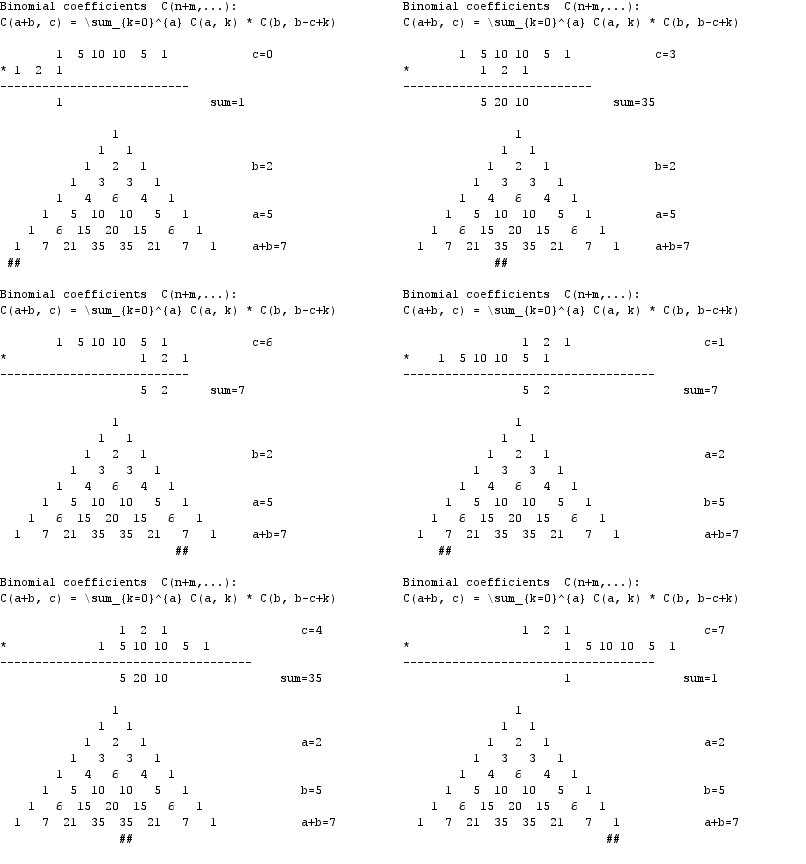
Hermann Stamm-Wilbrandt, Compute C(n+m,...) based on C(n,...) and C(m,...) values animation.
Christopher Stover and Eric W. Weisstein, Composition. From MathWorld - A Wolfram Web Resource.
Gérard Villemin's Almanach of Numbers, Triangle de Pascal.
Eric Weisstein's World of Mathematics, Pascal's Triangle.
Wikipedia, Pascal's triangle.
Herbert S. Wilf, Generatingfunctionology, 2nd edn., Academic Press, NY, 1994, pp. 12ff.
Ken Williams, Mathforum, Interactive Pascal's Triangle.
Doron Zeilberger, The Combinatorial Astrology of Rabbi Abraham Ibn Ezra, arXiv:math/9809136 [math.CO], 1998.
Chris Zheng and Jeffrey Zheng, Triangular Numbers and Their Inherent Properties, Variant Construction from Theoretical Foundation to Applications, Springer, Singapore, 51-65.
Igor Victorovich Statsenko, On the ordinal numbers of triangles of generalized special numbers, Innovation science No 2-2, State Ufa, Aeterna Publishing House, 2024, pp. 15-19. In Russian.
FORMULA
a(n, k) = C(n,k) = binomial(n, k).
C(n, k) = C(n-1, k) + C(n-1, k-1).
The triangle is symmetric: C(n,k) = C(n,n-k).
a(n+1, m) = a(n, m) + a(n, m-1), a(n, -1) := 0, a(n, m) := 0, n<m; a(0, 0)=1.
C(n, k) = n!/(k!(n-k)!) if 0<=k<=n, otherwise 0.
G.f.: 1/(1-y-x*y) = Sum_(C(n, k)*x^k*y^n, n, k>=0)
G.f.: 1/(1-x-y) = Sum_(C(n+k, k)*x^k*y^n, n, k>=0).
G.f. for row n: (1+x)^n = Sum_{k=0..n} C(n, k)*x^k.
G.f. for column k: x^k/(1-x)^(k+1); [corrected by Werner Schulte, Jun 15 2022].
E.g.f.: A(x, y) = exp(x+x*y).
E.g.f. for column n: x^n*exp(x)/n!.
In general the m-th power of A007318 is given by: T(0, 0) = 1, T(n, k) = T(n-1, k-1) + m*T(n-1, k), where n is the row-index and k is the column; also T(n, k) = m^(n-k)*C(n, k).
Triangle T(n, k) read by rows; given by A000007 DELTA A000007, where DELTA is Deléham's operator defined in A084938.
Let P(n+1) = the number of integer partitions of (n+1); let p(i) = the number of parts of the i-th partition of (n+1); let d(i) = the number of different parts of the i-th partition of (n+1); let m(i, j) = multiplicity of the j-th part of the i-th partition of (n+1). Define the operator Sum_{i=1..P(n+1), p(i)=k+1} as the sum running from i=1 to i=P(n+1) but taking only partitions with p(i)=(k+1) parts into account. Define the operator Product_{j=1..d(i)} = product running from j=1 to j=d(i). Then C(n, k) = Sum_{p(i)=(k+1), i=1..P(n+1)} p(i)! / [Product_{j=1..d(i)} m(i, j)!]. E.g., C(5, 3) = 10 because n=6 has the following partitions with m=3 parts: (114), (123), (222). For their multiplicities one has: (114): 3!/(2!*1!) = 3; (123): 3!/(1!*1!*1!) = 6; (222): 3!/3! = 1. The sum is 3 + 6 + 1 = 10 = C(5, 3). - Thomas Wieder, Jun 03 2005
C(n, k) = Sum_{j=0..k} = (-1)^j*C(n+1+j, k-j)*A000108(j). - Philippe Deléham, Oct 10 2005
G.f.: 1 + x*(1 + x) + x^3*(1 + x)^2 + x^6*(1 + x)^3 + ... . - Michael Somos, Sep 16 2006
Sum_{k=0..floor(n/2)} x^(n-k)*T(n-k,k) = A000007(n), A000045(n+1), A002605(n), A030195(n+1), A057087(n), A057088(n), A057089(n), A057090(n), A057091(n), A057092(n), A057093(n) for x = 0, 1, 2, 3, 4, 5, 6, 7, 8, 9, 10, respectively. Sum_{k=0..floor(n/2)} (-1)^k*x^(n-k)*T(n-k,k) = A000007(n), A010892(n), A009545(n+1), A057083(n), A001787(n+1), A030191(n), A030192(n), A030240(n), A057084(n), A057085(n+1), A057086(n), A084329(n+1) for x = 0, 1, 2, 3, 4, 5, 6, 7, 8, 9, 10, 20, respectively. - Philippe Deléham, Sep 16 2006
C(n,k) <= A062758(n) for n > 1. - Reinhard Zumkeller, Mar 04 2008
C(t+p-1, t) = Sum_{i=0..t} C(i+p-2, i) = Sum_{i=1..p} C(i+t-2, t-1). A binomial number is the sum of its left parent and all its right ancestors, which equals the sum of its right parent and all its left ancestors. - Lee Naish (lee(AT)cs.mu.oz.au), Mar 07 2008
From Paul D. Hanna, Mar 24 2011: (Start)
Let A(x) = Sum_{n>=0} x^(n*(n+1)/2)*(1+x)^n be the g.f. of the flattened triangle:
A(x) = 1 + (x + x^2) + (x^3 + 2*x^4 + x^5) + (x^6 + 3*x^7 + 3*x^8 + x^9) + ...
then A(x) equals the series Sum_{n>=0} (1+x)^n*x^n*Product_{k=1..n} (1-(1+x)*x^(2*k-1))/(1-(1+x)*x^(2*k));
also, A(x) equals the continued fraction 1/(1- x*(1+x)/(1+ x*(1-x)*(1+x)/(1- x^3*(1+x)/(1+ x^2*(1-x^2)*(1+x)/(1- x^5*(1+x)/(1+ x^3*(1-x^3)*(1+x)/(1- x^7*(1+x)/(1+ x^4*(1-x^4)*(1+x)/(1- ...))))))))).
These formulas are due to (1) a q-series identity and (2) a partial elliptic theta function expression. (End)
Row n of the triangle is the result of applying the ConvOffs transform to the first n terms of the natural numbers (1, 2, 3, ..., n). See A001263 or A214281 for a definition of this transformation. - Gary W. Adamson, Jul 12 2012
From L. Edson Jeffery, Aug 02 2012: (Start)
Row n (n >= 0) of the triangle is given by the n-th antidiagonal of the infinite matrix P^n, where P = (p_{i,j}), i,j >= 0, is the production matrix
0, 1,
1, 0, 1,
0, 1, 0, 1,
0, 0, 1, 0, 1,
0, 0, 0, 1, 0, 1,
0, 0, 0, 0, 1, 0, 1,
0, 0, 0, 0, 0, 1, 0, 1,
0, 0, 0, 0, 0, 0, 1, 0, 1,
... (End)
Row n of the triangle is also given by the n+1 coefficients of the polynomial P_n(x) defined by the recurrence P_0(x) = 1, P_1(x) = x + 1, P_n(x) = x*P_{n-1}(x) + P_{n-2}(x), n > 1. - L. Edson Jeffery, Aug 12 2013
For a closed-form formula for arbitrary left and right borders of Pascal-like triangles see A228196. - Boris Putievskiy, Aug 18 2013
For a closed-form formula for generalized Pascal's triangle see A228576. - Boris Putievskiy, Sep 04 2013
(1+x)^n = Sum_{k=0..n} (-1)^(n-k)*binomial(n,k)*Sum_{i=0..k} k^(n-i)*binomial(k,i)*x^(n-i)/(n-i)!. - Vladimir Kruchinin, Oct 21 2013
E.g.f.: A(x,y) = exp(x+x*y) = 1 + (x+y*x)/( E(0)-(x+y*x)), where E(k) = 1 + (x+y*x)/(1 + (k+1)/E(k+1) ); (continued fraction). - Sergei N. Gladkovskii, Nov 08 2013
E.g.f.: E(0) -1, where E(k) = 2 + x*(1+y)/(2*k+1 - x*(1+y)/E(k+1) ); (continued fraction). - Sergei N. Gladkovskii, Dec 24 2013
G.f.: 1 + x*(1+x)*(1+x^2*(1+x)/(W(0)-x^2-x^3)), where W(k) = 1 + (1+x)*x^(k+2) - (1+x)*x^(k+3)/W(k+1); (continued fraction). - Sergei N. Gladkovskii, Dec 24 2013
Sum_{n>=0} C(n,k)/n! = e/k!, where e = exp(1), while allowing n < k where C(n,k) = 0. Also Sum_{n>=0} C(n+k-1,k)/n! = e * A000262(k)/k!, and for k>=1 equals e * A067764(k)/A067653(k). - Richard R. Forberg, Jan 01 2014
Sum_{n>=k} 1/C(n,k) = k/(k-1) for k>=1. - Richard R. Forberg, Feb 10 2014
From Tom Copeland, Apr 17 and 26 2014: (Start)
Multiply each n-th diagonal of the Pascal lower triangular matrix by x^n and designate the result by A007318(x) = P(x). Then with :xD:^n = x^n*(d/dx)^n and B(n,x), the Bell polynomials (A008277),
A) P(x)= exp(x*dP) = exp[x*(e^M-I)] = exp[M*B(.,x)] = (I+dP)^B(.,x)
B) P(:xD:) = exp(dP:xD:) = exp[(e^M-I):xD:] = exp[M*B(.,:xD:)] = exp[M*xD] = (I+dP)^(xD) with action P(:xD:)g(x) = exp(dP:xD:)g(x) = g[(I+dP)*x] (cf. also A238363).
C) P(x)^y = P(y*x). P(2x) = A038207(x) = exp[M*B(.,2x)], the face vectors of the n-dim hypercubes.
D) P(x) = [St2]*exp(x*M)*[St1] = [St2]*(I+dP)^x*[St1]
E) = [St1]^(-1)*(I+dP)^x*[St1] = [St2]*(I+dP)^x*[St2]^(-1)
where [St1]=padded A008275 just as [St2]=A048993=padded A008277 and exp(x*M) = (I+dP)^x = Sum_{k>=0} C(x,k) dP^k. (End)
From Peter Bala, Dec 21 2014: (Start)
Recurrence equation: T(n,k) = T(n-1,k)*(n + k)/(n - k) - T(n-1,k-1) for n >= 2 and 1 <= k < n, with boundary conditions T(n,0) = T(n,n) = 1. Note, changing the minus sign in the recurrence to a plus sign gives a recurrence for the square of the binomial coefficients - see A008459.
There is a relation between the e.g.f.'s of the rows and the diagonals of the triangle, namely, exp(x) * e.g.f. for row n = e.g.f. for diagonal n. For example, for n = 3 we have exp(x)*(1 + 3*x + 3*x^2/2! + x^3/3!) = 1 + 4*x + 10*x^2/2! + 20*x^3/3! + 35*x^4/4! + .... This property holds more generally for the Riordan arrays of the form ( f(x), x/(1 - x) ), where f(x) is an o.g.f. of the form 1 + f_1*x + f_2*x^2 + .... See, for example, A055248 and A106516.
Let P denote the present triangle. For k = 0,1,2,... define P(k) to be the lower unit triangular block array
/I_k 0\
\ 0 P/ having the k X k identity matrix I_k as the upper left block; in particular, P(0) = P. The infinite product P(0)*P(1)*P(2)*..., which is clearly well-defined, is equal to the triangle of Stirling numbers of the second kind A008277. The infinite product in the reverse order, that is, ...*P(2)*P(1)*P(0), is equal to the triangle of Stirling cycle numbers A130534. (End)
C(a+b,c) = Sum_{k=0..a} C(a,k)*C(b,b-c+k). This is a generalization of equation 1 from section 4.2.5 of the Prudnikov et al. reference, for a=b=c=n: C(2*n,n) = Sum_{k=0..n} C(n,k)^2. See Links section for animation of new formula. - Hermann Stamm-Wilbrandt, Aug 26 2015
The row polynomials of the Pascal matrix P(n,x) = (1+x)^n are related to the Bernoulli polynomials Br(n,x) and their umbral compositional inverses Bv(n,x) by the umbral relation P(n,x) = (-Br(.,-Bv(.,x)))^n = (-1)^n Br(n,-Bv(.,x)), which translates into the matrix relation P = M * Br * M * Bv, where P is the Pascal matrix, M is the diagonal matrix diag(1,-1,1,-1,...), Br is the matrix for the coefficients of the Bernoulli polynomials, and Bv that for the umbral inverse polynomials defined umbrally by Br(n,Bv(.,x)) = x^n = Bv(n,Br(.,x)). Note M = M^(-1). - Tom Copeland, Sep 05 2015
1/(1-x)^k = (r(x) * r(x^2) * r(x^4) * ...) where r(x) = (1+x)^k. - Gary W. Adamson, Oct 17 2016
Boas-Buck type recurrence for column k for Riordan arrays (see the Aug 10 2017 remark in A046521, also for the reference) with the Boas-Buck sequence b(n) = {repeat(1)}. T(n, k) = ((k+1)/(n-k))*Sum_{j=k..n-1} T(j, k), for n >= 1, with T(n, n) = 1. This reduces, with T(n, k) = binomial(n, k), to a known binomial identity (e.g, Graham et al. p. 161). - Wolfdieter Lang, Nov 12 2018
C((p-1)/a, b) == (-1)^b * fact_a(a*b-a+1)/fact_a(a*b) (mod p), where fact_n denotes the n-th multifactorial, a divides p-1, and the denominator of the fraction on the right side of the equation represents the modular inverse. - Isaac Saffold, Jan 07 2019
C(n,k-1) = A325002(n,k) - [k==n+1] = (A325002(n,k) + A325003(n,k)) / 2 = [k==n+1] + A325003(n,k). - Robert A. Russell, Oct 20 2020
From Hermann Stamm-Wilbrandt, May 13 2021: (Start)
Binomial sums are Fibonacci numbers A000045:
Sum_{k=0..n} C(n + k, 2*k + 1) = F(2*n).
Sum_{k=0..n} C(n + k, 2*k) = F(2*n + 1). (End)
EXAMPLE
Triangle T(n,k) begins:
n\k 0 1 2 3 4 5 6 7 8 9 10 11 ...
0 1
1 1 1
2 1 2 1
3 1 3 3 1
4 1 4 6 4 1
5 1 5 10 10 5 1
6 1 6 15 20 15 6 1
7 1 7 21 35 35 21 7 1
8 1 8 28 56 70 56 28 8 1
9 1 9 36 84 126 126 84 36 9 1
10 1 10 45 120 210 252 210 120 45 10 1
11 1 11 55 165 330 462 462 330 165 55 11 1
...
There are C(4,2)=6 ways to distribute 5 balls BBBBB, among 3 different urns, < > ( ) [ ], so that each urn gets at least one ball, namely, <BBB>(B)[B], <B>(BBB)[B], <B>(B)[BBB], <BB>(BB)[B], <BB>(B)[BB], and <B>(BB)[BB].
There are C(4,2)=6 increasing functions from {1,2} to {1,2,3,4}, namely, {(1,1),(2,2)},{(1,1),(2,3)}, {(1,1),(2,4)}, {(1,2),(2,3)}, {(1,2),(2,4)}, and {(1,3),(2,4)}. - Dennis P. Walsh, Apr 07 2011
There are C(4,2)=6 subsets of {1,2,3,4,5} with median element 3, namely, {3}, {1,3,4}, {1,3,5}, {2,3,4}, {2,3,5}, and {1,2,3,4,5}. - Dennis P. Walsh, Dec 15 2011
The successive k-iterations of {A(0)} = E are E;E;E;...; the corresponding number of elements are 1,1,1,... The successive k-iterations of {A(1)} = {a} are (omitting brackets) a;a,E; a,E,E;...; the corresponding number of elements are 1,2,3,... The successive k-iterations of {A(2)} = {a,a} are aa; aa,a,E; aa, a, E and a,E and E;...; the corresponding number of elements are 1,3,6,... - Gregory L. Simay, Aug 06 2018
Boas-Buck type recurrence for column k = 4: T(8, 4) = (5/4)*(1 + 5 + 15 + 35) = 70. See the Boas-Buck comment above. - Wolfdieter Lang, Nov 12 2018
MAPLE
A007318 := (n, k)->binomial(n, k);
MATHEMATICA
Flatten[Table[Binomial[n, k], {n, 0, 11}, {k, 0, n}]] (* Robert G. Wilson v, Jan 19 2004 *)
Flatten[CoefficientList[CoefficientList[Series[1/(1 - x - x*y), {x, 0, 12}], x], y]] (* Mats Granvik, Jul 08 2014 *)
PROG
(Axiom) -- (start)
)set expose add constructor OutputForm
pascal(0, n) == 1
pascal(n, n) == 1
pascal(i, j | 0 < i and i < j) == pascal(i-1, j-1) + pascal(i, j-1)
pascalRow(n) == [pascal(i, n) for i in 0..n]
displayRow(n) == output center blankSeparate pascalRow(n)
for i in 0..20 repeat displayRow i -- (end)
(PARI) C(n, k)=binomial(n, k) \\ Charles R Greathouse IV, Jun 08 2011
(Python) # See Hobson link. Further programs:
from math import prod, factorial
def C(n, k): return prod(range(n, n-k, -1))//factorial(k) # M. F. Hasler, Dec 13 2019, updated Apr 29 2022, Feb 17 2023
(Haskell)
a007318 n k = a007318_tabl !! n !! k
a007318_row n = a007318_tabl !! n
a007318_list = concat a007318_tabl
a007318_tabl = iterate (\row -> zipWith (+) ([0] ++ row) (row ++ [0])) [1]
-- Cf. http://www.haskell.org/haskellwiki/Blow_your_mind#Mathematical_sequences
-- Reinhard Zumkeller, Nov 09 2011, Oct 22 2010
(Maxima) create_list(binomial(n, k), n, 0, 12, k, 0, n); /* Emanuele Munarini, Mar 11 2011 */
(Sage) def C(n, k): return Subsets(range(n), k).cardinality() # Ralf Stephan, Jan 21 2014
(Magma) /* As triangle: */ [[Binomial(n, k): k in [0..n]]: n in [0.. 10]]; // Vincenzo Librandi, Jul 29 2015
(GAP) Flat(List([0..12], n->List([0..n], k->Binomial(n, k)))); # Stefano Spezia, Dec 22 2018
CROSSREFS
Equals differences between consecutive terms of A102363. - David G. Williams (davidwilliams(AT)Paxway.com), Jan 23 2006
Row sums give A000079 (powers of 2).
Partial sums of rows give triangle A008949.
The triangle of the antidiagonals is A011973.
Another version: A108044.
Cf. A008277, A132311, A132312, A052216, A052217, A052218, A052219, A052220, A052221, A052222, A052223, A144225, A202750, A211226, A047999, A026729, A052553, A051920, A193242.
Triangle sums (see the comments): A000079 (Row1); A000007 (Row2); A000045 (Kn11 & Kn21); A000071 (Kn12 & Kn22); A001924 (Kn13 & Kn23); A014162 (Kn14 & Kn24); A014166 (Kn15 & Kn25); A053739 (Kn16 & Kn26); A053295 (Kn17 & Kn27); A053296 (Kn18 & Kn28); A053308 (Kn19 & Kn29); A053309 (Kn110 & Kn210); A001519 (Kn3 & Kn4); A011782 (Fi1 & Fi2); A000930 (Ca1 & Ca2); A052544 (Ca3 & Ca4); A003269 (Gi1 & Gi2); A055988 (Gi3 & Gi4); A034943 (Ze1 & Ze2); A005251 (Ze3 & Ze4). - Johannes W. Meijer, Sep 22 2010
Fibonacci-Pascal triangles: A027926, A036355, A037027, A074829, A105809, A109906, A111006, A114197, A162741, A228074, A228196, A228576.
Cf. A115940 (pandigital binomial coefficients C(m,k) with k>1).
Cf. (simplex colorings) A325002 (oriented), [k==n+1] (chiral), A325003 (achiral), A325000 (k or fewer colors), A325009 (orthotope facets, orthoplex vertices), A325017 (orthoplex facets, orthotope vertices).
AUTHOR
N. J. A. Sloane and Mira Bernstein, Apr 28 1994
EXTENSIONS
Checked all links, deleted 8 that seemed lost forever and were probably not of great importance. - N. J. A. Sloane, May 08 2018
STATUS
approved