
OFFSET
0,3
COMMENTS
The average of the first n (n > 0) pentagonal numbers is the n-th triangular number. - Mario Catalani (mario.catalani(AT)unito.it), Apr 10 2003
a(n) is the sum of n integers starting from n, i.e., 1, 2 + 3, 3 + 4 + 5, 4 + 5 + 6 + 7, etc. - Jon Perry, Jan 15 2004
Partial sums of 1, 4, 7, 10, 13, 16, ... (1 mod 3), a(2k) = k(6k-1), a(2k-1) = (2k-1)(3k-2). - Jon Perry, Sep 10 2004
Starting with offset 1 = binomial transform of [1, 4, 3, 0, 0, 0, ...]. Also, A004736 * [1, 3, 3, 3, ...]. - Gary W. Adamson, Oct 25 2007
If Y is a 3-subset of an n-set X then, for n >= 4, a(n-3) is the number of 4-subsets of X having at least two elements in common with Y. - Milan Janjic, Nov 23 2007
Solutions to the duplication formula 2*a(n) = a(k) are given by the index pairs (n, k) = (5,7), (5577, 7887), (6435661, 9101399), etc. The indices are integer solutions to the pair of equations 2(6n-1)^2 = 1 + y^2, k = (1+y)/6, so these n can be generated from the subset of numbers [1+A001653(i)]/6, any i, where these are integers, confined to the cases where the associated k=[1+A002315(i)]/6 are also integers. - R. J. Mathar, Feb 01 2008
a(n) is a binomial coefficient C(n,4) (A000332) if and only if n is a generalized pentagonal number (A001318). Also see A145920. - Matthew Vandermast, Oct 28 2008
Even octagonal numbers divided by 8. - Omar E. Pol, Aug 18 2011
Sequence found by reading the line from 0, in the direction 0, 5, ... and the line from 1, in the direction 1, 12, ..., in the square spiral whose vertices are the generalized pentagonal numbers A001318. - Omar E. Pol, Sep 08 2011
The hyper-Wiener index of the star-tree with n edges (see A196060, example). - Emeric Deutsch, Sep 30 2011
More generally the n-th k-gonal number is equal to n + (k-2)*A000217(n-1), n >= 1, k >= 3. In this case k = 5. - Omar E. Pol, Apr 06 2013
Note that both Euler's pentagonal theorem for the partition numbers and Euler's pentagonal theorem for the sum of divisors refer more exactly to the generalized pentagonal numbers, not this sequence. For more information see A001318, A175003, A238442. - Omar E. Pol, Mar 01 2014
The Fuss-Catalan numbers are Cat(d,k)= [1/(k*(d-1)+1)]*binomial(k*d,k) and enumerate the number of (d+1)-gon partitions of a (k*(d-1)+2)-gon (cf. Schuetz and Whieldon link). a(n)= Cat(n,3), so enumerates the number of (n+1)-gon partitions of a (3*(n-1)+2)-gon. Analogous sequences are A100157 (k=4) and A234043 (k=5). - Tom Copeland, Oct 05 2014
Binomial transform of (0, 1, 3, 0, 0, 0, ...) (A169585 with offset 1) and second partial sum of (0, 1, 3, 3, 3, ...). - Gary W. Adamson, Oct 05 2015
For n > 0, a(n) is the number of compositions of n+8 into n parts avoiding parts 2 and 3. - Milan Janjic, Jan 07 2016
a(n) is also the number of edges in the Mycielskian of the complete graph K[n]. Indeed, K[n] has n vertices and n(n-1)/2 edges. Then its Mycielskian has n + 3n(n-1)/2 = n(3n-1)/2. See p. 205 of the West reference. - Emeric Deutsch, Nov 04 2016
Sum of the numbers from n to 2n-1. - Wesley Ivan Hurt, Dec 03 2016
Also the number of maximal cliques in the n-Andrásfai graph. - Eric W. Weisstein, Dec 01 2017
Coefficients in the hypergeometric series identity 1 - 5*(x - 1)/(2*x + 1) + 12*(x - 1)*(x - 2)/((2*x + 1)*(2*x + 2)) - 22*(x - 1)*(x - 2)*(x - 3)/((2*x + 1)*(2*x + 2)*(2*x + 3)) + ... = 0, valid for Re(x) > 1. Cf. A002412 and A002418. Column 2 of A103450. - Peter Bala, Mar 14 2019
A generalization of the Comment dated Apr 10 2003 follows. (k-3)*A000292(n-2) plus the average of the first n (2k-1)-gonal numbers is the n-th k-gonal number. - Charlie Marion, Nov 01 2020
a(n+1) is the number of Dyck paths of size (3,3n+1); i.e., the number of NE lattice paths from (0,0) to (3,3n+1) which stay above the line connecting these points. - Harry Richman, Jul 13 2021
REFERENCES
Tom M. Apostol, Introduction to Analytic Number Theory, Springer-Verlag, 1976, pages 2 and 311.
Raymond Ayoub, An Introduction to the Analytic Theory of Numbers, Amer. Math. Soc., 1963; p. 129.
Albert H. Beiler, Recreations in the Theory of Numbers, Dover, NY, 1964, p. 189.
E. Deza and M. M. Deza, Figurate numbers, World Scientific Publishing (2012), page 6.
L. E. Dickson, History of the Theory of Numbers. Carnegie Institute Public. 256, Washington, DC, Vol. 1, 1919; Vol. 2, 1920; Vol. 3, 1923, see vol. 2, p. 1.
G. H. Hardy and E. M. Wright, An Introduction to the Theory of Numbers. 3rd ed., Oxford Univ. Press, 1954, p. 284.
Clifford A. Pickover, A Passion for Mathematics, Wiley, 2005; see p. 64.
N. J. A. Sloane, A Handbook of Integer Sequences, Academic Press, 1973 (includes this sequence).
N. J. A. Sloane and Simon Plouffe, The Encyclopedia of Integer Sequences, Academic Press, 1995 (includes this sequence).
André Weil, Number theory: an approach through history; from Hammurapi to Legendre, Birkhäuser, Boston, 1984; see p. 186.
David Wells, The Penguin Dictionary of Curious and Interesting Numbers, Penguin Books, 1987, pp. 98-100.
Douglas B. West, Introduction to Graph Theory, 2nd ed., Prentice-Hall, NJ, 2001.
LINKS
Daniel Mondot, Table of n, a(n) for n = 0..10000 (first 1000 terms by T. D. Noe)
George E. Andrews, Euler's "De Partitio Numerorum", Bull. Amer. Math. Soc., 44 (No. 4, 2007), 561-573.
S. Barbero, U. Cerruti and N. Murru, Transforming Recurrent Sequences by Using the Binomial and Invert Operators, J. Int. Seq. 13 (2010) # 10.7.7, section 4.4.
Jordan Bell, Euler and the pentagonal number theorem, arXiv:math/0510054 [math.HO], 2005-2006.
Anicius Manlius Severinus Boethius, De institutione arithmetica libri duo, Book 2, sections 13-14.
C. K. Cook and M. R. Bacon, Some polygonal number summation formulas, Fib. Q., 52 (2014), 336-343.
Stephan Eberhart, Letter to N. J. A. Sloane, Jan 06 1978, also scanned copy of Mathematical-Physical Correspondence, No. 22, Christmas 1977.
Leonhard Euler, De mirabilibus proprietatibus numerorum pentagonalium, par. 1
Leonhard Euler, Observatio de summis divisorum p. 8.
Leonhard Euler, An observation on the sums of divisors, arXiv:math/0411587 [math.HO], 2004, 2009. See p. 8.
Leonhard Euler, On the remarkable properties of the pentagonal numbers, arXiv:math/0505373 [math.HO], 2005.
Rodney T. Hansen, Arithmetic of pentagonal numbers, Fib. Quart., 8 (1970), 83-87.
INRIA Algorithms Project, Encyclopedia of Combinatorial Structures 339
Milan Janjic and Boris Petkovic, A Counting Function, arXiv preprint arXiv:1301.4550 [math.CO], 2013. - From N. J. A. Sloane, Feb 13 2013
Jangwon Ju and Daejun Kim, The pentagonal theorem of sixty-three and generalizations of Cauchy's lemma, arXiv:2010.16123 [math.NT], 2020.
Bir Kafle, Florian Luca and Alain Togbé, Pentagonal and heptagonal repdigits, Annales Mathematicae et Informaticae. pp. 137-145.
Sameen Ahmed Khan, Sums of the powers of reciprocals of polygonal numbers, Int'l J. of Appl. Math. (2020) Vol. 33, No. 2, 265-282.
Hyun Kwang Kim, On Regular Polytope Numbers, Proc. Amer. Math. Soc., 131 (2002), 65-75.
Clark Kimberling, Complementary Equations, Journal of Integer Sequences, Vol. 10 (2007), Article 07.1.4.
Clark Kimberling and John E. Brown, Partial Complements and Transposable Dispersions, J. Integer Seqs., Vol. 7, 2004.
R. P. Loh, A. G. Shannon and A. F. Horadam, Divisibility Criteria and Sequence Generators Associated with Fermat Coefficients, Preprint, 1980.
Simon Plouffe, Approximations de séries génératrices et quelques conjectures, Dissertation, Université du Québec à Montréal, 1992; arXiv:0911.4975 [math.NT], 2009.
Simon Plouffe, 1031 Generating Functions, Appendix to Thesis, Montreal, 1992
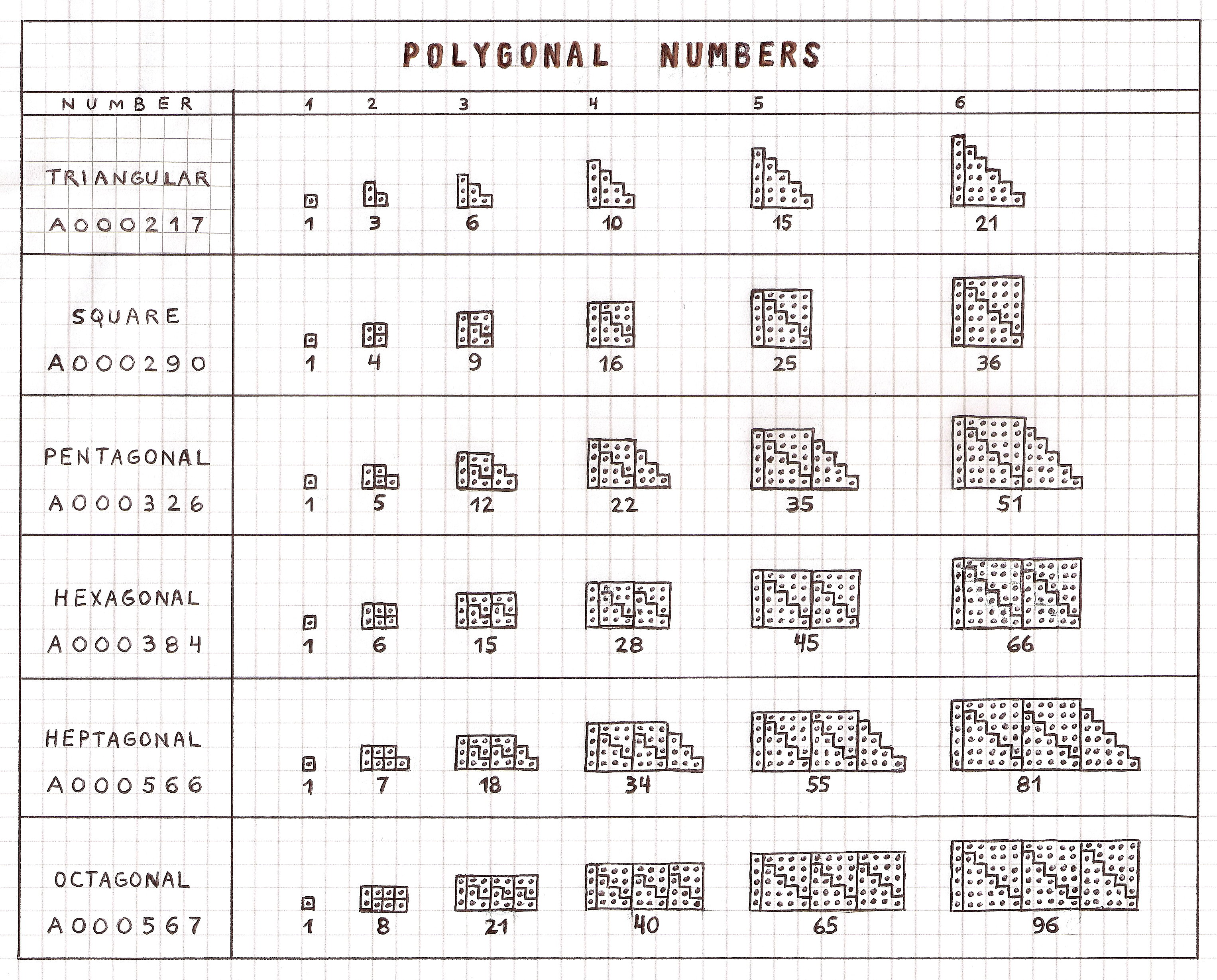
Cliff Reiter, Polygonal Numbers and Fifty One Stars, Lafayette College, Easton, PA (2019).
Alison Schuetz and Gwyneth Whieldon, Polygonal Dissections and Reversions of Series, arXiv:1401.7194 [math.CO], 2014.
W. Sierpiński, Sur les nombres pentagonaux, Bull. Soc. Royale Sciences Liège, 33 (No. 9-10, 1964), 513-517. [Annotated scanned copy]
N. J. A. Sloane, Illustration of initial terms of A000217, A000290, A000326.

Michel Waldschmidt, Continued fractions, Ecole de recherche CIMPA-Oujda, Théorie des Nombres et ses Applications, 18 - 29 mai 2015: Oujda (Maroc).
Eric Weisstein's World of Mathematics, Andrásfai Graph.
Eric Weisstein's World of Mathematics, Maximal Clique.
Eric Weisstein's World of Mathematics, Pentagonal Number.
Wikipedia, Mycielskian.
Wikipedia, Pentagonal number
Index entries for linear recurrences with constant coefficients, signature (3,-3,1).
FORMULA
Product_{m > 0} (1 - q^m) = Sum_{k} (-1)^k*x^a(k). - Paul Barry, Jul 20 2003
G.f.: x*(1+2*x)/(1-x)^3.
E.g.f.: exp(x)*(x+3*x^2/2).
a(n) = n*(3*n-1)/2.
a(-n) = A005449(n).
a(n) = binomial(3*n, 2)/3. - Paul Barry, Jul 20 2003
a(0) = 0, a(1) = 1; for n >= 2, a(n) = 2*a(n-1) - a(n-2) + 3. - Miklos Kristof, Mar 09 2005
a(n) = Sum_{k=1..n} (2*n - k). - Paul Barry, Aug 19 2005
a(n) = 3*A000217(n) - 2*n. - Lekraj Beedassy, Sep 26 2006
a(n) = A126890(n, n-1) for n > 0. - Reinhard Zumkeller, Dec 30 2006
a(n) = binomial(n+1, 2) + 2*binomial(n, 2).
a(n) = 3*a(n-1) - 3*a(n-2) + a(n-3), a(0) = 0, a(1) = 1, a(2) = 5. - Jaume Oliver Lafont, Dec 02 2008
a(n) = a(n-1) + 3*n-2 with n > 0, a(0)=0. - Vincenzo Librandi, Nov 20 2010
a(n) = A014642(n)/8. - Omar E. Pol, Aug 18 2011
a(n) = (A000290(n) + A000384(n))/2 = (A000217(n) + A000566(n))/2 = A049450(n)/2. - Omar E. Pol, Jan 11 2013
a(n) = A005449(n) - n. - Philippe Deléham, Mar 30 2013
From Oskar Wieland, Apr 10 2013: (Start)
a(n) = a(n+1) - A016777(n),
a(n) = a(n+2) - A016969(n),
a(n) = a(n+5) - A016777(n)*5,
a(n) = a(n+6) - A016969(n)*3,
a(n) = a(n+7) - A016777(n)*7,
a(n) = a(n+8) - A016969(n)*4,
a(n) = a(n+9) - A016777(n)*9. (End)
Sum_{n>=1} a(n)/n! = 2.5*exp(1). - Richard R. Forberg, Jul 15 2013
a(n) = floor(n/(exp(2/(3*n)) - 1)), for n > 0. - Richard R. Forberg, Jul 27 2013
From Vladimir Shevelev, Jan 24 2014: (Start)
a(3*a(n) + 4*n + 1) = a(3*a(n) + 4*n) + a(3*n+1).
A generalization. Let {G_k(n)}_(n >= 0) be sequence of k-gonal numbers (k >= 3). Then the following identity holds: G_k((k-2)*G_k(n) + c(k-3)*n + 1) = G_k((k-2)*G_k(n) + c(k-3)*n) + G_k((k-2)*n + 1), where c = A000124. (End)
A242357(a(n)) = 1 for n > 0. - Reinhard Zumkeller, May 11 2014
Sum_{n>=1} 1/a(n)= (1/3)*(9*log(3) - sqrt(3)*Pi). - Enrique Pérez Herrero, Dec 02 2014. See the decimal expansion A244641.
a(n) = (A000292(6*n+k-1)-A000292(k))/(6*n-1)-A000217(3*n+k), for any k >= 0. - Manfred Arens, Apr 26 2015 [minor edits from Wolfdieter Lang, May 10 2015]
a(n) = A258708(3*n-1,1) for n > 0. - Reinhard Zumkeller, Jun 23 2015
Sum_{n>=1} (-1)^(n+1)/a(n) = 2*(sqrt(3)*Pi - 6*log(2))/3 = 0.85501000622865446... - Ilya Gutkovskiy, Jul 28 2016
a(m+n) = a(m) + a(n) + 3*m*n. - Etienne Dupuis, Feb 16 2017
In general, let P(k,n) be the n-th k-gonal number. Then P(k,m+n) = P(k,m) + (k-2)mn + P(k,n). - Charlie Marion, Apr 16 2017
a(n) = binomial(n,2) + n^2. - Pedro Caceres, Jul 28 2019
Product_{n>=2} (1 - 1/a(n)) = 3/5. - Amiram Eldar, Jan 21 2021
(n+1)*(a(n^2) + a(n^2+1) + ... + a(n^2+n)) = n*(a(n^2+n+1) + ... + a(n^2+2n)). - Charlie Marion, Apr 28 2024
EXAMPLE
Illustration of initial terms:
.
. o
. o o
. o o o o
. o o o o o o
. o o o o o o o o o
. o o o o o o o o o o o
. o o o o o o o o o o o o o
. o o o o o o o o o o o o o o
. o o o o o o o o o o o o o o o
.
. 1 5 12 22 35
- Philippe Deléham, Mar 30 2013
MAPLE
A000326:=-(1+2*z)/(z-1)**3; # Simon Plouffe in his 1992 dissertation
a[0]:=0:a[1]:=1:for n from 2 to 50 do a[n]:=2*a[n-1]-a[n-2]+3 od: seq(a[n], n=0..50); # Miklos Kristof, Zerinvary Lajos, Feb 18 2008
MATHEMATICA
Table[n (3 n - 1)/2, {n, 0, 60}] (* Stefan Steinerberger, Apr 01 2006 *)
Array[# (3 # - 1)/2 &, 47, 0] (* Zerinvary Lajos, Jul 10 2009 *)
LinearRecurrence[{3, -3, 1}, {0, 1, 5}, 61] (* Harvey P. Dale, Dec 27 2011 *)
pentQ[n_] := IntegerQ[(1 + Sqrt[24 n + 1])/6]; pentQ[0] = True; Select[Range[0, 3200], pentQ@# &] (* Robert G. Wilson v, Mar 31 2014 *)
Join[{0}, Accumulate[Range[1, 312, 3]]] (* Harvey P. Dale, Mar 26 2016 *)
(* For Mathematica 10.4+ *) Table[PolygonalNumber[RegularPolygon[5], n], {n, 0, 46}] (* Arkadiusz Wesolowski, Aug 27 2016 *)
CoefficientList[Series[x (-1 - 2 x)/(-1 + x)^3, {x, 0, 20}], x] (* Eric W. Weisstein, Dec 01 2017 *)
PolygonalNumber[5, Range[0, 20]] (* Eric W. Weisstein, Dec 01 2017 *)
PROG
(PARI) a(n)=n*(3*n-1)/2
(PARI) vector(100, n, n--; binomial(3*n, 2)/3) \\ Altug Alkan, Oct 06 2015
(PARI) is_a000326 = my(s); n==0 || (issquare (24*n+1, &s) && s%6==5) \\ Hugo Pfoertner, Aug 03 2023
(Haskell)
a000326 n = n * (3 * n - 1) `div` 2 -- Reinhard Zumkeller, Jul 07 2012
(Magma) [n*(3*n-1)/2 : n in [0..100]]; // Wesley Ivan Hurt, Oct 15 2015
(GAP) List([0..50], n->n*(3*n-1)/2); # Muniru A Asiru, Mar 18 2019
(Python) # Intended to compute the initial segment of the sequence, not isolated terms.
def aList():
x, y = 1, 1
yield 0
while True:
yield x
x, y = x + y + 3, y + 3
A000326 = aList()
print([next(A000326) for i in range(47)]) # Peter Luschny, Aug 04 2019
CROSSREFS
The generalized pentagonal numbers b*n+3*n*(n-1)/2, for b = 1 through 12, form sequences A000326, A005449, A045943, A115067, A140090, A140091, A059845, A140672, A140673, A140674, A140675, A151542.
Cf. A001318 (generalized pentagonal numbers), A049452, A033570, A010815, A034856, A051340, A004736, A033568, A049453, A002411 (partial sums), A033579.
See A220083 for a list of numbers of the form n*P(s,n)-(n-1)*P(s,n-1), where P(s,n) is the n-th polygonal number with s sides.
Cf. A240137: sum of n consecutive cubes starting from n^3.
Cf. similar sequences listed in A022288.
Partial sums of A016777.
KEYWORD
core,nonn,easy,nice
AUTHOR
EXTENSIONS
Incorrect example removed by Joerg Arndt, Mar 11 2010
STATUS
approved